

20 Francs – Belgium
Belgium
Context
Years: 1867–1870
Issuer: Belgium 
Ruler: Leopold II
Currency:
(1832—2001)
Demonetization: 20 April 1957
Total mintage: 7,148,733
Material
References
KM: #Click to copy to clipboard32
Numista: #13801
Value
Exchange value: 20 BEF
Bullion value: $969.51
Obverse
Description:
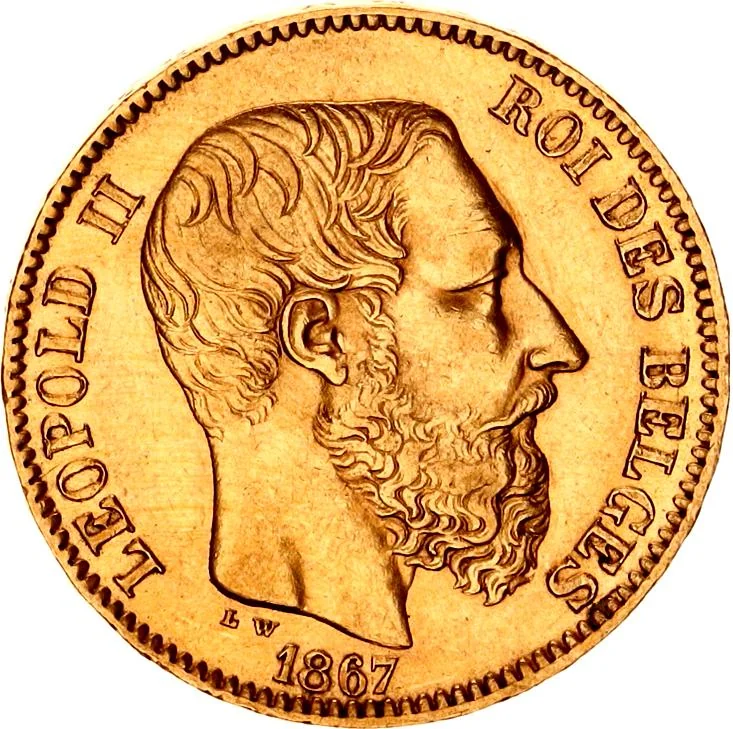
King Leopold II facing right with French lettering. Date and designer below.
Inscription:
LEOPOLD II ROI DES BELGES
L W
1868
L W
1868
Translation:
Leopold II King of the Belgians
L W
1868
L W
1868
Script: Latin
Language: French
Engraver: Léopold Wiener
Reverse
Description:
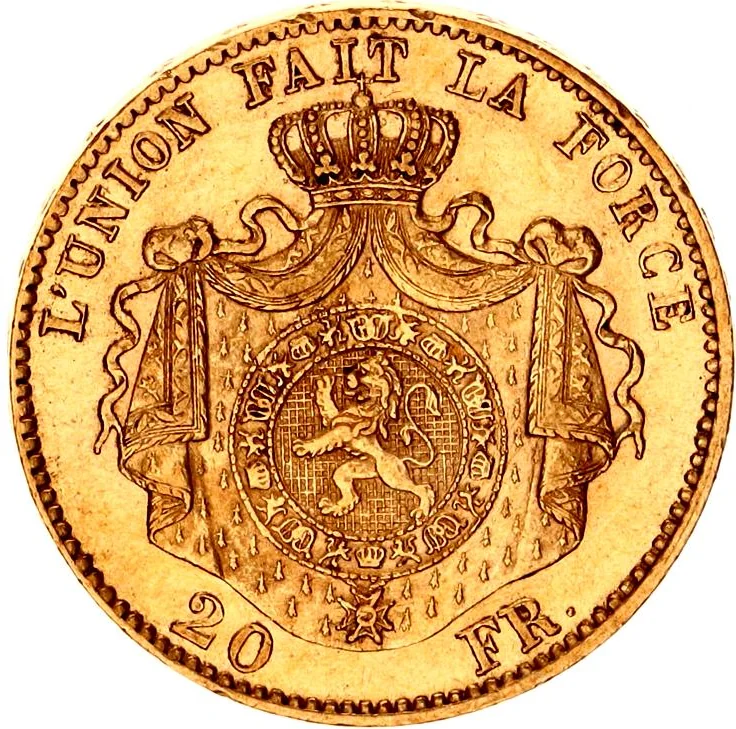
Belgian crowned coat of arms with French motto above, value below.
Inscription:
L'UNION FAIT LA FORCE
20 FR.
20 FR.
Translation:
Union Makes Strength
20 Francs
20 Francs
Script: Latin
Language: French
Engraver: Léopold Wiener
Edge
Plain with raised lettering
Legend:
DIEU * PROTEGE * LA * BELGIQUE *****
Translation:
GOD * PROTECT * BELGIQUE
Language: French
Categories
| Symbol> Crown |
| Symbols> Coat of Arms |
Mints
| Name | Mark |
|---|---|
| Royal Mint of Belgium | — |
Mintings
| Year | Mint Mark | Mintage | Quality | Collection |
|---|---|---|---|---|
| 1867 | — | 1,341,307 | ||
| 1868 | — | 1,381,749 | ||
| 1869 | — | 1,234,474 | ||
| 1870 | — | 3,191,203 |
Historical background
In 1867, Belgium operated under a complex and transitional monetary system, a legacy of its recent independence and the broader European context. The country was part of the Latin Monetary Union (LMU), established in 1865, which Belgium had helped found alongside France, Italy, and Switzerland. This agreement aimed to standardize coinage by fixing the silver content and gold-to-silver ratio, allowing the coins of member nations to circulate freely across borders. Belgium's national currency, the Belgian franc, was thus pegged to this bimetallic standard, with its value defined as equal to the French franc.
However, the system was under significant strain by 1867. The LMU's bimetallism was being destabilized by the global fluctuation in the relative market values of gold and silver. An overvaluation of silver within the Union led to an influx of silver coins, while gold coins were often hoarded or exported. This created practical difficulties for commerce and government finance, as the intended parity between the metals was artificial and difficult to maintain. Belgium, as a small, trade-dependent nation, felt these pressures acutely, with concerns about the loss of monetary sovereignty and the practical costs of maintaining a circulating medium.
Consequently, 1867 was a year of debate and looming decision. While the LMU framework provided stability for international trade, its inherent flaws were becoming apparent. Belgian policymakers and financiers were engaged in discussions about the future, weighing the benefits of the Union against the need for a more stable, perhaps gold-based, system. The situation was a microcosm of a global monetary debate, positioning Belgium at a crossroads between the old bimetallic order and the emerging gold standard that would come to dominate the subsequent decades.
However, the system was under significant strain by 1867. The LMU's bimetallism was being destabilized by the global fluctuation in the relative market values of gold and silver. An overvaluation of silver within the Union led to an influx of silver coins, while gold coins were often hoarded or exported. This created practical difficulties for commerce and government finance, as the intended parity between the metals was artificial and difficult to maintain. Belgium, as a small, trade-dependent nation, felt these pressures acutely, with concerns about the loss of monetary sovereignty and the practical costs of maintaining a circulating medium.
Consequently, 1867 was a year of debate and looming decision. While the LMU framework provided stability for international trade, its inherent flaws were becoming apparent. Belgian policymakers and financiers were engaged in discussions about the future, weighing the benefits of the Union against the need for a more stable, perhaps gold-based, system. The situation was a microcosm of a global monetary debate, positioning Belgium at a crossroads between the old bimetallic order and the emerging gold standard that would come to dominate the subsequent decades.
🌟 Uncommon