

100 Euro (Prince Pribina) – Slovakia
Non-circulating coins
Commemoration: 1150th Anniversary of Death of Prince Pribina
Slovakia
Context
Material
References
KM: #Click to copy to clipboard119
Numista: #33032
Value
Exchange value: 100 EUR = $118.14
Bullion value: $1425.55
Inflation-adjusted value: 160.62 EUR
Obverse
Description:
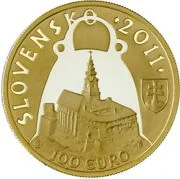
Bell silhouette enclosing Nitra Castle.
Inscription:
SLOVENSKO ·2011·
100 EURO
100 EURO
Translation:
SLOVAKIA ·2011·
100 EURO
100 EURO
Script: Latin
Language: Slovak
Engraver: Ivan Řehák
Reverse
Description:
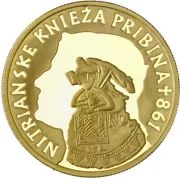
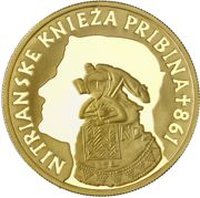
Silhouette of Pribina centered on an archaeological plate.
Inscription:
NITRIANSKE KNIEŽA PRIBINA † 861
Translation:
Nitrian Prince Pribina † 861
Script: Latin
Language: Slovak
Engraver: Ivan Řehák
Edge
Reeded
Categories
| Event> Death anniversary |
Mints
| Name | Mark |
|---|---|
| Kremnica | (MK) |
Mintings
| Year | Mint Mark | Mintage | Quality | Collection |
|---|---|---|---|---|
| 2011 | MK | 6,800 | Proof |
Historical background
In 2011, Slovakia was a consolidated member of the Eurozone, having adopted the euro as its official currency on January 1, 2009. This move replaced the Slovak koruna (SKK) and was a key milestone in the country's post-communist economic integration with Western Europe. The transition was generally considered successful, providing macroeconomic stability, lower transaction costs, and enhanced investor confidence. By 2011, the euro was firmly established in daily use, and the country was navigating the broader European financial landscape from within the single currency bloc.
The primary currency-related context in 2011 was Slovakia's involvement in the ongoing Eurozone sovereign debt crisis. As a member state, Slovakia was required to contribute to the European Financial Stability Facility (EFSF), the bailout fund designed to rescue struggling economies like Greece, Ireland, and Portugal. This sparked significant domestic political controversy. In October 2011, the government of Prime Minister Iveta Radičová collapsed after a vote of no confidence, triggered by a coalition partner's refusal to support the EFSF expansion, highlighting deep public and political divisions over using Slovak funds to aid other EU nations.
Despite this political turmoil, Slovakia's own economic fundamentals within the Eurozone were relatively strong in 2011. It maintained solid economic growth compared to the Eurozone average and held one of the group's lowest levels of public debt. The currency situation was thus characterized by a dual reality: internal stability and prudent fiscal management at home, juxtaposed with intense political debate over the country's financial obligations and solidarity within the crisis-stricken monetary union. This period underscored the challenges of a small, fiscally conservative member state operating within a heterogeneous currency area during a time of severe stress.
The primary currency-related context in 2011 was Slovakia's involvement in the ongoing Eurozone sovereign debt crisis. As a member state, Slovakia was required to contribute to the European Financial Stability Facility (EFSF), the bailout fund designed to rescue struggling economies like Greece, Ireland, and Portugal. This sparked significant domestic political controversy. In October 2011, the government of Prime Minister Iveta Radičová collapsed after a vote of no confidence, triggered by a coalition partner's refusal to support the EFSF expansion, highlighting deep public and political divisions over using Slovak funds to aid other EU nations.
Despite this political turmoil, Slovakia's own economic fundamentals within the Eurozone were relatively strong in 2011. It maintained solid economic growth compared to the Eurozone average and held one of the group's lowest levels of public debt. The currency situation was thus characterized by a dual reality: internal stability and prudent fiscal management at home, juxtaposed with intense political debate over the country's financial obligations and solidarity within the crisis-stricken monetary union. This period underscored the challenges of a small, fiscally conservative member state operating within a heterogeneous currency area during a time of severe stress.
💎 Extremely Rare