

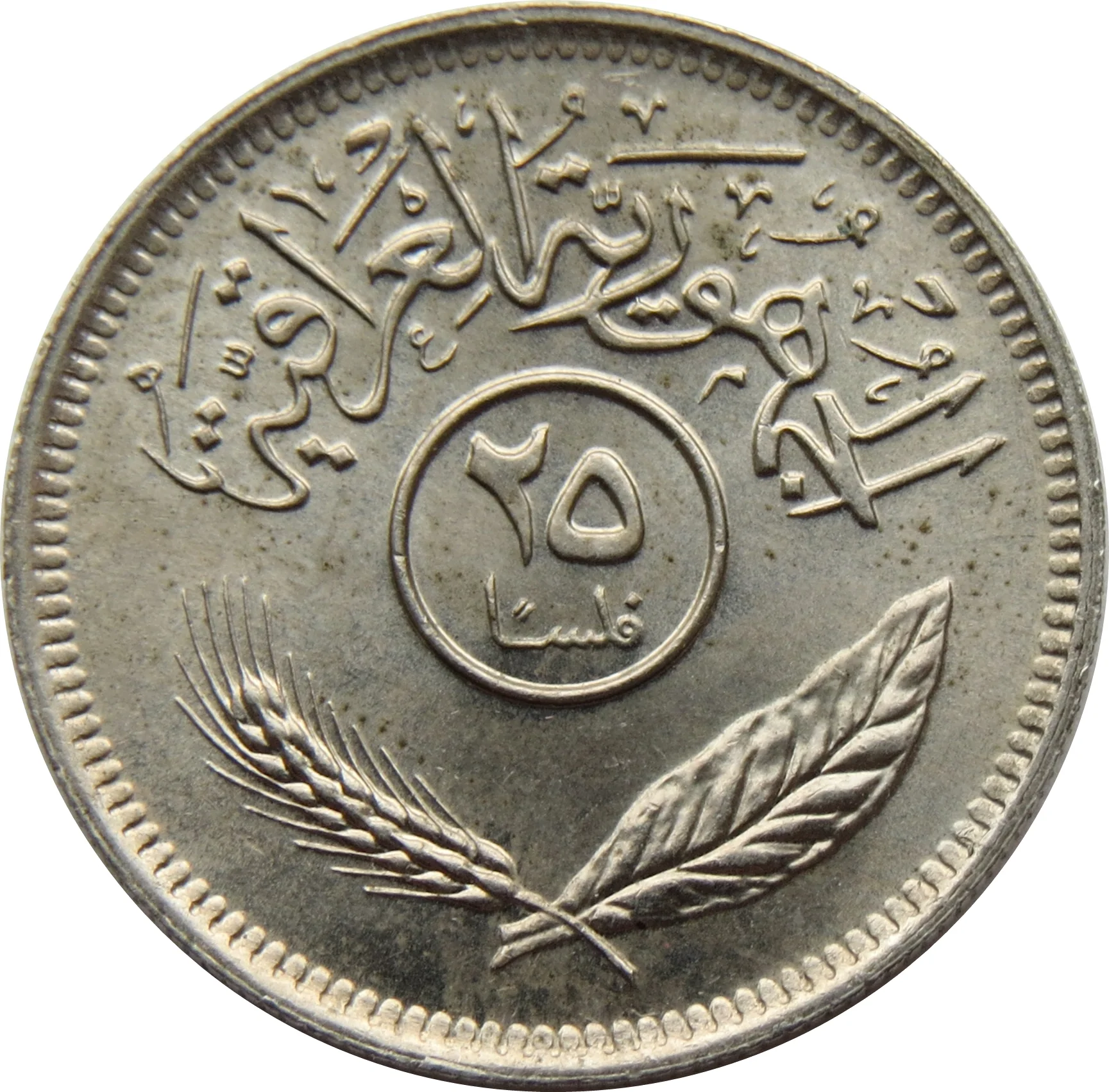
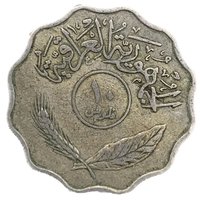
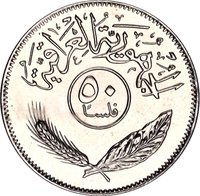
Obverse
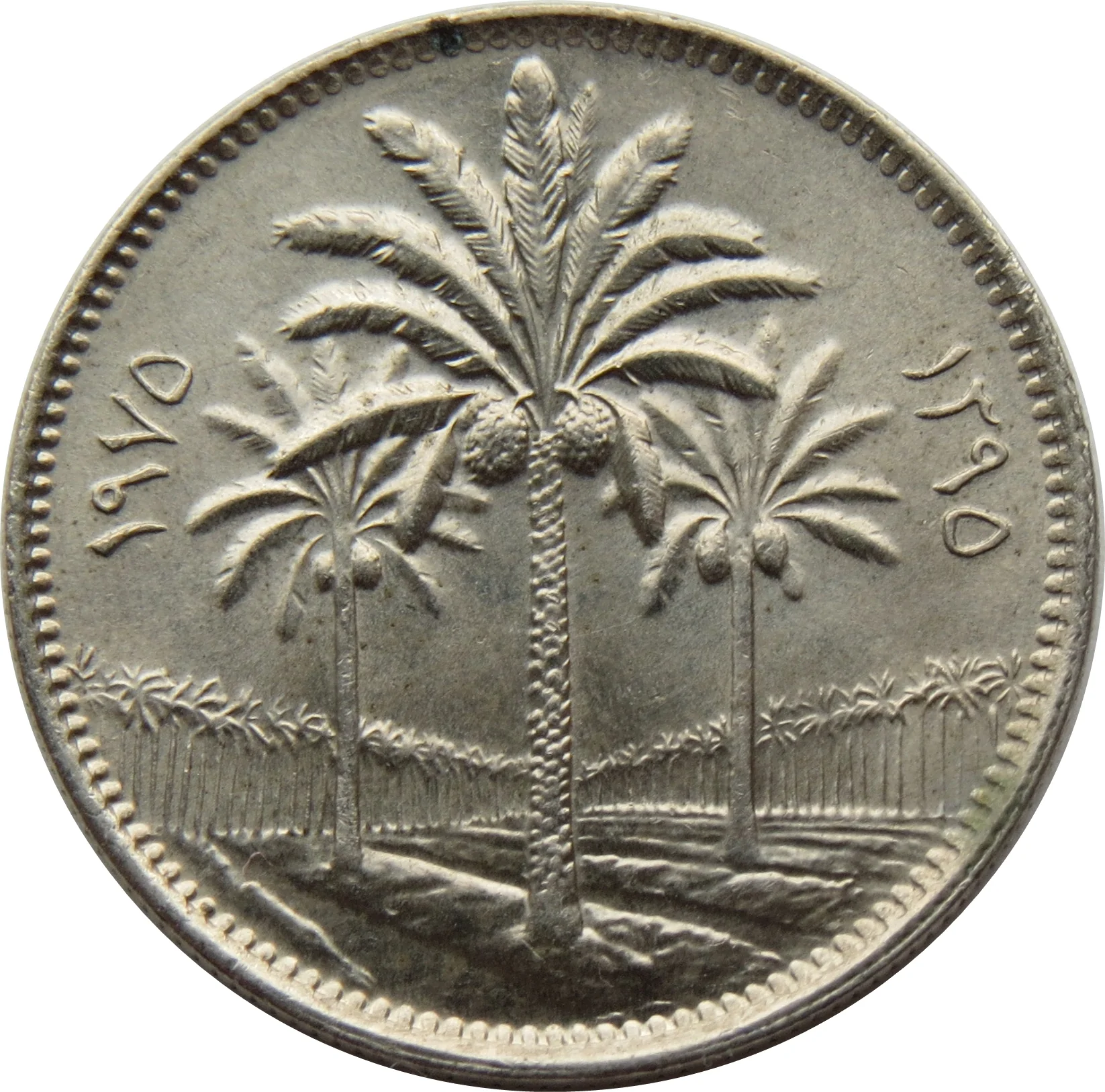
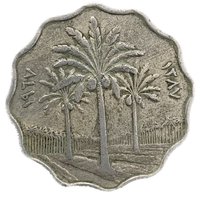
Reverse
Description:
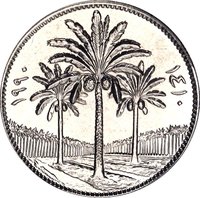
Three palms in front, trees lining both sides behind.
Inscription:
١٣٩٥ ١٩٧٥
Translation:
1395 1975
Script: Arabic
Engraver: Geoffrey Colley
Edge
Reeded
Mints
| Name | Mark |
|---|---|
| Royal Canadian Mint of Winnipeg | — |
| Royal Mint | — |
Mintings
| Year | Mint Mark | Mintage | Quality | Collection |
|---|---|---|---|---|
| 1969 | — | 6,000,000 | ||
| 1970 | — | 6,000,000 | ||
| 1972 | — | 12,000,000 | ||
| 1975 | — | 48,000,000 | ||
| 1981 | — | 60,000,000 |
Historical background
In 1969, Iraq's currency situation was characterized by relative stability under the centralized economic management of the Arab Socialist Ba'ath Party, which had consolidated power the previous year. The Iraqi dinar, introduced in 1932 to replace the Indian rupee, was a strong and fully convertible currency, pegged to the British pound sterling at a fixed rate of 1 dinar = 1 pound. This peg, managed by the state-owned Central Bank of Iraq, provided predictability for foreign trade and was a point of national prestige, reflecting the country's substantial oil revenues which provided a solid fiscal and foreign exchange foundation.
Economically, the currency's strength was underpinned by Iraq's position as a major oil exporter, with the Iraq National Oil Company (INOC) having been established in 1964 to control the strategic sector. The government's Five-Year Development Plan (1965-1969), heavily funded by oil receipts, directed investment into infrastructure and industry without necessitating major currency devaluation. However, this outward stability existed within a framework of increasing state control and socialist-oriented policies, including nationalizations, which gradually insulated the domestic economy from global market fluctuations but also limited private sector foreign exchange activity.
Politically, the currency was a tool of sovereignty and control. The new Ba'athist government, led by President Ahmed Hassan al-Bakr with Saddam Hussein as his deputy, prioritized economic independence and reduced reliance on Western financial systems. While no major currency reform occurred in 1969 itself, the stable dinar facilitated the regime's ambitious domestic projects and its strategic positioning within the Arab world, particularly amid ongoing tensions with Iran and Israel. The system's inherent vulnerability, however, lay in its overwhelming dependence on a single commodity—oil—making its long-term stability susceptible to future geopolitical shocks and shifts in global oil prices.
Economically, the currency's strength was underpinned by Iraq's position as a major oil exporter, with the Iraq National Oil Company (INOC) having been established in 1964 to control the strategic sector. The government's Five-Year Development Plan (1965-1969), heavily funded by oil receipts, directed investment into infrastructure and industry without necessitating major currency devaluation. However, this outward stability existed within a framework of increasing state control and socialist-oriented policies, including nationalizations, which gradually insulated the domestic economy from global market fluctuations but also limited private sector foreign exchange activity.
Politically, the currency was a tool of sovereignty and control. The new Ba'athist government, led by President Ahmed Hassan al-Bakr with Saddam Hussein as his deputy, prioritized economic independence and reduced reliance on Western financial systems. While no major currency reform occurred in 1969 itself, the stable dinar facilitated the regime's ambitious domestic projects and its strategic positioning within the Arab world, particularly amid ongoing tensions with Iran and Israel. The system's inherent vulnerability, however, lay in its overwhelming dependence on a single commodity—oil—making its long-term stability susceptible to future geopolitical shocks and shifts in global oil prices.
🌱 Very Common