

100 schilling – Austria
Add to wishlist
Non-circulating coins
Commemoration: Millennium Series 996-1996 - Emperor (Kaiser) Franz Joseph I
Austria
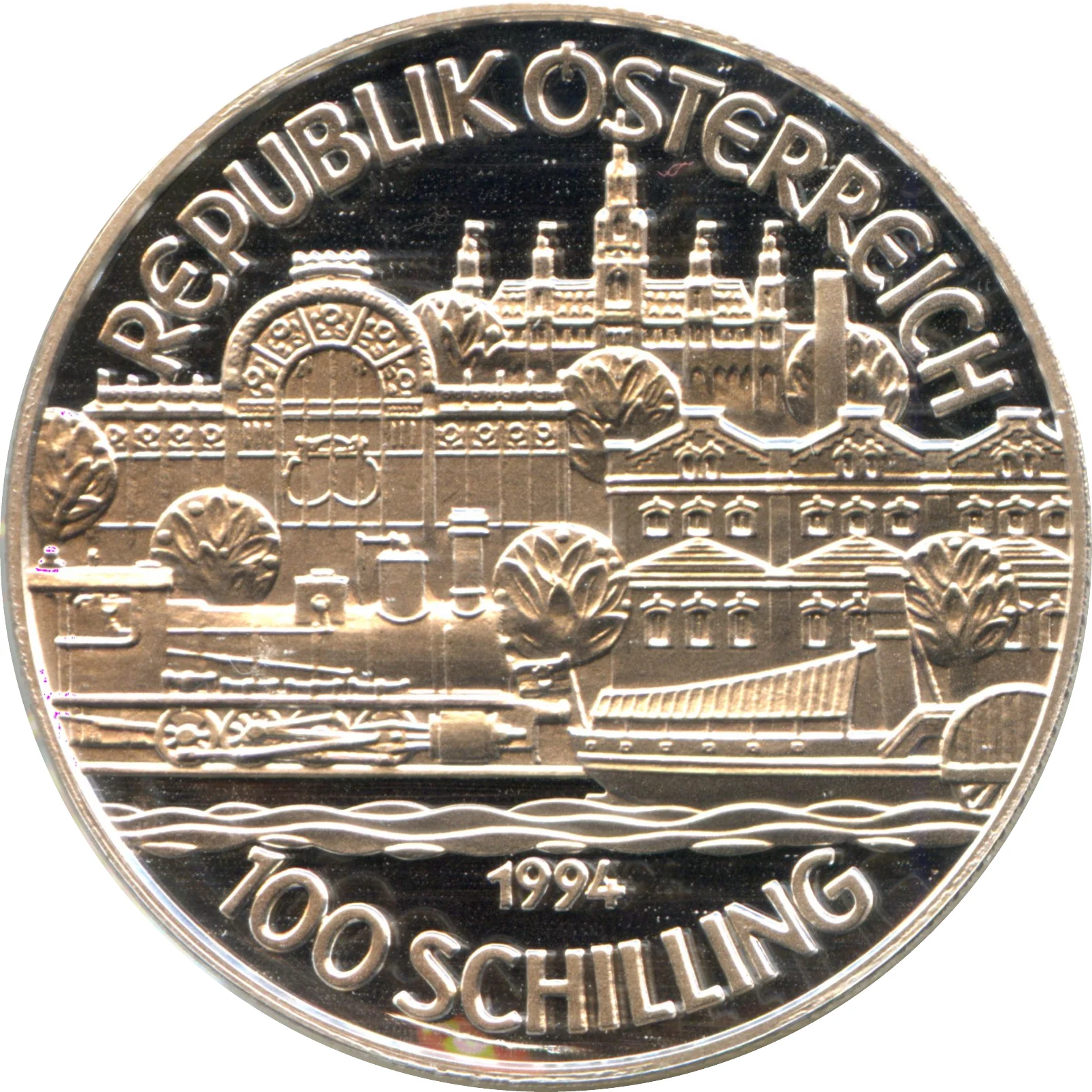
Obverse
Description:
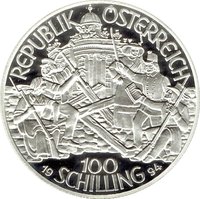
1994 Austrian 100 Schilling
Inscription:
REPUBLIK OESTERREICH
100 SCHILLING
100 SCHILLING
Script: Latin
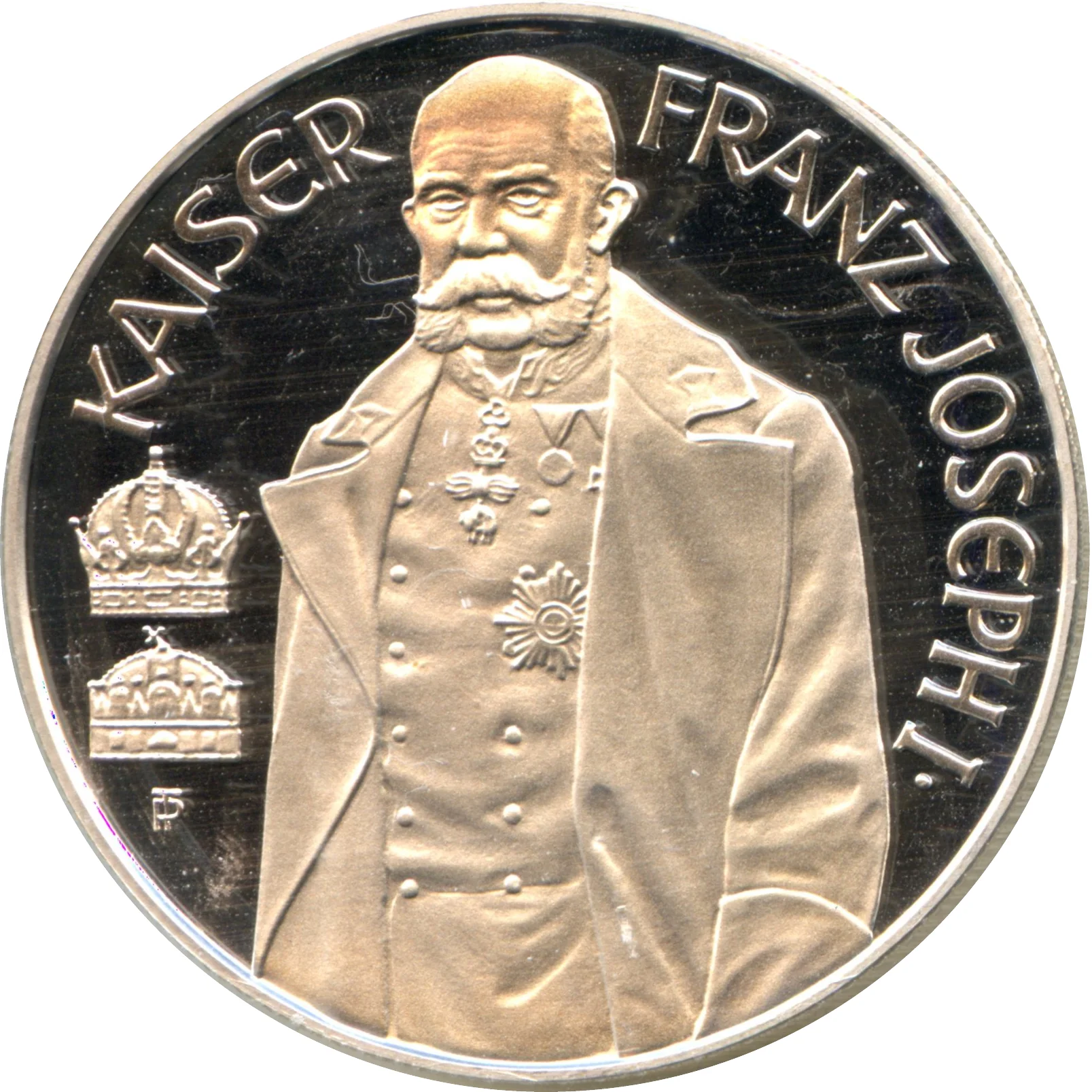
Reverse
Description:
Half-face portrait of Franz Joseph, flanked by the Austrian and Hungarian crowns.
Inscription:
KAISER FRANZ-JOSEPH I.
Script: Latin
Edge
Reeded
Mints
| Name | Mark |
|---|---|
| Münze Österreich | — |
Mintings
| Year | Mint Mark | Mintage | Quality | Collection |
|---|---|---|---|---|
| 1994 | — | 75,000 | Proof |
Historical background
In 1994, Austria’s currency situation was defined by its firm integration into the European Exchange Rate Mechanism (ERM I) and its unwavering commitment to a hard currency policy, known as the "Hartwährungspolitik." This policy, pursued for decades, pegged the Austrian schilling (ATS) closely to the Deutsche Mark (DEM), the anchor currency of the European Monetary System. This deliberate alignment provided Austria with immense stability, low inflation, and a credible monetary framework, effectively importing the anti-inflationary credibility of the German Bundesbank. Consequently, the schilling was considered one of Europe's most stable currencies, a cornerstone of the country's prosperous and predictable economic environment.
The year was particularly significant as it fell within the final phase of Austria's path toward European Union membership, which was achieved on January 1, 1995. The currency stability was a key asset in these accession negotiations, demonstrating the country's economic convergence with core EU economies. Domestically, there was little debate about the schilling's value; public and political consensus strongly favored the stable link to the Deutsche Mark. This stability, however, meant that Austria's monetary policy was largely determined by German interest rate decisions, a trade-off accepted for the benefits of price stability and the upcoming integration into the broader European project.
Looking forward, 1994 was a quiet prelude to major change. While the schilling's day-to-day existence was stable, the groundwork was being laid for its eventual replacement. Austria's EU accession treaty committed the country to future participation in Economic and Monetary Union (EMU). Therefore, the core narrative of 1994 was one of a stable and successful national currency operating within a European framework, but with its long-term fate already sealed by the coming launch of the euro. The schilling’s final years would be spent in this stable duality, serving national economic needs while preparing for its convergence into the single currency.
The year was particularly significant as it fell within the final phase of Austria's path toward European Union membership, which was achieved on January 1, 1995. The currency stability was a key asset in these accession negotiations, demonstrating the country's economic convergence with core EU economies. Domestically, there was little debate about the schilling's value; public and political consensus strongly favored the stable link to the Deutsche Mark. This stability, however, meant that Austria's monetary policy was largely determined by German interest rate decisions, a trade-off accepted for the benefits of price stability and the upcoming integration into the broader European project.
Looking forward, 1994 was a quiet prelude to major change. While the schilling's day-to-day existence was stable, the groundwork was being laid for its eventual replacement. Austria's EU accession treaty committed the country to future participation in Economic and Monetary Union (EMU). Therefore, the core narrative of 1994 was one of a stable and successful national currency operating within a European framework, but with its long-term fate already sealed by the coming launch of the euro. The schilling’s final years would be spent in this stable duality, serving national economic needs while preparing for its convergence into the single currency.
⭐ Somewhat Rare