

½ Dollar – United States
Non-circulating coins
Commemoration: US Capitol Visitor Center
United States
Context
Year: 2001
Issuer: United States 
Period:
(since 1776)
Currency:
(since 1785)
Subdivision: ½ Dollar = 50 Cents
Total mintage: 177,119
Material
References
KM: #Click to copy to clipboard323
Numista: #32996
Value
Exchange value: ½ USD = $0.50
Inflation-adjusted value: 0.93 USD
Obverse
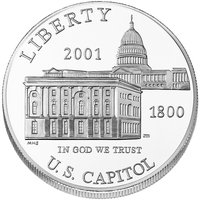
Description:
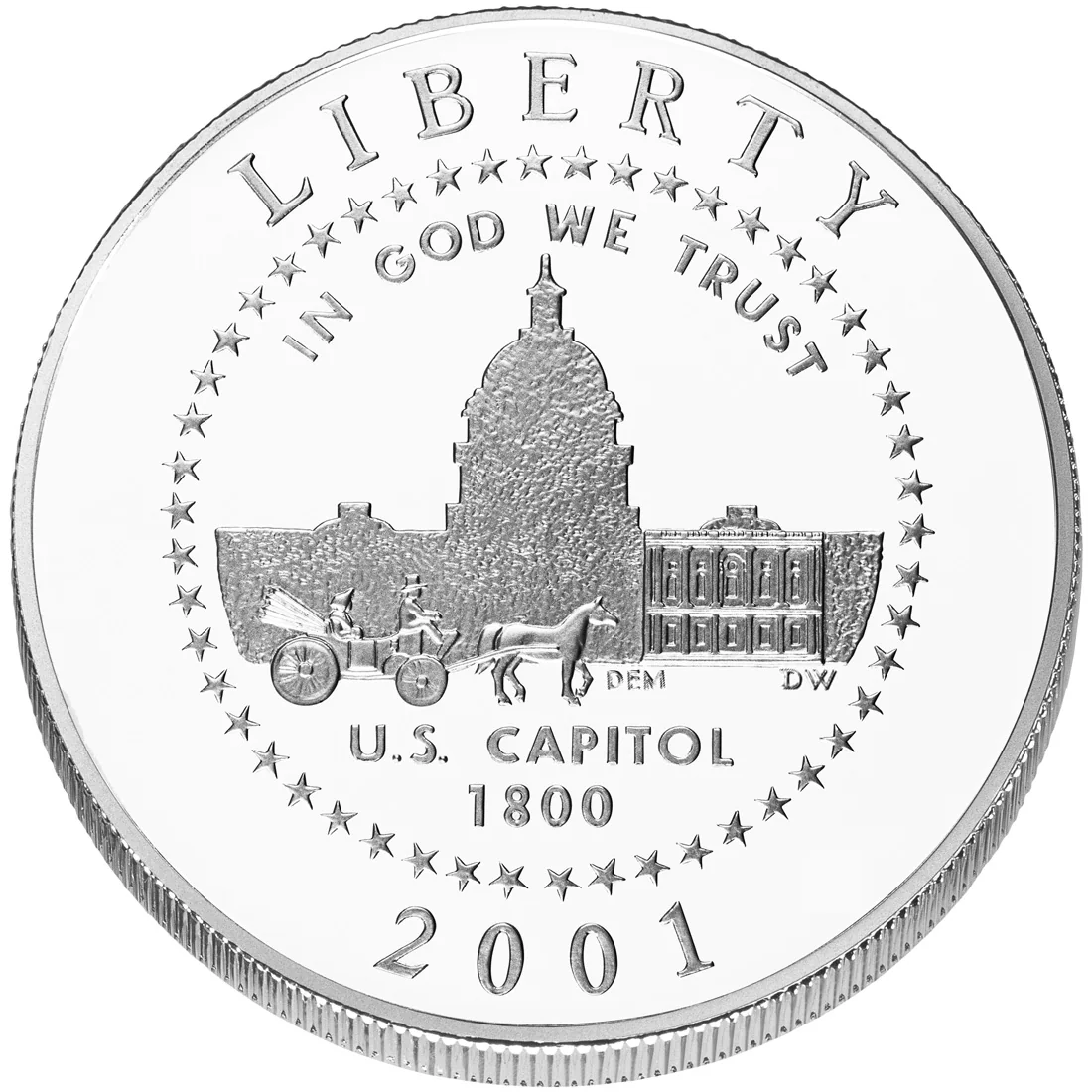
The original Capitol's North Wing is overlaid on the current building's outline, with a carriage in front and a circle of stars.
Inscription:
LIBERTY
IN GOD WE TRUST
U.S. CAPITOL
1800
2001
IN GOD WE TRUST
U.S. CAPITOL
1800
2001
Script: Latin
Designer: Dean McMullen
Reverse
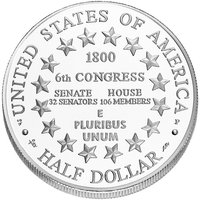
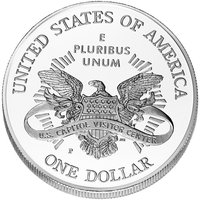
Description:
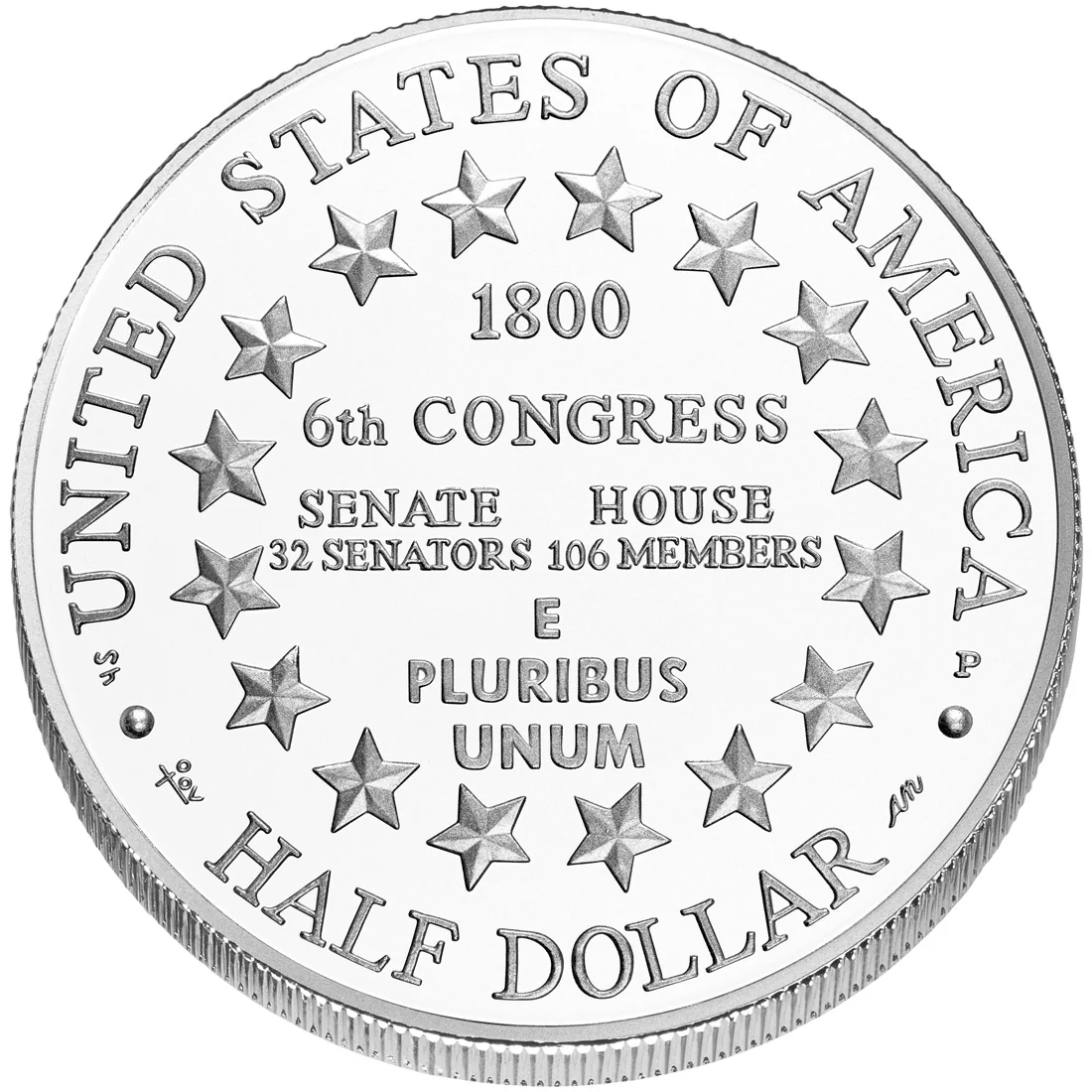
Inscriptions in varied fonts encircled by 16 stars, representing the states of 1800.
Inscription:
UNITED STATES OF AMERICA
1800
6th CONGRESS
SENATE
32 SENATORS
HOUSE
106 MEMBERS
E PLURIBUS UNUM
HALF DOLLAR
1800
6th CONGRESS
SENATE
32 SENATORS
HOUSE
106 MEMBERS
E PLURIBUS UNUM
HALF DOLLAR
Script: Latin
Designers: Alex Shagin, Marcel Jovine
Edge
Reeded
Mints
| Name | Mark |
|---|---|
| United States Mint of Philadelphia | P |
Historical background
The United States entered 2001 with a strong and stable currency, the U.S. dollar, which served as the world's dominant reserve currency. This position was underpinned by a robust economy that had experienced a long period of growth during the 1990s, low inflation, and consistent budget surpluses under the Clinton administration. The Federal Reserve, led by Chairman Alan Greenspan, had successfully navigated the economy through the 1997 Asian Financial Crisis and the LTCM collapse, reinforcing global confidence in the dollar's stability. The euro, introduced in 1999, was still in its infancy and posed no immediate challenge to the dollar's supremacy.
However, the economic landscape shifted dramatically in 2001. The dot-com bubble burst, leading to a significant stock market decline and the onset of a recession in March. The terrorist attacks of September 11th further destabilized financial markets and injected profound uncertainty into the global economic system. In response, the Federal Reserve embarked on an aggressive series of interest rate cuts, lowering the federal funds rate from 6.5% at the start of the year to 1.75% by year's end. This monetary easing was designed to stimulate the economy but also had the effect of weakening the dollar's yield advantage, putting downward pressure on its exchange rate against other major currencies.
Despite this domestic turbulence, the dollar's global role remained largely unchallenged. A "flight to safety" following 9/11 initially saw investors buy U.S. Treasury assets, supporting the dollar. Furthermore, the Bush administration maintained a "strong dollar policy" in rhetoric, though its focus shifted toward domestic stimulus through tax cuts. The combined fiscal and monetary stimulus laid the groundwork for future imbalances, but in 2001, the dollar weathered the storms due to its unparalleled depth and liquidity, and the lack of a credible alternative in a time of global crisis. The year thus ended with a currency that was slightly softer but still fundamentally secure in its position at the center of the international financial system.
However, the economic landscape shifted dramatically in 2001. The dot-com bubble burst, leading to a significant stock market decline and the onset of a recession in March. The terrorist attacks of September 11th further destabilized financial markets and injected profound uncertainty into the global economic system. In response, the Federal Reserve embarked on an aggressive series of interest rate cuts, lowering the federal funds rate from 6.5% at the start of the year to 1.75% by year's end. This monetary easing was designed to stimulate the economy but also had the effect of weakening the dollar's yield advantage, putting downward pressure on its exchange rate against other major currencies.
Despite this domestic turbulence, the dollar's global role remained largely unchallenged. A "flight to safety" following 9/11 initially saw investors buy U.S. Treasury assets, supporting the dollar. Furthermore, the Bush administration maintained a "strong dollar policy" in rhetoric, though its focus shifted toward domestic stimulus through tax cuts. The combined fiscal and monetary stimulus laid the groundwork for future imbalances, but in 2001, the dollar weathered the storms due to its unparalleled depth and liquidity, and the lack of a credible alternative in a time of global crisis. The year thus ended with a currency that was slightly softer but still fundamentally secure in its position at the center of the international financial system.
🌟 Limited