

100 Bahts – Thailand
Circulating commemorative coins
Commemoration: World Bank - Internat. Monetary Fund
Thailand
Context
Year: 1991
Thai Year: 2534
Issuer: Thailand 
Ruler: Bhumibol Adulyadej
Currency:
(since 1897)
Total mintage: 560,000
Material
Diameter: 38 mm
Weight: 25 g
Shape: Round
Composition: Copper-nickel
Technique: Milled
Alignment: Medal alignment
flip
References
Y: #Click to copy to clipboard242
Numista: #13795
Value
Exchange value: 100 THB = $3.22
Obverse
Description:
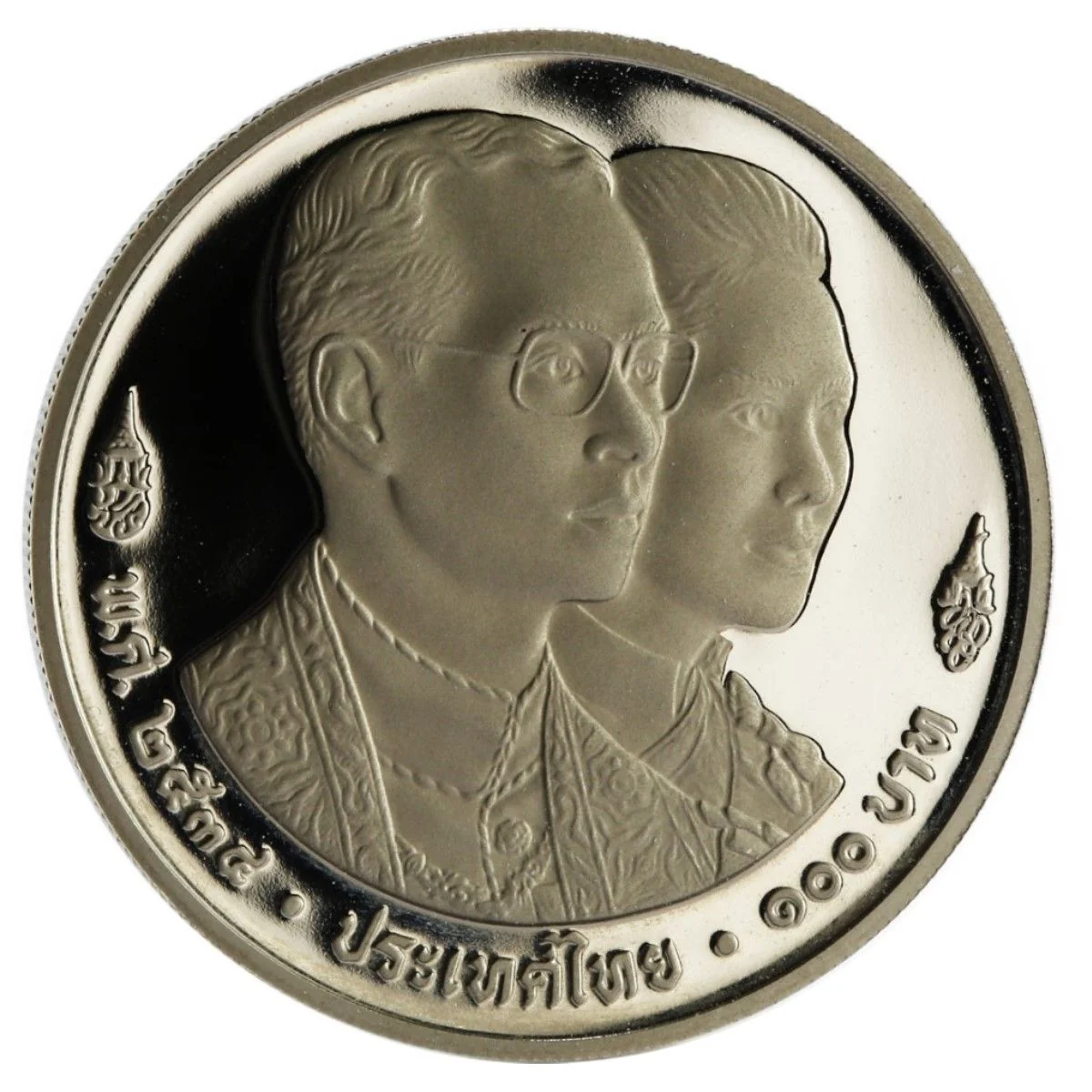
Busts of King Bhumibol Adulyadej and Queen Sirikit in royal attire, wearing the collars of the Order of the Royal House of Chakri. The Queen also wears the King's royal cypher medal. Their royal cyphers appear on the sides.
Inscription:
พ.ศ.๒๕๓๔ . ประเทศไทย . ๑๐๐ บาท
Translation:
B.E. 2534 . Thailand . 100 Baht
Language: Thai
Reverse
Description:
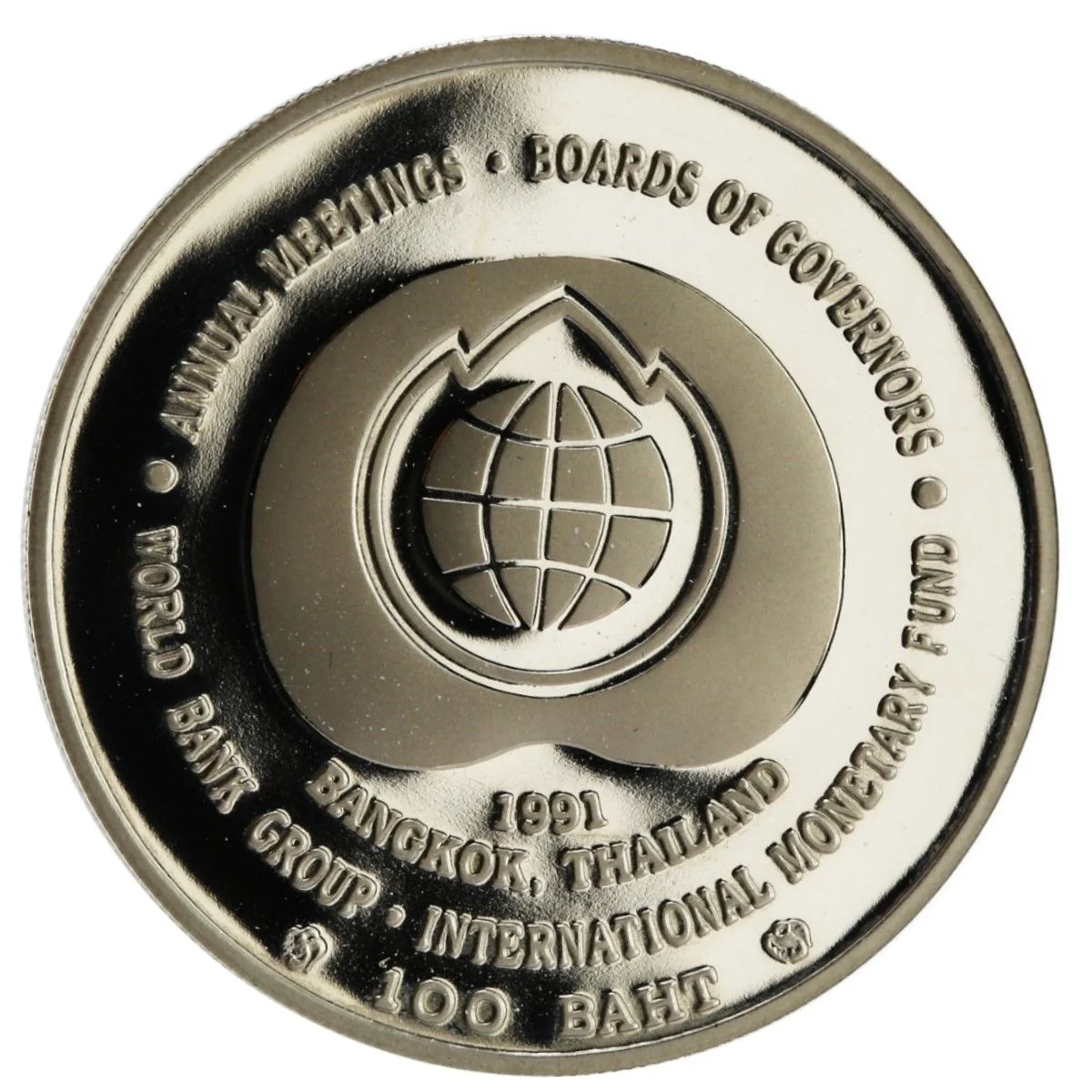
Meeting logo.
Inscription:
. ANNUAL MEETINGS . BOARDS OF GOVERNORS .
1991
BANGKOK THAILAND
WORLD BANK GROUP . INTERNATIONAL MONETARY FUND
100 BAHT
1991
BANGKOK THAILAND
WORLD BANK GROUP . INTERNATIONAL MONETARY FUND
100 BAHT
Edge
Mintings
| Year | Mint Mark | Mintage | Quality | Collection |
|---|---|---|---|---|
| 1991 | — | 500,000 | ||
| 1991 | — | 60,000 | Proof |
Historical background
In 1991, Thailand's currency, the baht, operated under a tightly managed exchange rate system, pegged to a basket of currencies heavily weighted toward the U.S. dollar. This policy, maintained by the Bank of Thailand (BOT), provided stability for trade and investment, which was crucial for an export-oriented economy experiencing rapid growth. The peg was widely seen as a cornerstone of Thailand's economic success, fostering confidence among foreign investors and contributing to the country's reputation as an emerging "Asian Tiger." Inflation was relatively low, and the economy was booming, with GDP growth exceeding 8% that year.
However, underlying pressures were beginning to emerge. Thailand's large current account deficit, fueled by strong import growth and a high level of foreign-denominated debt in the private sector, created a vulnerability. The baht's peg, while stable, was perceived by some economists as potentially overvalued, making Thai exports less competitive just as regional rivals were devaluing their currencies. Furthermore, the country's financial liberalization in the late 1980s had opened the capital account, allowing for large inflows of "hot money" seeking high returns, which increased the economy's exposure to sudden shifts in investor sentiment.
The political context added another layer of complexity. The year 1991 began under the unelected government of Prime Minister Chatichai Choonhavan, which was overthrown by a military coup in February. The subsequent National Peace Keeping Council, led by General Suchinda Kraprayoon, initially pledged pro-market policies but introduced political uncertainty. Despite this turbulence, the currency regime itself was not yet in crisis; the severe pressures that would culminate in the 1997 Asian Financial Crisis were still gathering force. Thus, 1991 represents a point of apparent stability, but one where the foundations for future turmoil were being laid.
However, underlying pressures were beginning to emerge. Thailand's large current account deficit, fueled by strong import growth and a high level of foreign-denominated debt in the private sector, created a vulnerability. The baht's peg, while stable, was perceived by some economists as potentially overvalued, making Thai exports less competitive just as regional rivals were devaluing their currencies. Furthermore, the country's financial liberalization in the late 1980s had opened the capital account, allowing for large inflows of "hot money" seeking high returns, which increased the economy's exposure to sudden shifts in investor sentiment.
The political context added another layer of complexity. The year 1991 began under the unelected government of Prime Minister Chatichai Choonhavan, which was overthrown by a military coup in February. The subsequent National Peace Keeping Council, led by General Suchinda Kraprayoon, initially pledged pro-market policies but introduced political uncertainty. Despite this turbulence, the currency regime itself was not yet in crisis; the severe pressures that would culminate in the 1997 Asian Financial Crisis were still gathering force. Thus, 1991 represents a point of apparent stability, but one where the foundations for future turmoil were being laid.
⭐ Somewhat Rare