

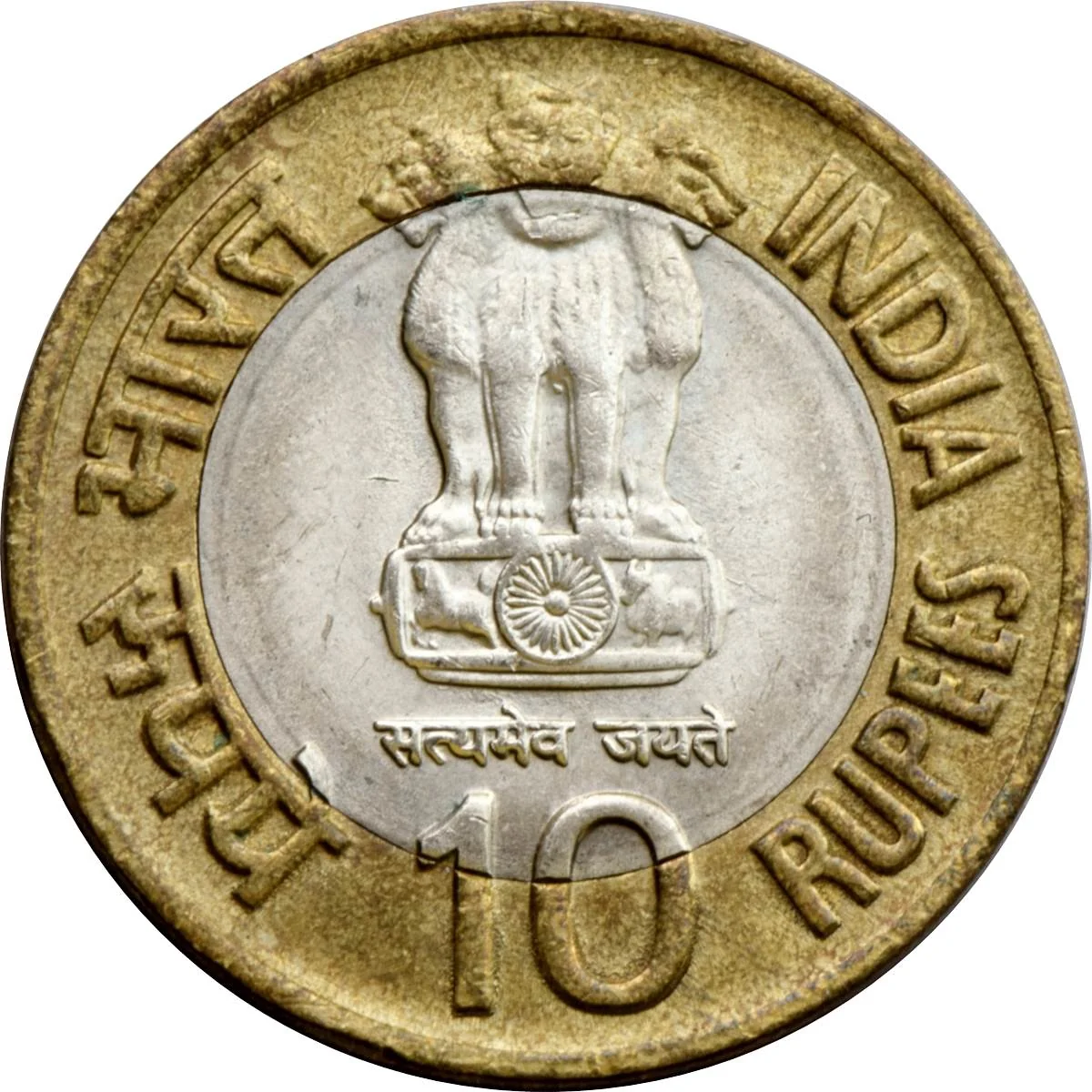
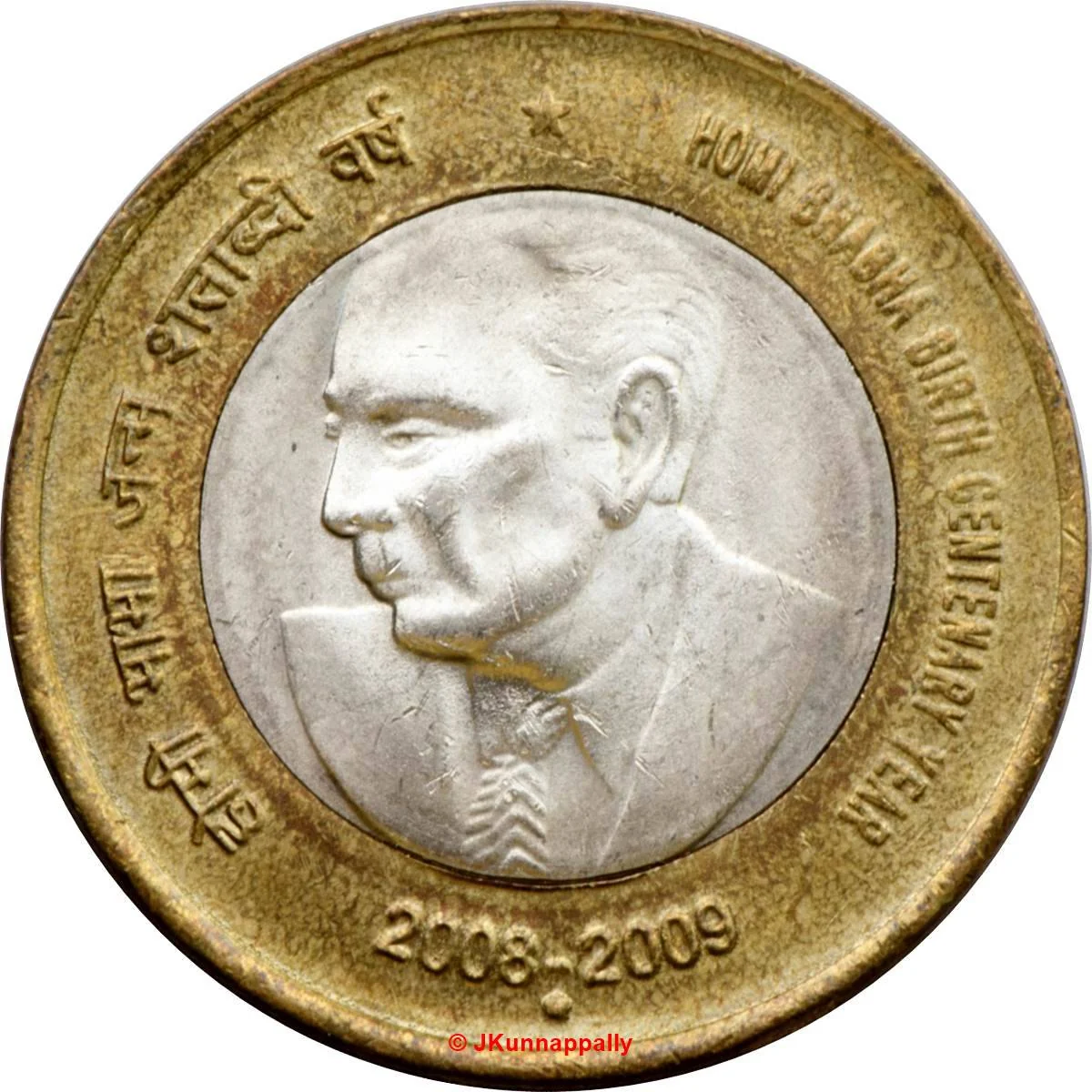
10 rupees – India
Add to wishlist
Circulating commemorative coins
Commemoration: Dr. Homi Bhabha
India
Material
Diameter: 27 mm
Weight: 7.71 g
Thickness: 1.82 mm
Shape: Round
Standard: Silver quarter ounce
Technique: Milled
Alignment: Medal alignment
flip
References
KM: #
Numista: #13789
Value
Exchange value: 10 INR
Inflation-adjusted value: 29.56 INR
Obverse
Reverse
Edge
Plain
Categories
| Event> Birth anniversary |
Mintings
| Year | Mint Mark | Mintage | Quality | Collection |
|---|---|---|---|---|
| 2009 | ° | — | ||
| 2009 | ♦ | — | ||
| 2009 | M | — | Proof |
Historical background
In 2009, India's currency and broader economic situation were dominated by the aftershocks of the global financial crisis. The year began with the Indian Rupee (INR) under significant pressure, having depreciated sharply against the US Dollar in late 2008 as foreign institutional investors withdrew capital from emerging markets. This led to heightened volatility and concerns about external stability. In response, the Reserve Bank of India (RBI) actively intervened in the foreign exchange market, utilizing its reserves to curb excessive rupee volatility. Concurrently, the RBI implemented a series of aggressive monetary policy measures, including interest rate cuts and liquidity injections, to shield the domestic economy from the global downturn and stimulate growth.
The government complemented the RBI's actions with a substantial fiscal stimulus, comprising both tax cuts and increased public expenditure. This dual approach of monetary easing and fiscal expansion helped India achieve a relatively swift "V-shaped" recovery in GDP growth by the second half of 2009, making it one of the first major economies to rebound. However, these policies also sowed the seeds for future challenges. The large fiscal deficit, which widened to over 6% of GDP, and the expansionary monetary stance began to stoke inflationary pressures, particularly in food prices. By the end of 2009, wholesale price index (WPI) inflation entered a sustained upward trajectory.
Thus, the currency situation in 2009 was a story of successful crisis management that transitioned into a new policy dilemma. The RBI's interventions had stabilized the rupee, and capital flows began to return, but the focus was shifting from fostering growth to managing inflation and fiscal consolidation. The year ended with the central bank starting to signal a reversal of its easy monetary policy, setting the stage for a tightening cycle in 2010 to address the emerging threat of high inflation, which would become the predominant macroeconomic concern in the years immediately following.
The government complemented the RBI's actions with a substantial fiscal stimulus, comprising both tax cuts and increased public expenditure. This dual approach of monetary easing and fiscal expansion helped India achieve a relatively swift "V-shaped" recovery in GDP growth by the second half of 2009, making it one of the first major economies to rebound. However, these policies also sowed the seeds for future challenges. The large fiscal deficit, which widened to over 6% of GDP, and the expansionary monetary stance began to stoke inflationary pressures, particularly in food prices. By the end of 2009, wholesale price index (WPI) inflation entered a sustained upward trajectory.
Thus, the currency situation in 2009 was a story of successful crisis management that transitioned into a new policy dilemma. The RBI's interventions had stabilized the rupee, and capital flows began to return, but the focus was shifting from fostering growth to managing inflation and fiscal consolidation. The year ended with the central bank starting to signal a reversal of its easy monetary policy, setting the stage for a tightening cycle in 2010 to address the emerging threat of high inflation, which would become the predominant macroeconomic concern in the years immediately following.
🌱 Very Common