

10 Bahts (Department of Finance) – Thailand
Circulating commemorative coins
Commemoration: 120th Anniversary of Department of Finance
Thailand
Context
Year: 2010
Thai Year: 2553
Issuer: Thailand 
Ruler: Bhumibol Adulyadej
Currency:
(since 1897)
Total mintage: 1,000,000
Material
References
Y: #Click to copy to clipboard497
Numista: #32901
Value
Exchange value: 10 THB = $0.32
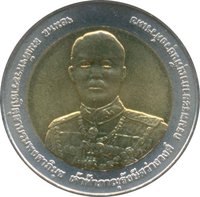
Obverse
Description:
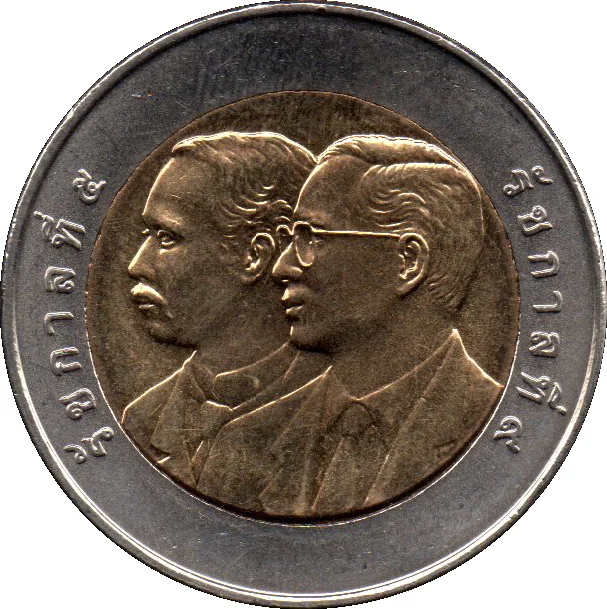
Portraits of Kings Rama V and Rama IX, inscribed "Roi Rama 5 Roi Rama 9".
Inscription:
รัชกาลที่ ๕ รัชกาลที่ ๙
Translation:
The Fifth Reign The Ninth Reign
Language: Thai
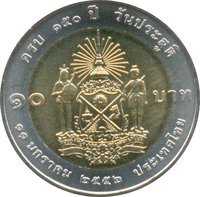
Reverse
Description:
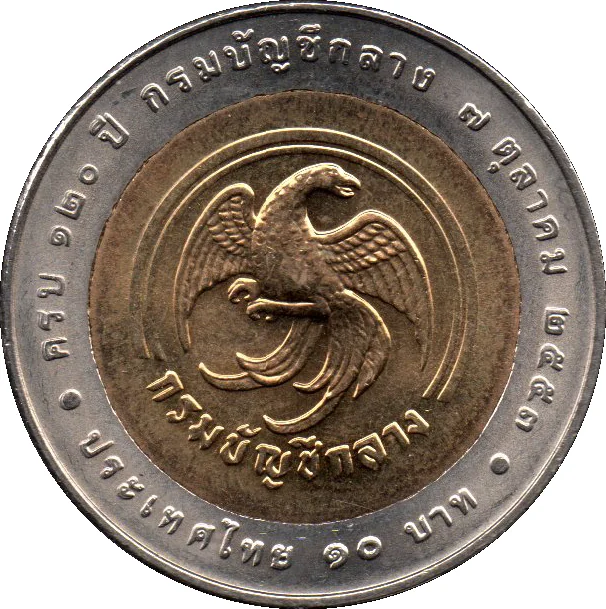
Finance Department symbol (Bird)
Inscription:
. ครบ ๑๒๐ ปี กรมบัญชีกลาง ๗ ตุลาคม ๒๕๕๓.
กรมบัญชีกลาง
ประเทศไทย ๑๐ บาท
กรมบัญชีกลาง
ประเทศไทย ๑๐ บาท
Translation:
On the occasion of the 120th anniversary of the Comptroller General's Department, 7th October 2010.
Comptroller General's Department
Thailand 10 Baht
Comptroller General's Department
Thailand 10 Baht
Language: Thai
Edge
Segmented reeding
Mintings
| Year | Mint Mark | Mintage | Quality | Collection |
|---|---|---|---|---|
| 2010 | — | 1,000,000 |
Historical background
In 2010, Thailand's currency, the baht (THB), was characterized by significant strength and volatility, driven by both global and domestic factors. Emerging strongly from the 2008 global financial crisis, Thailand experienced robust capital inflows as investors sought higher yields in Asian markets. This demand, coupled with the country's large current account surplus, pushed the baht to appreciate considerably against the US dollar, reaching around 30 THB/USD by mid-2010, a level not seen since the 1997 Asian Financial Crisis. This strength was viewed as a double-edged sword: while it signaled economic resilience, it threatened export competitiveness, a critical pillar of the Thai economy.
Domestically, the currency situation was exacerbated by intense political turmoil. The year was marked by prolonged and sometimes violent protests by the "Red Shirt" United Front for Democracy Against Dictatorship (UDD), which paralyzed parts of Bangkok from March to May. This political instability created uncertainty for investors, leading to episodic capital outflows and pressure on the baht. The Bank of Thailand (BoT) faced a challenging policy dilemma: intervening to curb the baht's appreciation to protect exporters, while also managing inflationary pressures and avoiding measures that might destabilize the financial system further during a political crisis.
In response, the Bank of Thailand employed a mix of interventions, including direct market operations and the implementation of a 15% withholding tax on foreign investments in Thai bonds in October 2010. This capital control measure aimed to deter speculative short-term inflows and reduce currency volatility. The policy had an immediate sharp impact, causing the baht to drop rapidly, but it also drew criticism for potentially damaging Thailand's appeal to long-term investors. Ultimately, the 2010 currency narrative was one of a strong but vulnerable baht, caught between global liquidity flows and a fraught domestic political landscape, with authorities walking a fine line between stability and control.
Domestically, the currency situation was exacerbated by intense political turmoil. The year was marked by prolonged and sometimes violent protests by the "Red Shirt" United Front for Democracy Against Dictatorship (UDD), which paralyzed parts of Bangkok from March to May. This political instability created uncertainty for investors, leading to episodic capital outflows and pressure on the baht. The Bank of Thailand (BoT) faced a challenging policy dilemma: intervening to curb the baht's appreciation to protect exporters, while also managing inflationary pressures and avoiding measures that might destabilize the financial system further during a political crisis.
In response, the Bank of Thailand employed a mix of interventions, including direct market operations and the implementation of a 15% withholding tax on foreign investments in Thai bonds in October 2010. This capital control measure aimed to deter speculative short-term inflows and reduce currency volatility. The policy had an immediate sharp impact, causing the baht to drop rapidly, but it also drew criticism for potentially damaging Thailand's appeal to long-term investors. Ultimately, the 2010 currency narrative was one of a strong but vulnerable baht, caught between global liquidity flows and a fraught domestic political landscape, with authorities walking a fine line between stability and control.

🌱 Fairly Common