

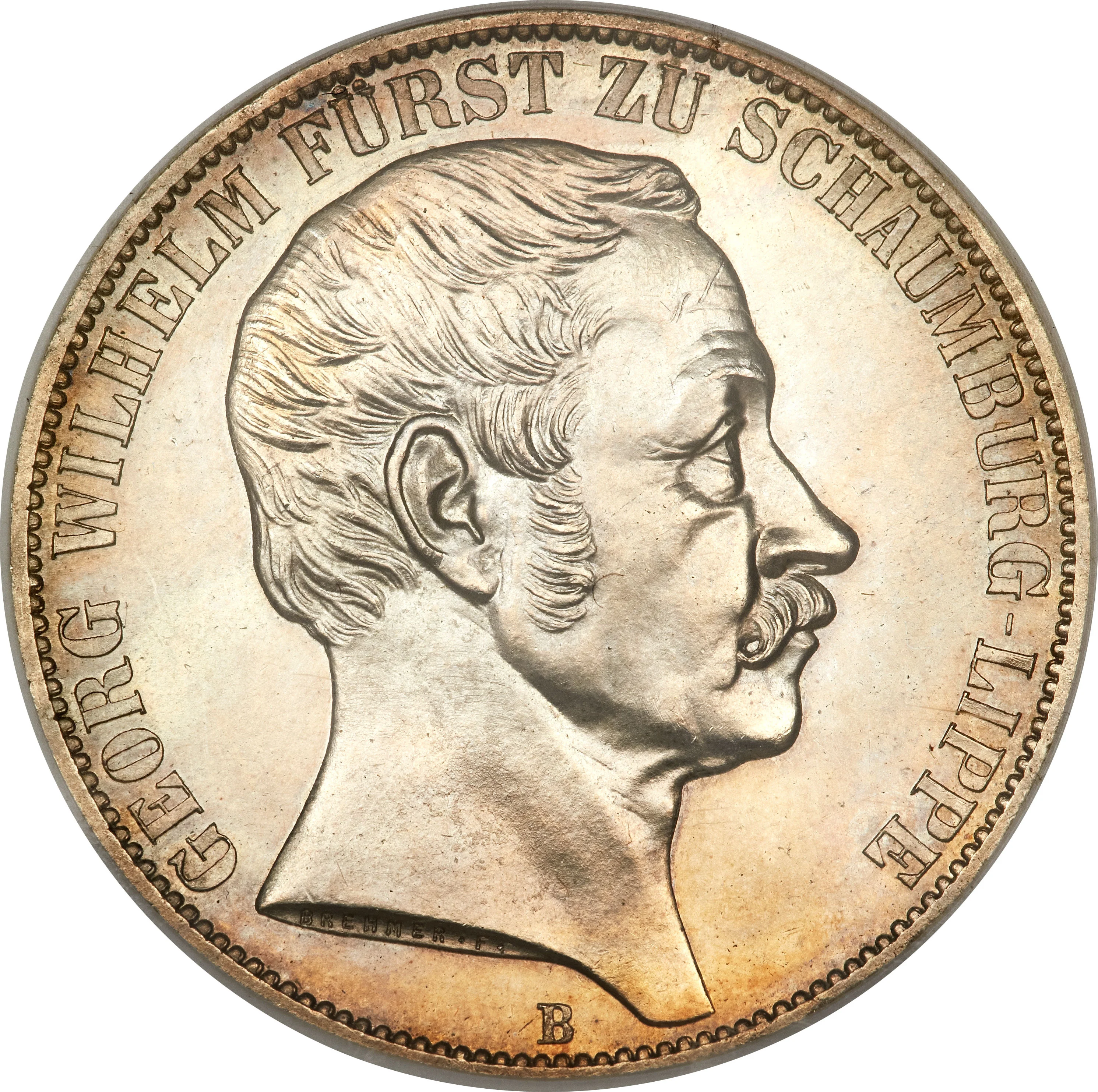
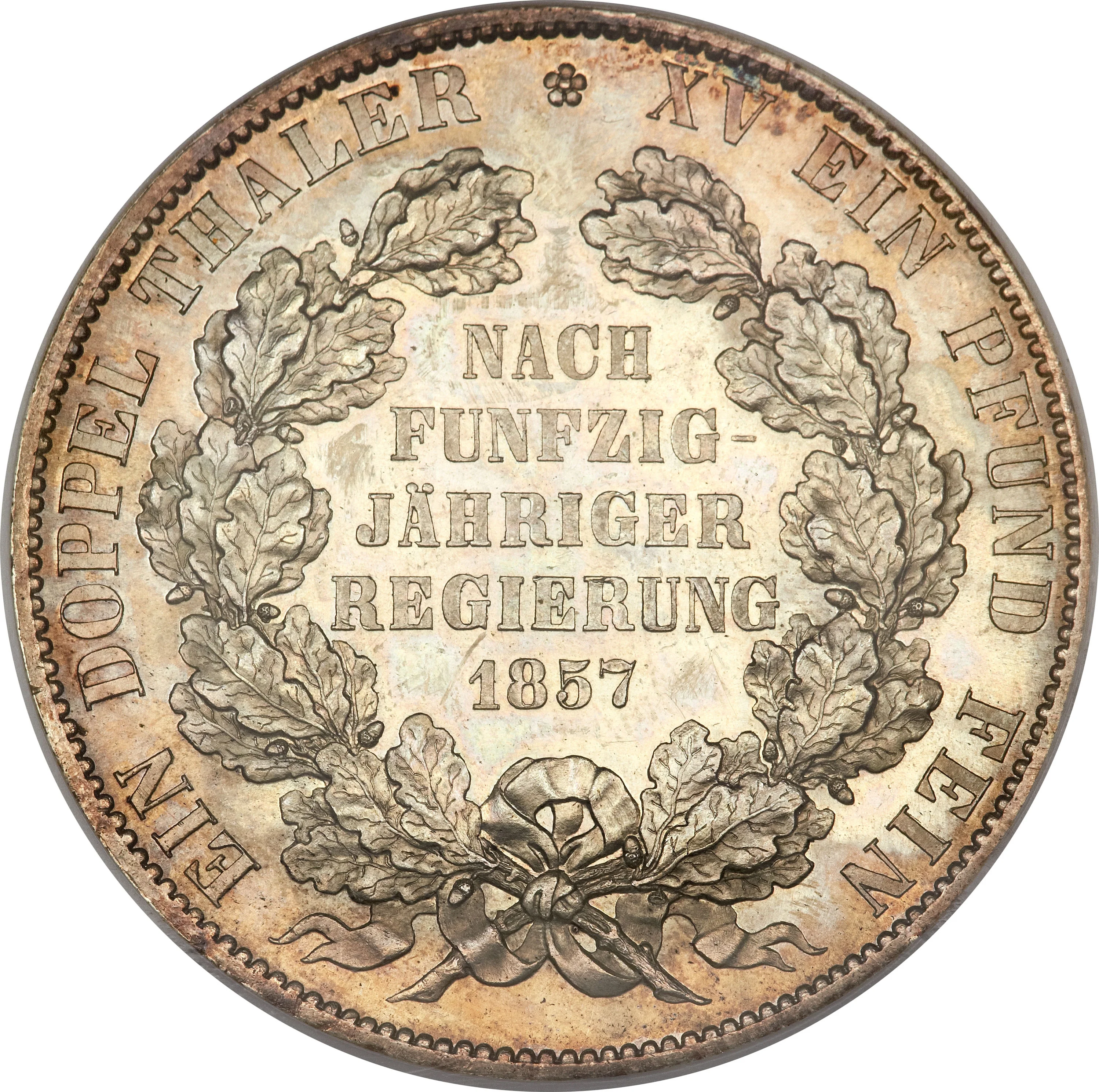
2 Vereinsthaler (Reign of Prince Georg Wilhelm) – Principality of Schaumburg-Lippe
Circulating commemorative coins
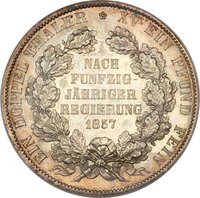
Commemoration: 50th Anniversary of the Reign of Prince Georg Wilhelm
Germany
Context
Year: 1857
Country: Germany 
Issuer: Principality of Schaumburg-Lippe
Ruler: George William
Currency:
(1857—1873)
Subdivision: 2 Vereinsthaler = 1⁄15 Metric Pound
Demonetized: Yes
Total mintage: 2,000
Material
References
KM: #Click to copy to clipboard38
Numista: #32839
Value
Bullion value: $94.30
Obverse
Description:
Right-facing bust.
Inscription:
GEORG WILHELM FÜRST ZU SCHAUMBURG-LIPPE
BREHMER·F·
B
BREHMER·F·
B
Translation:
George William, Prince of Schaumburg-Lippe
Brehmer, maker
Brehmer, maker
Script: Latin
Language: German
Engraver: Heinrich Friedrich Brehmer
Reverse
Edge
Lettering:MITT ~ GOTTES ~ HÜLFE
Legend:
MITT ~ GOTTES ~ HÜLFE
Translation:
With God's help
Language: German
Mints
| Name | Mark |
|---|---|
| Hanover | — |
Mintings
| Year | Mint Mark | Mintage | Quality | Collection |
|---|---|---|---|---|
| 1857 | — | 2,000 |
Historical background
In 1857, the Principality of Schaumburg-Lippe, a small north German state, operated within the complex and fragmented monetary landscape of the German Confederation. It was a member of the Thaler Currency Area, adhering to the Prussian Thaler standard as defined by the Dresden Coinage Convention of 1838. This treaty established a fixed exchange rate between the two major silver coin standards in Germany: the northern Thaler (divided into 30 Groschen) and the southern Gulden. Schaumburg-Lippe's primary unit was the Thaler, which provided regional monetary stability and facilitated trade with powerful neighbours like Prussia and Hanover.
However, the principality did not possess its own central mint. Its coinage was therefore limited and often supplied by external mints under contract, leading to a circulation dominated by a mix of Prussian, Hanoverian, and other German state coins, alongside smaller local issues. This reliance on foreign minting underscored the principality's limited sovereignty in monetary matters. The year 1857 itself was significant as it marked the signing of the Vienna Coinage Treaty, a new agreement designed to further standardize currency across the Confederation under the guidance of Austria and Prussia.
The Vienna Treaty introduced the Vereinsthaler (Union Thaler), a new common silver coin intended to gradually replace the older regional types. For Schaumburg-Lippe, this represented a continuation of its integration into the Prussian-led monetary bloc, ensuring its currency remained aligned with the dominant economic powers. Thus, in 1857, the principality was in a transitional phase, moving from the Dresden system toward the Vienna system, while its day-to-day currency remained a practical amalgamation of externally produced coins within a stable, federally agreed-upon silver standard.
However, the principality did not possess its own central mint. Its coinage was therefore limited and often supplied by external mints under contract, leading to a circulation dominated by a mix of Prussian, Hanoverian, and other German state coins, alongside smaller local issues. This reliance on foreign minting underscored the principality's limited sovereignty in monetary matters. The year 1857 itself was significant as it marked the signing of the Vienna Coinage Treaty, a new agreement designed to further standardize currency across the Confederation under the guidance of Austria and Prussia.
The Vienna Treaty introduced the Vereinsthaler (Union Thaler), a new common silver coin intended to gradually replace the older regional types. For Schaumburg-Lippe, this represented a continuation of its integration into the Prussian-led monetary bloc, ensuring its currency remained aligned with the dominant economic powers. Thus, in 1857, the principality was in a transitional phase, moving from the Dresden system toward the Vienna system, while its day-to-day currency remained a practical amalgamation of externally produced coins within a stable, federally agreed-upon silver standard.
✨ Legendary