

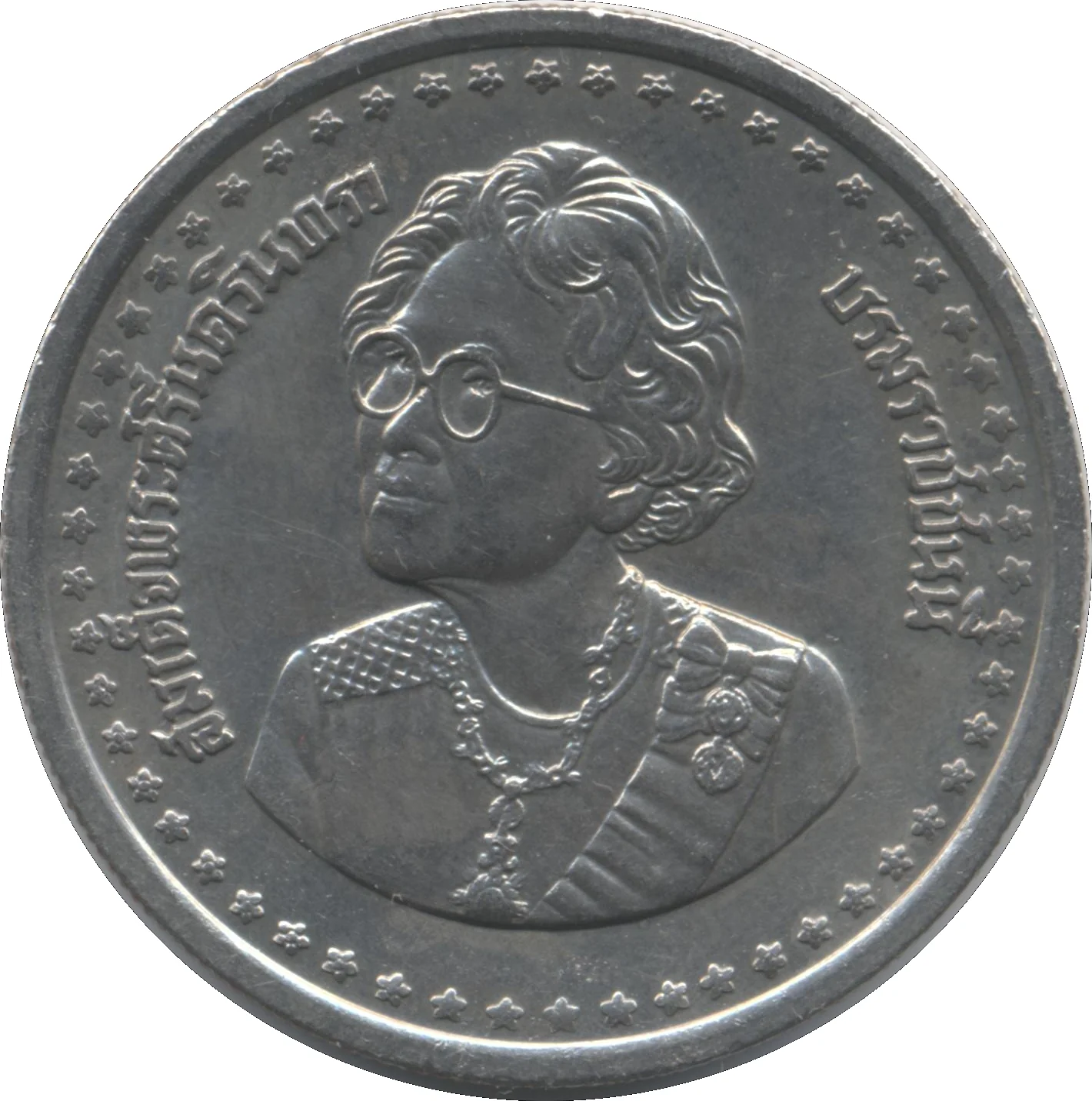
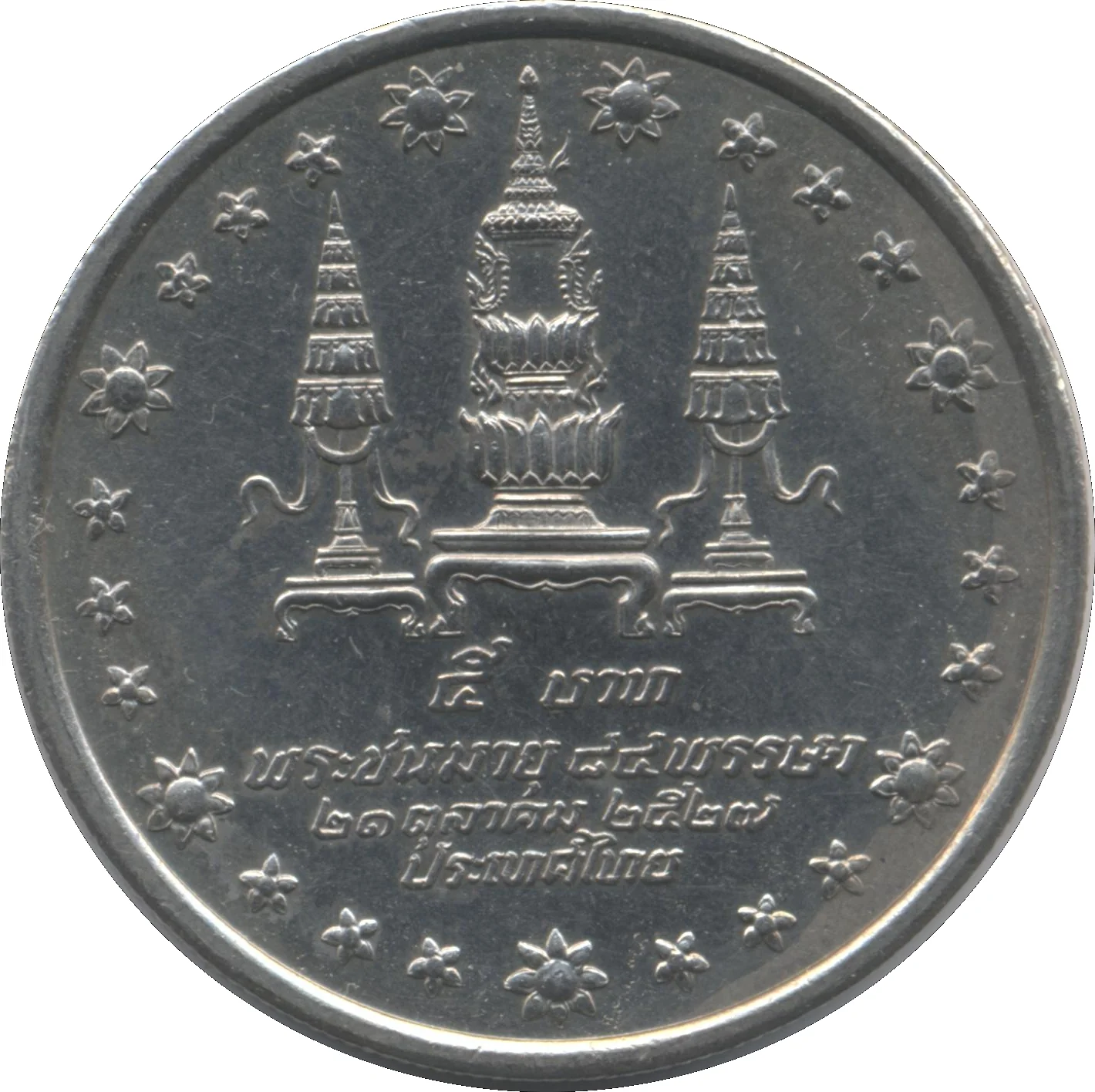
5 bahts (King's Mother) – Thailand
Add to wishlist
Circulating commemorative coins
Commemoration: 84th Anniversary of the King's Mother
Thailand
Context
Year: 1984
Thai Year:: 2527
Issuer: Thailand
Ruler: Bhumibol Adulyadej
Currency:
(since 1897)
Demonetized: Yes
Total mintage: 600,000
Material
References
Y: #
Numista: #13772
Value
Exchange value: 5 THB
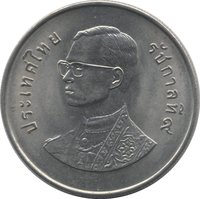
Obverse
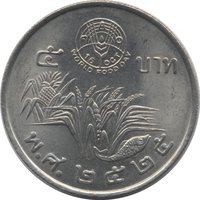
Reverse
Edge
Reeded
Mintings
| Year | Mint Mark | Mintage | Quality | Collection |
|---|---|---|---|---|
| 1984 | — | 600,000 | ||
| 1984 | — | — | Proof |
Historical background
In 1984, Thailand faced a critical juncture in its economic management, grappling with the pressures of a fixed exchange rate system that had become unsustainable. The country had pegged its currency, the baht, to a weighted basket of currencies of its major trading partners, but in practice, it was closely aligned with the strong US dollar. This linkage, established in the late 1970s, initially provided stability. However, as the dollar appreciated sharply in the early 1980s due to US monetary policy, the baht was pulled upward in tandem, severely damaging Thailand's export competitiveness and widening its current account deficit.
The situation culminated on November 2, 1984, when the Bank of Thailand, under the government of Prime Minister Prem Tinsulanonda, executed a decisive devaluation. The baht was devalued by 14.8%, moving from a rate of approximately 23 baht to the US dollar to 27 baht. This was not a simple one-off adjustment but a strategic shift to a more flexible managed float, where the baht's value would be determined by a basket of currencies with the composition kept secret to deter speculation. The move was politically sensitive and undertaken with great secrecy to prevent capital flight, reflecting the high stakes involved.
This devaluation is widely regarded as a pivotal and successful economic reform. It restored Thailand's external competitiveness, boosted export-led growth, and laid the foundation for the subsequent investment boom and rapid economic expansion in the late 1980s and early 1990s. The 1984 devaluation demonstrated a pragmatic shift in policy, setting a precedent for active currency management that would define Thailand's approach until the Asian Financial Crisis of 1997 forced another, more dramatic, regime change.
The situation culminated on November 2, 1984, when the Bank of Thailand, under the government of Prime Minister Prem Tinsulanonda, executed a decisive devaluation. The baht was devalued by 14.8%, moving from a rate of approximately 23 baht to the US dollar to 27 baht. This was not a simple one-off adjustment but a strategic shift to a more flexible managed float, where the baht's value would be determined by a basket of currencies with the composition kept secret to deter speculation. The move was politically sensitive and undertaken with great secrecy to prevent capital flight, reflecting the high stakes involved.
This devaluation is widely regarded as a pivotal and successful economic reform. It restored Thailand's external competitiveness, boosted export-led growth, and laid the foundation for the subsequent investment boom and rapid economic expansion in the late 1980s and early 1990s. The 1984 devaluation demonstrated a pragmatic shift in policy, setting a precedent for active currency management that would define Thailand's approach until the Asian Financial Crisis of 1997 forced another, more dramatic, regime change.
🌟 Limited