

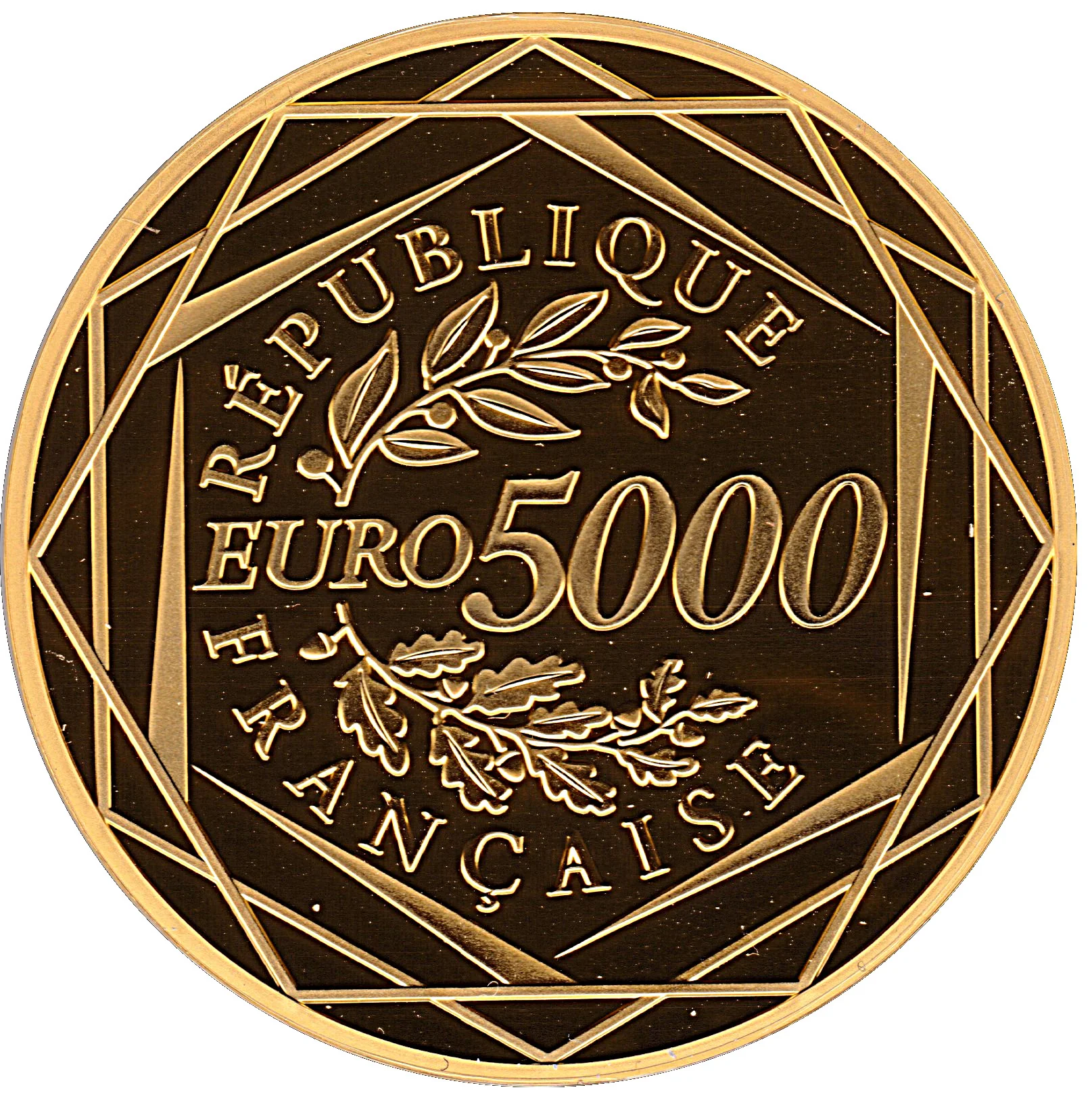


Obverse
Description:
The face value is framed by oak and laurel branches, evoking the euro's initials. The entire reverse motif is set within an assembly of lines representing the Hexagon.
Inscription:
RÉPUBLIQUE
EURO 5000
FRANÇAISE
EURO 5000
FRANÇAISE
Translation:
FRENCH REPUBLIC
EURO 5000
EURO 5000
Script: Latin
Language: French
Engraver: Joaquin Jimenez
Reverse
Description:
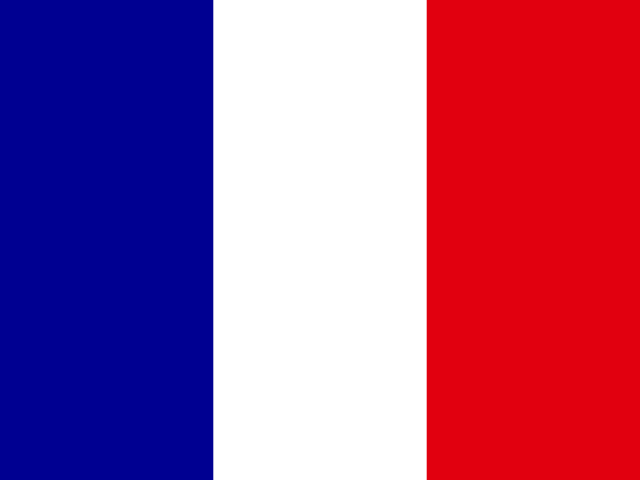
A contemporary chaplain rooster with stylized crest and feathers, bearing the motto "Liberté, Égalité, Fraternité". The French flag in the background uses heraldic colors styled like 10, 20, and 50 centime coins: horizontal blue lines, flat white, and vertical red lines.
Inscription:
LIBERTÉ
ÉGALITÉ
FRATERNITÉ
2016
ÉGALITÉ
FRATERNITÉ
2016
Translation:
LIBERTY
EQUALITY
FRATERNITY
2016
EQUALITY
FRATERNITY
2016
Script: Latin
Language: French
Edge
Mints
| Name | Mark |
|---|---|
| Monnaie de Paris | — |
Mintings
| Year | Mint Mark | Mintage | Quality | Collection |
|---|---|---|---|---|
| 2016 | — | 2,000 |
Historical background
In 2016, France remained a core member of the Eurozone, using the euro (€) as its sole legal tender. The currency situation was therefore defined not by national monetary policy—which was set by the European Central Bank (ECB) in Frankfurt—but by the ECB's ongoing efforts to stimulate the sluggish Eurozone economy after the sovereign debt crisis. For France, this meant operating in an environment of historically low interest rates and unconventional measures like quantitative easing, aimed at boosting inflation and growth. Domestically, this low-rate environment helped keep government borrowing costs down but also squeezed bank profitability and offered limited returns for savers.
The year was marked by significant political pressure on the euro's stability due to the looming threat of "Frexit." The rise of Marine Le Pen's National Front, which explicitly campaigned on leaving the euro and restoring the French franc, introduced a tangible risk of currency fragmentation. This concern peaked in the aftermath of the UK's Brexit referendum in June 2016, which fueled speculation about the potential unravelling of the EU. Consequently, investors and European partners closely watched French economic indicators and political polls, as the very future of the single currency in one of its founding nations appeared, for the first time, to be a subject of serious electoral debate.
Economically, the strong euro policy maintained by the ECB, coupled with the euro's relative strength against currencies like the British pound post-Brexit, presented challenges for French exporters, particularly in the vital tourism and agricultural sectors. Domestically, there was persistent public grumbling about perceived price increases since the franc's transition, often blamed on the euro. Thus, the currency situation in 2016 was a duality: one of technical stability and institutional integration within the Eurozone framework, but simultaneously one of profound political uncertainty and simmering public discontent that placed the common currency itself at the centre of a fierce national debate about France's European future.
The year was marked by significant political pressure on the euro's stability due to the looming threat of "Frexit." The rise of Marine Le Pen's National Front, which explicitly campaigned on leaving the euro and restoring the French franc, introduced a tangible risk of currency fragmentation. This concern peaked in the aftermath of the UK's Brexit referendum in June 2016, which fueled speculation about the potential unravelling of the EU. Consequently, investors and European partners closely watched French economic indicators and political polls, as the very future of the single currency in one of its founding nations appeared, for the first time, to be a subject of serious electoral debate.
Economically, the strong euro policy maintained by the ECB, coupled with the euro's relative strength against currencies like the British pound post-Brexit, presented challenges for French exporters, particularly in the vital tourism and agricultural sectors. Domestically, there was persistent public grumbling about perceived price increases since the franc's transition, often blamed on the euro. Thus, the currency situation in 2016 was a duality: one of technical stability and institutional integration within the Eurozone framework, but simultaneously one of profound political uncertainty and simmering public discontent that placed the common currency itself at the centre of a fierce national debate about France's European future.



✨ Legendary