

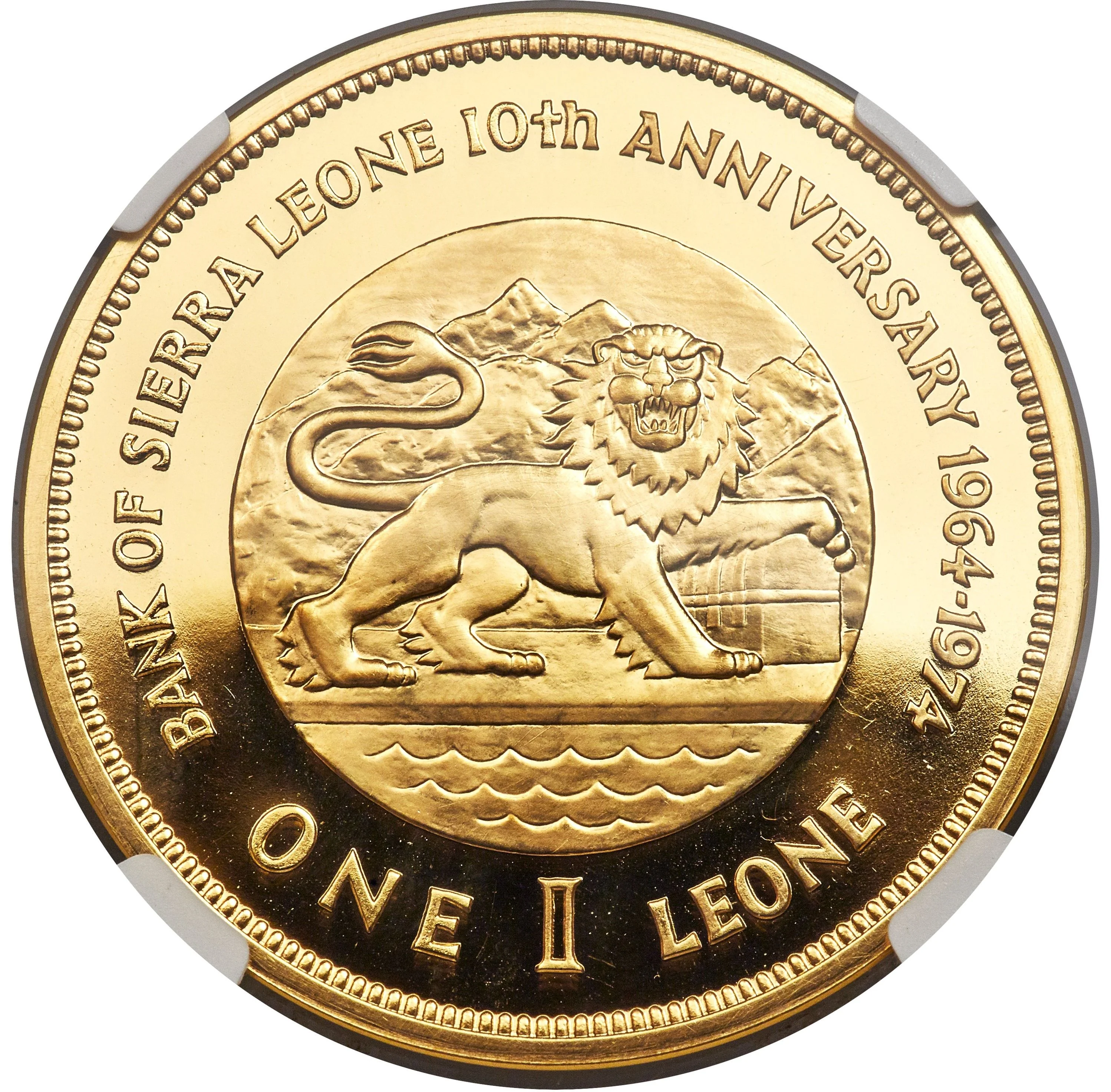
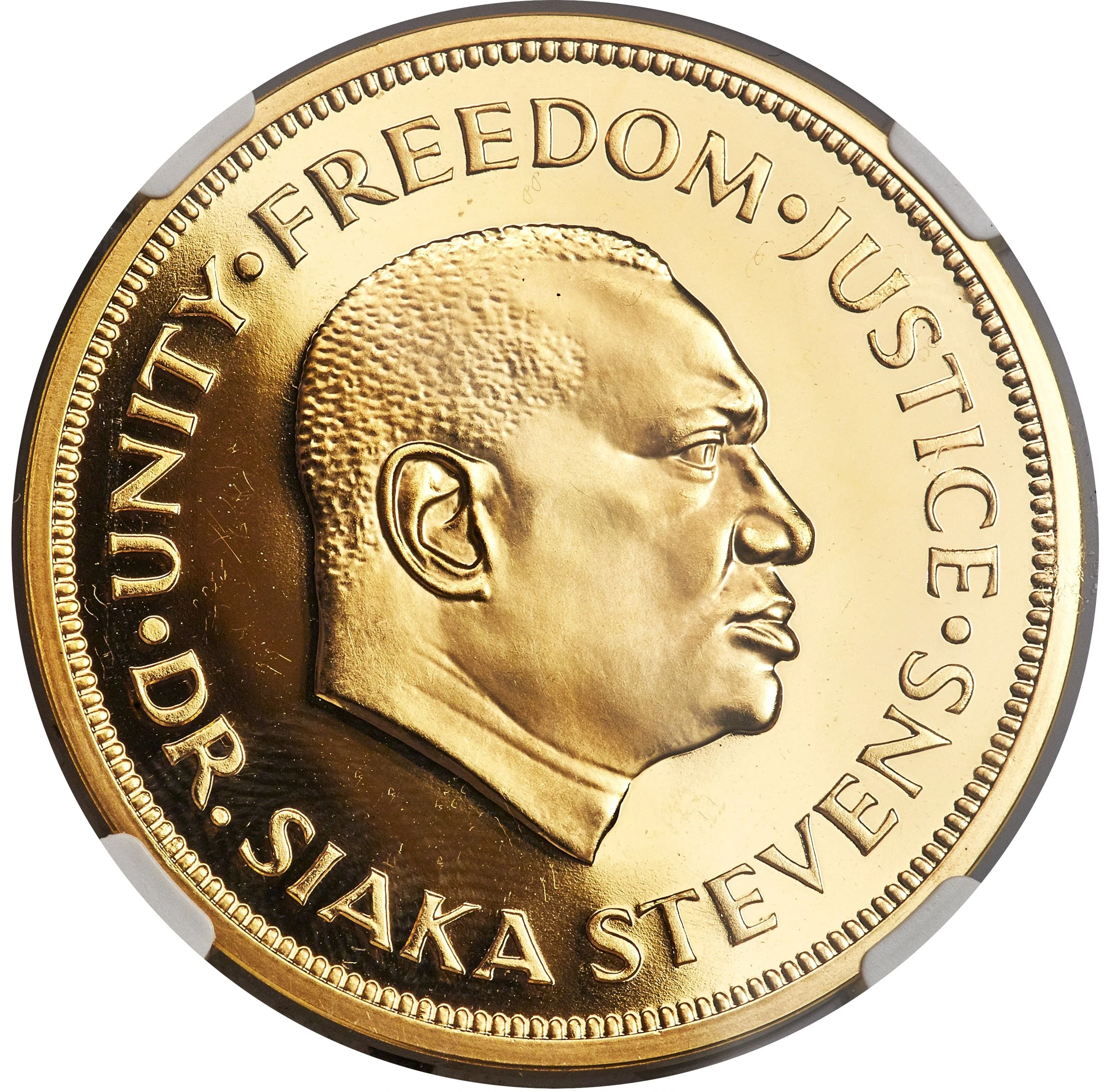
1 Leone (Bank of Sierra Leone) – Sierra Leone
Non-circulating coins
Commemoration: 10th Anniversary of the Bank of Sierra Leone
Sierra Leone
Context
Year: 1974
Issuer: Sierra Leone 
Ruler: Siaka Stevens
Currency:
(1964—2023)
Demonetization: 1 January 2024
Total mintage: 104
Material
References
KM: #Click to copy to clipboard26b
Numista: #325366
Value
Exchange value: 1 SLL
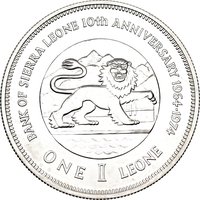
Obverse
Reverse
Description:
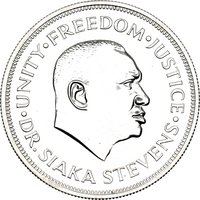
Dr. Siaka Stevens portrait
Inscription:
· UNITY · FREEDOM · JUSTICE ·
DR. SIAKA STEVENS
DR. SIAKA STEVENS
Script: Latin
Edge
Categories
| Animal> Feline |
| Person> Politician |
Mints
| Name | Mark |
|---|---|
| Royal Mint | — |
Mintings
| Year | Mint Mark | Mintage | Quality | Collection |
|---|---|---|---|---|
| 1974 | — | 100 | ||
| 1974 | — | 4 | Proof |
Historical background
In 1974, Sierra Leone operated under a fixed exchange rate system, with its currency, the Leone (SLL), pegged to the British Pound Sterling. This arrangement was a legacy of the country's colonial history and its membership in the Sterling Area, a monetary system that facilitated trade and financial stability among Commonwealth nations. The peg provided a degree of predictability for international transactions, which was crucial for an economy heavily dependent on the export of primary commodities, particularly diamonds and iron ore.
However, this stability was increasingly superficial. The early 1970s brought significant economic pressures, including the 1973 oil price shock, which inflated import costs and widened Sierra Leone's trade deficit. Concurrently, a global recession dampened demand for its exports, straining foreign exchange reserves. Domestically, fiscal discipline was weakening under President Siaka Stevens' government, with public spending often exceeding revenue. This combination of external shocks and internal imbalances created underlying pressure on the Leone's fixed parity, suggesting the currency was becoming overvalued.
Consequently, 1974 represented a calm before a storm in Sierra Leone's monetary history. While the Leone's official peg to the Pound Sterling remained intact that year, the fundamental economic weaknesses were accumulating. These pressures would ultimately force a major devaluation later in the decade, beginning a long-term trend of depreciation. Thus, the currency situation in 1974 was characterized by an outwardly stable but increasingly unsustainable fixed exchange rate, masking the severe structural challenges that would soon necessitate profound monetary adjustment.
However, this stability was increasingly superficial. The early 1970s brought significant economic pressures, including the 1973 oil price shock, which inflated import costs and widened Sierra Leone's trade deficit. Concurrently, a global recession dampened demand for its exports, straining foreign exchange reserves. Domestically, fiscal discipline was weakening under President Siaka Stevens' government, with public spending often exceeding revenue. This combination of external shocks and internal imbalances created underlying pressure on the Leone's fixed parity, suggesting the currency was becoming overvalued.
Consequently, 1974 represented a calm before a storm in Sierra Leone's monetary history. While the Leone's official peg to the Pound Sterling remained intact that year, the fundamental economic weaknesses were accumulating. These pressures would ultimately force a major devaluation later in the decade, beginning a long-term trend of depreciation. Thus, the currency situation in 1974 was characterized by an outwardly stable but increasingly unsustainable fixed exchange rate, masking the severe structural challenges that would soon necessitate profound monetary adjustment.
✨ Legendary