

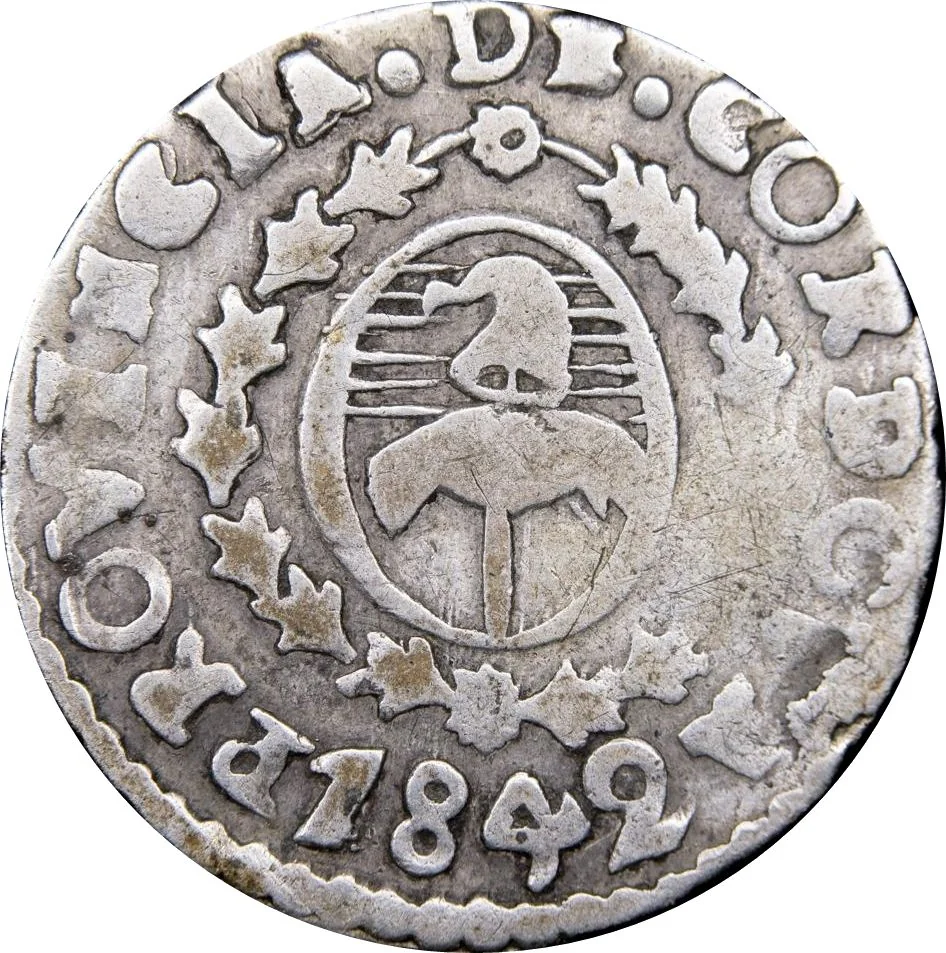
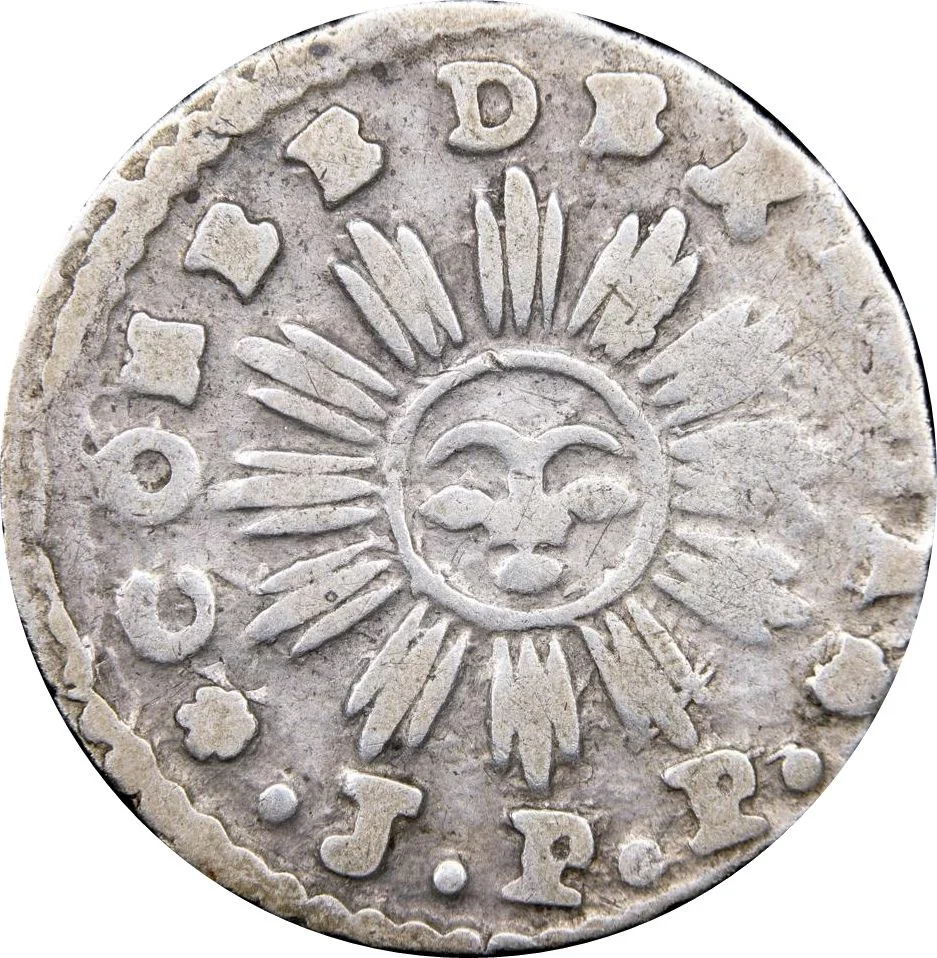

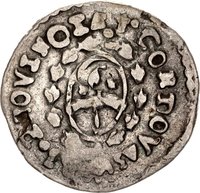
Obverse
Description:
Azure, a Phrygian cap flying to the left.
Inscription:
PROVINCIA DE CORDOVA
Script: Latin
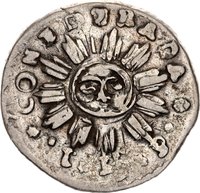
Reverse
Edge
Reeded
Legend:
// o//o//o//o//
Categories
| Symbol> Hand |
| Symbols> Coat of Arms |
| Symbol> Wreath |
| Symbol> Phrygian cap |
| Symbol> Sun |
Mintings
| Year | Mint Mark | Mintage | Quality | Collection |
|---|---|---|---|---|
| 1842 | JPP | — |
Historical background
In 1842, the province of Córdoba, Argentina, was entangled in the profound monetary chaos that characterized the post-independence Río de la Plata region. The collapse of central authority and the rise of autonomous provincial governments led each to issue its own paper currency to finance chronic deficits, primarily from inter-provincial wars. Córdoba, under Governor Manuel López, was no exception, circulating its own billetes or papel moneda, which were essentially debt obligations of the provincial treasury with forced circulation.
The currency situation was defined by severe depreciation and lack of confidence. Córdoba's notes were not backed by specie (gold or silver) and their value plummeted as the government, facing relentless fiscal pressure, continuously increased the money supply. This resulted in rampant inflation, a wide gap between the face value of the paper currency and its real value in metal, and a complex, ever-changing web of exchange rates between the currencies of Córdoba, Buenos Aires, and other provinces. Commerce was severely hampered, with merchants and the public deeply distrustful of the rapidly depreciating paper.
Ultimately, this monetary fragmentation was a direct symptom of the broader political and economic disintegration of the Argentine Confederation. The lack of a unified national currency and a stable fiscal system crippled inter-provincial trade and economic development. Córdoba's currency woes of 1842 were thus a local manifestation of a national crisis, reflecting the struggle to build stable institutions in the decades following independence from Spain.
The currency situation was defined by severe depreciation and lack of confidence. Córdoba's notes were not backed by specie (gold or silver) and their value plummeted as the government, facing relentless fiscal pressure, continuously increased the money supply. This resulted in rampant inflation, a wide gap between the face value of the paper currency and its real value in metal, and a complex, ever-changing web of exchange rates between the currencies of Córdoba, Buenos Aires, and other provinces. Commerce was severely hampered, with merchants and the public deeply distrustful of the rapidly depreciating paper.
Ultimately, this monetary fragmentation was a direct symptom of the broader political and economic disintegration of the Argentine Confederation. The lack of a unified national currency and a stable fiscal system crippled inter-provincial trade and economic development. Córdoba's currency woes of 1842 were thus a local manifestation of a national crisis, reflecting the struggle to build stable institutions in the decades following independence from Spain.

💎 Very Rare