

500 Lire – San Marino
Non-circulating coins
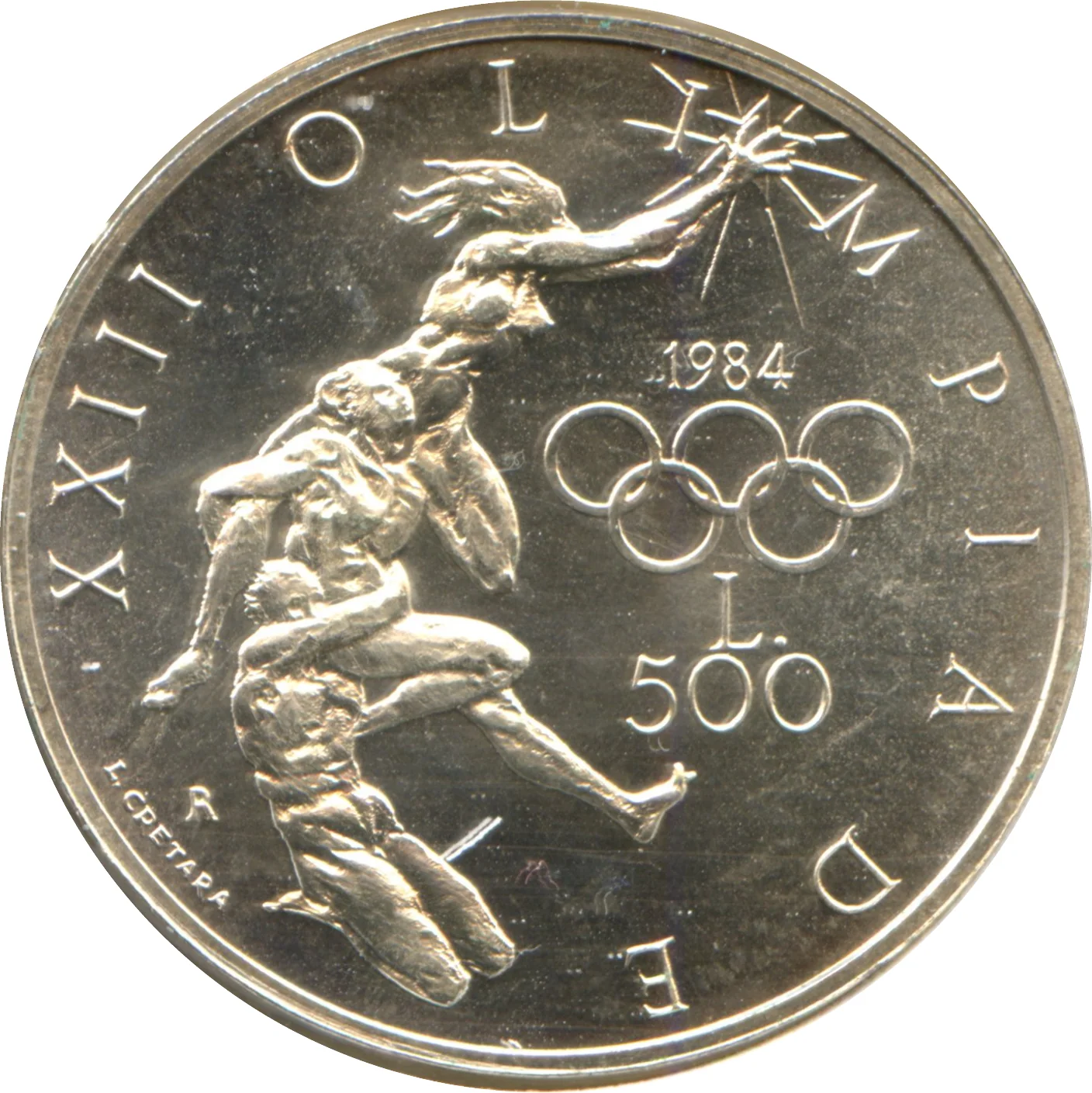
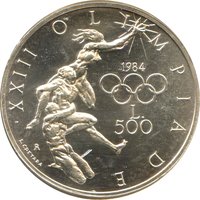
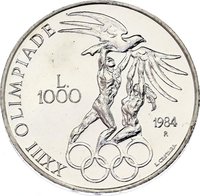
Commemoration: Summer Olympics, 1984
San Marino
Context
Year: 1984
Issuer: San Marino 
Period:
(since 301)
Currency:
(1864—2001)
Demonetized: Yes
Total mintage: 67,000
Material
References
KM: #Click to copy to clipboard168
Numista: #13719
Value
Exchange value: 500 SML
Bullion value: $26.48
Obverse
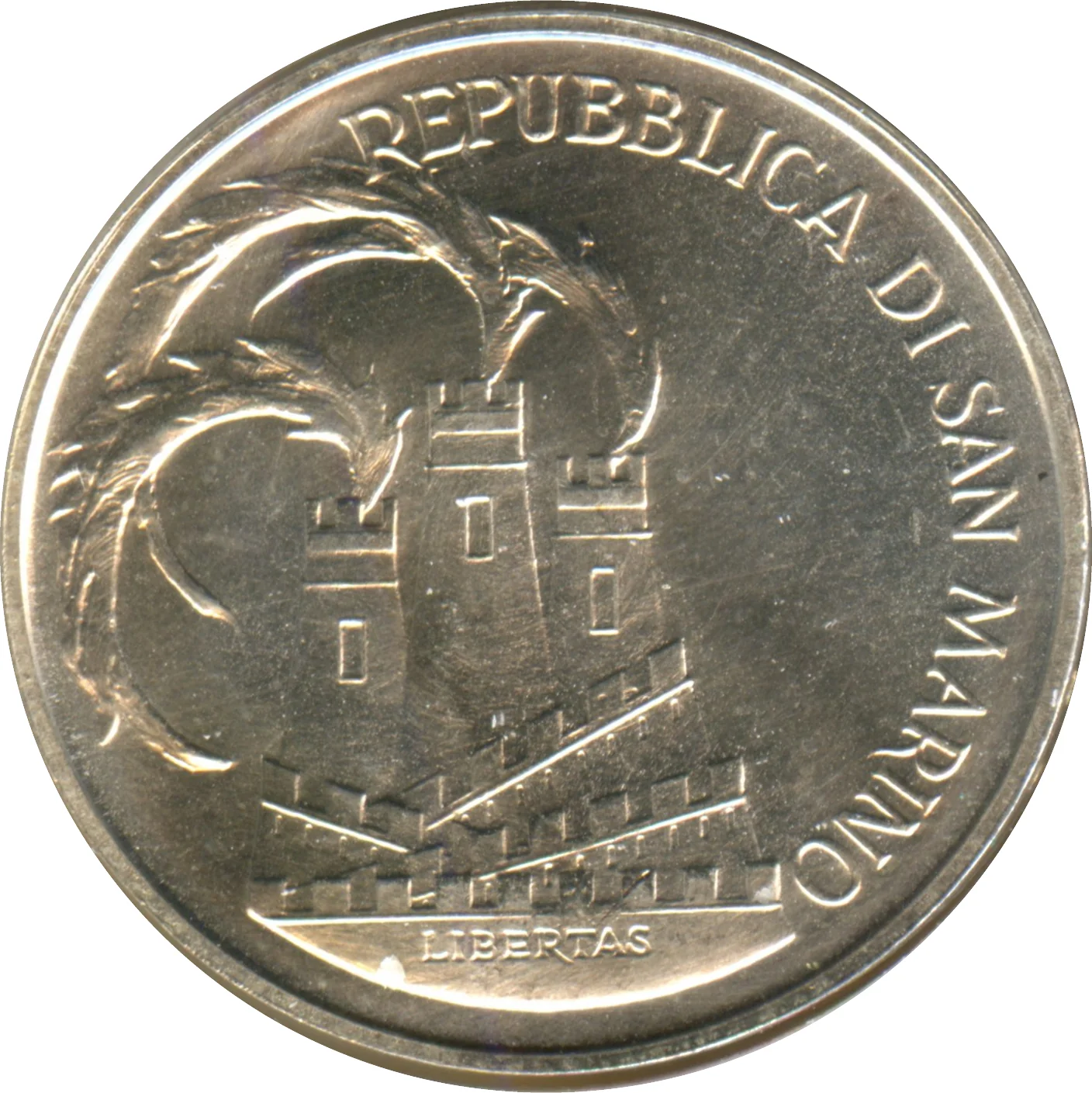
Description:
Smokestacks in silhouette.
Inscription:
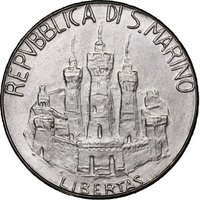
REPUBBLICA DI SAN MARINO
Translation:
Republic of San Marino
Script: Latin
Language: Italian
Engraver: Laura Cretara
Reverse
Edge
Categories
| Sport> Summer Olympic Games |
Mints
| Name | Mark |
|---|---|
| Rome | R |
Historical background
In 1984, San Marino's currency situation was defined by its unique and dependent relationship with Italy, formalized by a series of bilateral conventions. The Republic did not issue an independent, freely floating currency. Instead, its legal tender was the Italian lira, and the Sammarinese government minted its own limited series of coins (in lire denominations) under a strict quota agreement with Italy. These coins, featuring Sammarinese symbols, were legal tender within San Marino and, crucially, also in Italy due to the monetary agreement, effectively making them a commemorative circulation currency within the Italian monetary zone.
This arrangement provided monetary stability but came with significant constraints on economic sovereignty. San Marino had no central bank to conduct independent monetary policy, credit control, or lender-of-last-resort functions. The republic's financial system was entirely integrated with Italy's, meaning its interest rates, money supply, and inflation were directly imported from its much larger neighbor. This dependency was a double-edged sword: it spared San Marino the complexities of managing its own currency but left its economy highly vulnerable to Italy's economic fluctuations and policy decisions.
The context of 1984 was one of particular strain due to Italy's own economic challenges, including high inflation and lira instability. For San Marino, this period highlighted the limitations of the monetary agreement, as it had no tools to mitigate imported inflation or exchange rate pressures. Furthermore, discussions were ongoing regarding the European Monetary System (EMS), into which Italy was integrated, adding a layer of complexity for San Marino's future. Thus, in 1984, San Marino's currency situation was one of stable but complete dependence, operating within a system that guaranteed functionality but offered no autonomy, set against a backdrop of European monetary evolution.
This arrangement provided monetary stability but came with significant constraints on economic sovereignty. San Marino had no central bank to conduct independent monetary policy, credit control, or lender-of-last-resort functions. The republic's financial system was entirely integrated with Italy's, meaning its interest rates, money supply, and inflation were directly imported from its much larger neighbor. This dependency was a double-edged sword: it spared San Marino the complexities of managing its own currency but left its economy highly vulnerable to Italy's economic fluctuations and policy decisions.
The context of 1984 was one of particular strain due to Italy's own economic challenges, including high inflation and lira instability. For San Marino, this period highlighted the limitations of the monetary agreement, as it had no tools to mitigate imported inflation or exchange rate pressures. Furthermore, discussions were ongoing regarding the European Monetary System (EMS), into which Italy was integrated, adding a layer of complexity for San Marino's future. Thus, in 1984, San Marino's currency situation was one of stable but complete dependence, operating within a system that guaranteed functionality but offered no autonomy, set against a backdrop of European monetary evolution.
🌟 Uncommon