

1 rand (Parliament) – South Africa
Add to wishlist
Non-circulating coins
Commemoration: 75th Anniversary of Parliament
South Africa
Context
Material
References
KM: #
Numista: #32288
Value
Exchange value: 1 ZAR
Bullion value: $29.95
Inflation-adjusted value: 19.22 ZAR
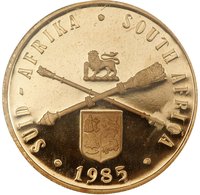
Obverse
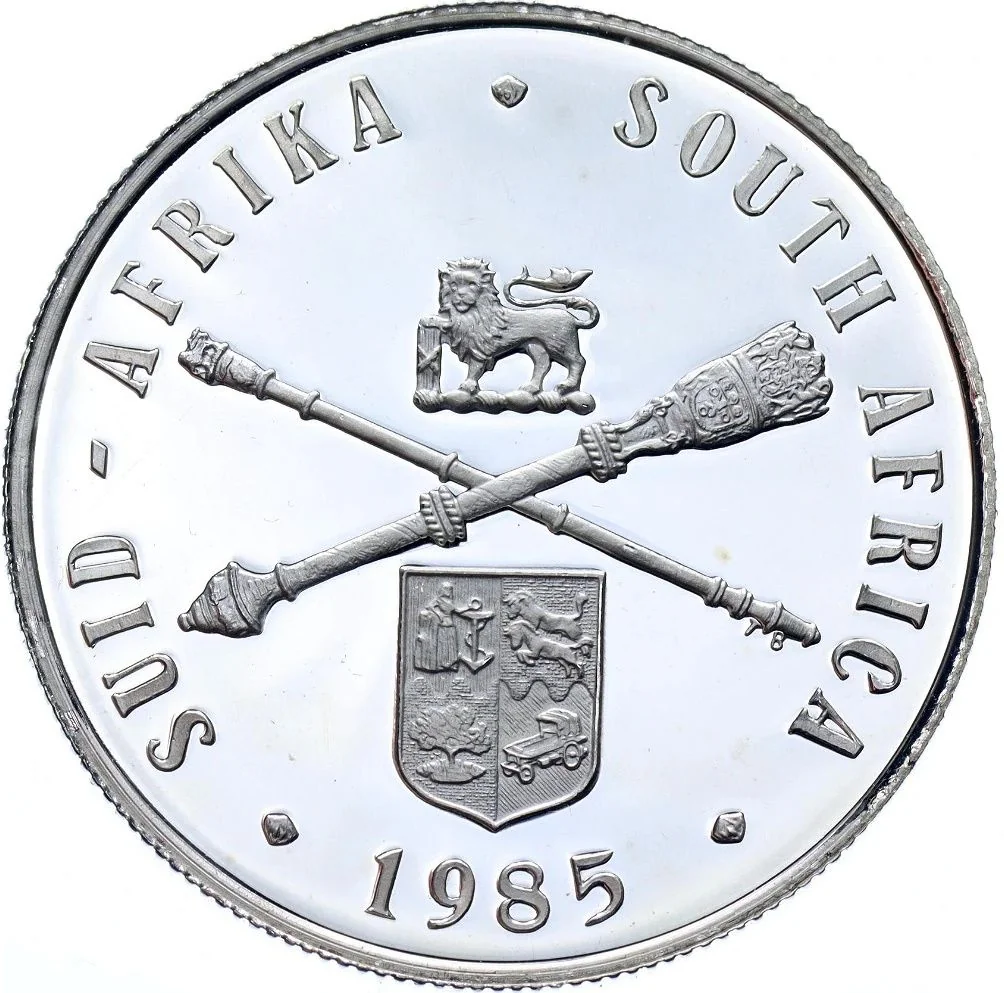
Description:
Scepters cross, dividing shield and lion.
Inscription:
SUID-AFRIKA . SOUTH AFRICA
1985
TB
1985
TB
Script: Latin
Engraver: Timothy Bell
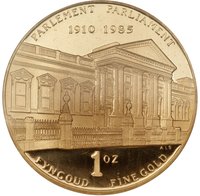
Reverse
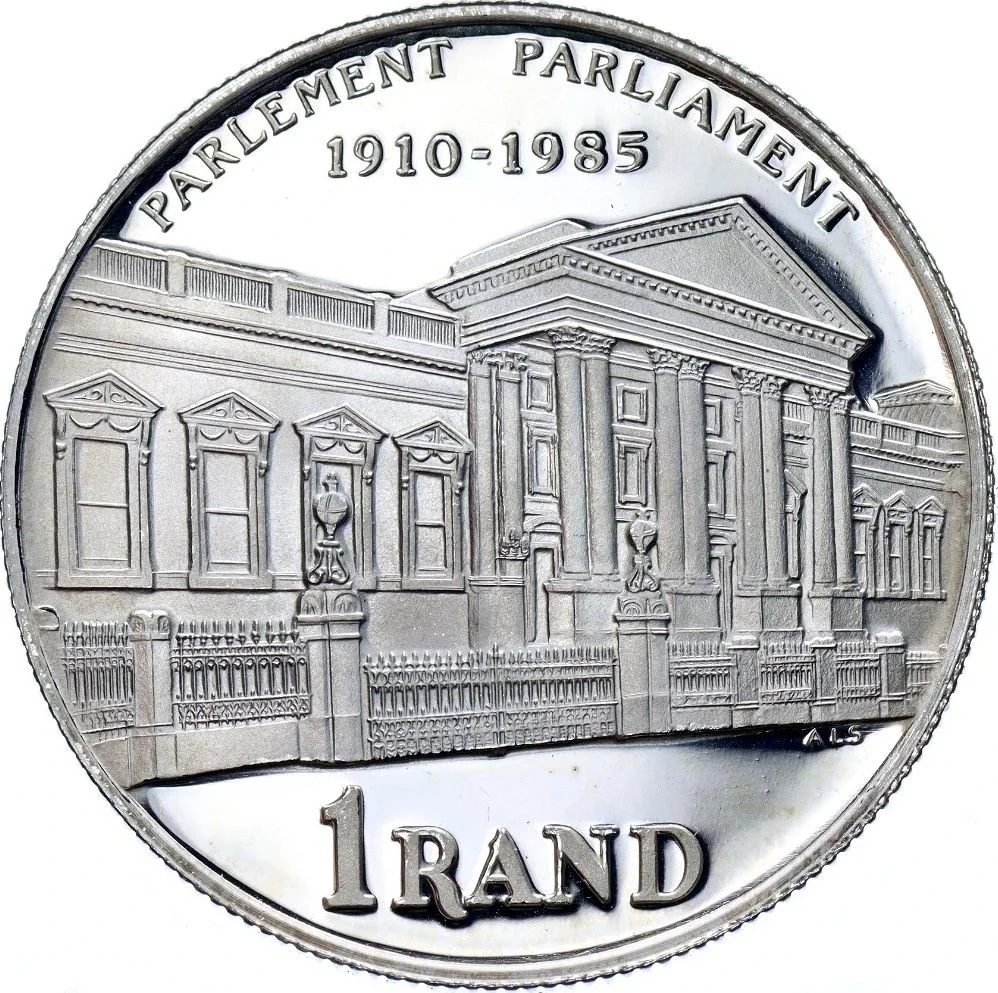
Description:
Parliament House
Inscription:
PARLEMENT PARLIAMENT
1910-1985
1 RAND
ALS
1910-1985
1 RAND
ALS
Script: Latin
Engraver: Arthur Sutherland
Edge
Reeded
Categories
| Symbols> Coat of Arms |
Mints
| Name | Mark |
|---|---|
| Pretoria | — |
Mintings
| Year | Mint Mark | Mintage | Quality | Collection |
|---|---|---|---|---|
| 1985 | — | 34,429 | ||
| 1985 | — | 25,698 | Proof |
Historical background
In 1985, South Africa faced a severe currency crisis that brought its economy to the brink of collapse and starkly exposed the financial cost of apartheid. The crisis was triggered by a perfect storm of internal political unrest and international pressure. Following the escalation of township revolts and the government's declaration of a State of Emergency, foreign banks, led by Chase Manhattan, refused to roll over short-term loans. This "debt standstill" created an immediate liquidity crisis, as South Africa was cut off from crucial international capital markets and faced the impossibility of servicing its approximately $24 billion in foreign debt.
The government's response was drastic. On August 27, 1985, President P.W. Botha delivered his defiant "Rubicon" speech, which instead of announcing expected reforms, further alarmed the international community. The following day, the South African Reserve Bank and government were forced to suspend trading on the Johannesburg Stock Exchange and announced a unilateral moratorium on foreign debt repayments. Crucially, they also instituted a dual-currency system: the commercial rand for domestic use and the financial rand (or "blocked rand") for foreign investment, which traded at a significant discount. This was a desperate measure to control capital flight and stabilize the collapsing value of the currency, which had plummeted by over 35% against the US dollar in the first eight months of the year.
The 1985 currency crisis had profound and lasting consequences. It forced the apartheid government into a series of humiliating negotiations with international creditors, leading to the 1987 "New York Agreement" to reschedule its debt. Economically, the crisis led to years of stagnation, high inflation, and capital controls, isolating the country further. Politically, it demonstrated that financial pressure could achieve what diplomacy alone had not, severely weakening the regime by crippling its economic engine and proving that the sustainability of apartheid was fundamentally incompatible with global financial integration.
The government's response was drastic. On August 27, 1985, President P.W. Botha delivered his defiant "Rubicon" speech, which instead of announcing expected reforms, further alarmed the international community. The following day, the South African Reserve Bank and government were forced to suspend trading on the Johannesburg Stock Exchange and announced a unilateral moratorium on foreign debt repayments. Crucially, they also instituted a dual-currency system: the commercial rand for domestic use and the financial rand (or "blocked rand") for foreign investment, which traded at a significant discount. This was a desperate measure to control capital flight and stabilize the collapsing value of the currency, which had plummeted by over 35% against the US dollar in the first eight months of the year.
The 1985 currency crisis had profound and lasting consequences. It forced the apartheid government into a series of humiliating negotiations with international creditors, leading to the 1987 "New York Agreement" to reschedule its debt. Economically, the crisis led to years of stagnation, high inflation, and capital controls, isolating the country further. Politically, it demonstrated that financial pressure could achieve what diplomacy alone had not, severely weakening the regime by crippling its economic engine and proving that the sustainability of apartheid was fundamentally incompatible with global financial integration.
🌟 Limited