

500 Lire – San Marino
Non-circulating coins
Commemoration: Numismatic Agency opening
San Marino
Context
Year: 1975
Issuer: San Marino 
Period:
(since 301)
Currency:
(1864—2001)
Demonetization: 1 March 2002
Total mintage: 200,000
Material
References
KM: #Click to copy to clipboard48
Numista: #13705
Value
Exchange value: 500 SML
Bullion value: $26.48
Obverse
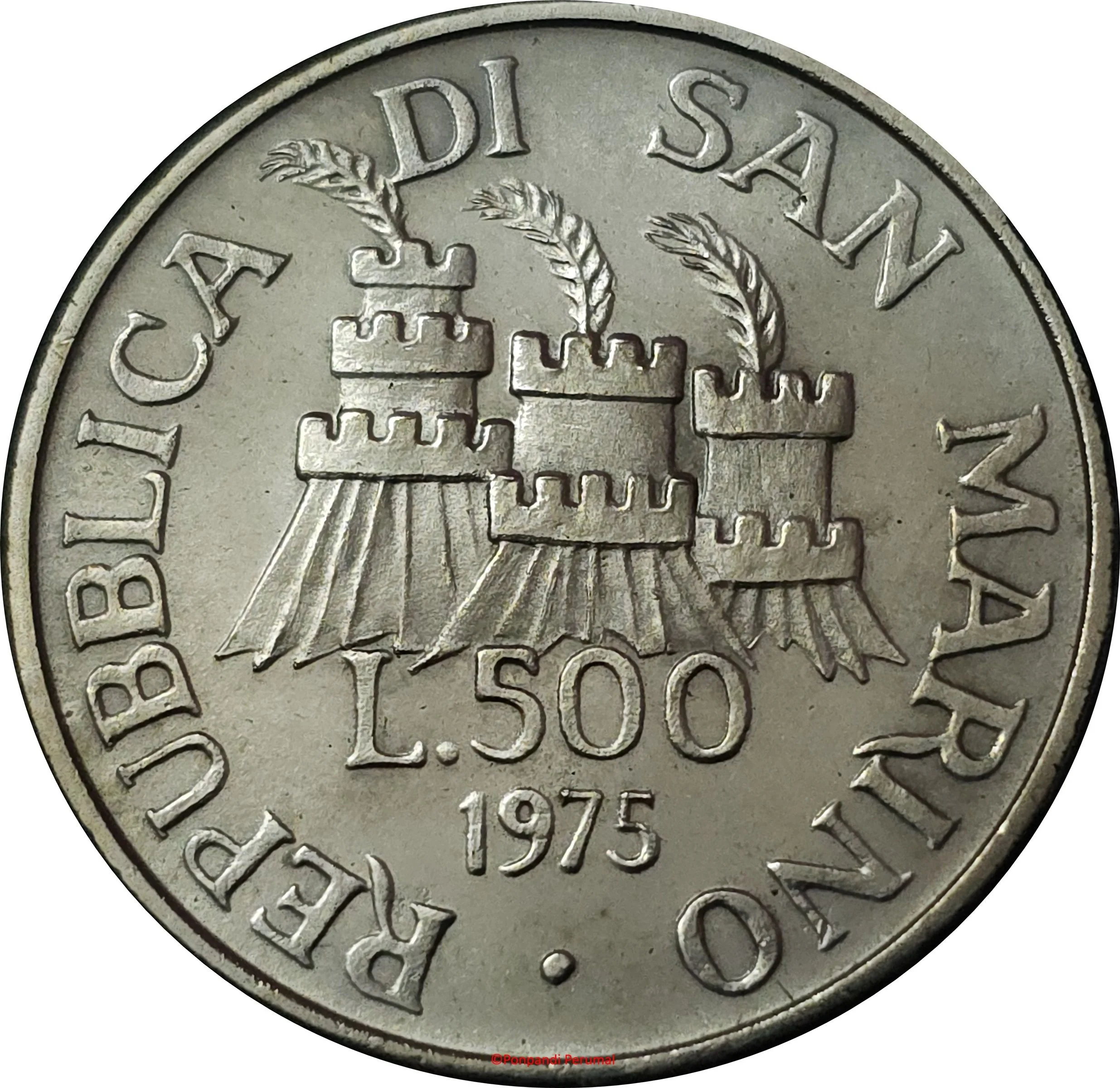
Description:
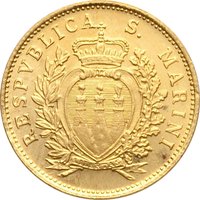
Arms of San Marino.
Value and date below.
Value and date below.
Inscription:
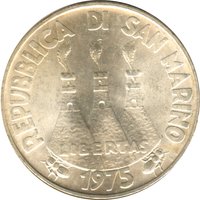
REPUBBLICA DI SAN MARINO
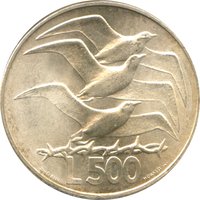
L 500
1975
L 500
1975
Script: Latin
Engravers: Luciano Minguzzi, Guerrino Mattia Monassi
Reverse
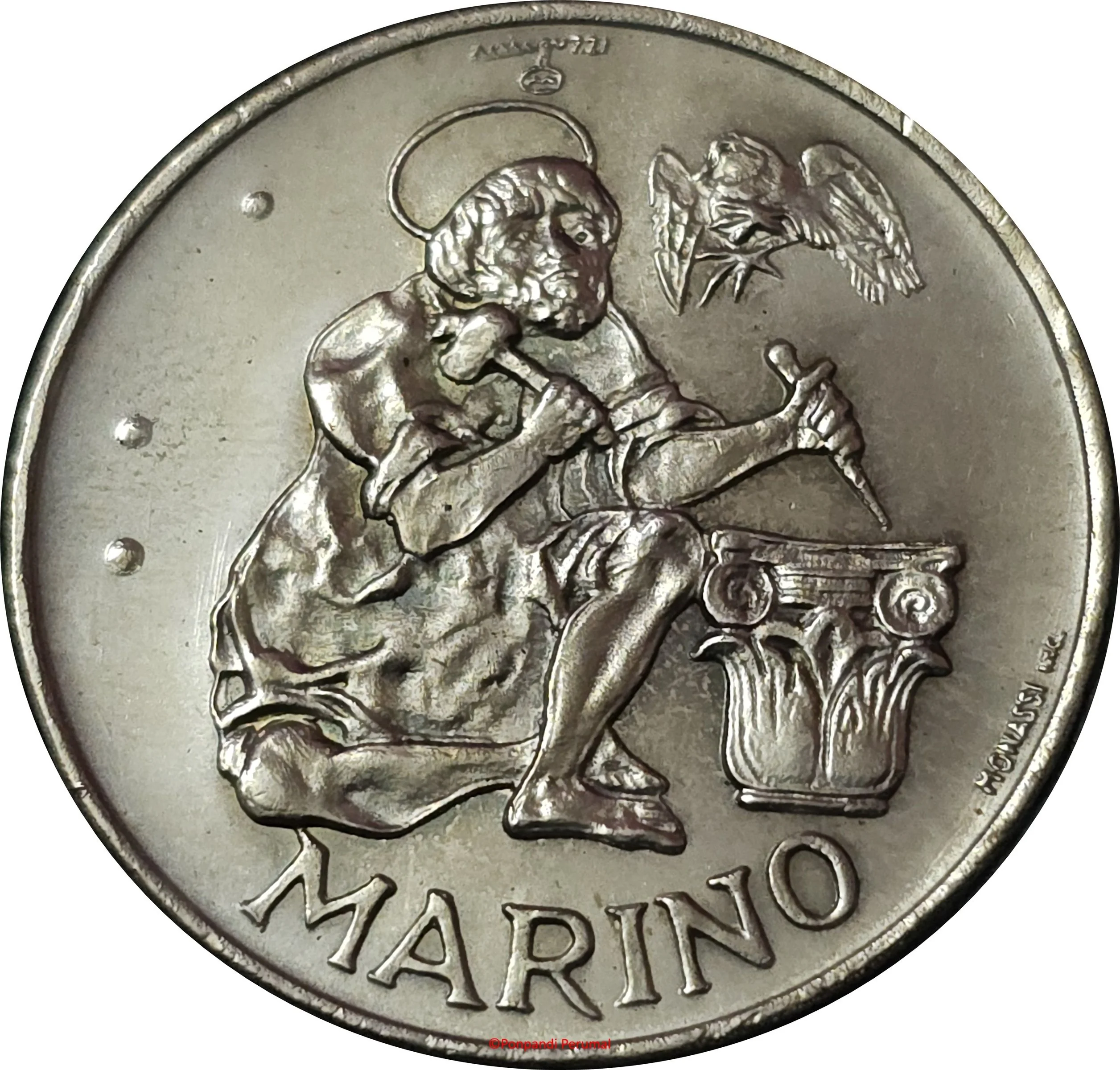
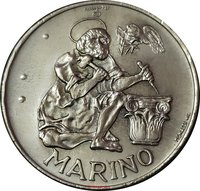
Description:
Saint Marinus carving a capital.
Inscription:
MARINO
MINGUZZI MONASSI INC.
MINGUZZI MONASSI INC.
Script: Latin
Engravers: Luciano Minguzzi, Guerrino Mattia Monassi
Edge
Smooth with inscription in relief
Legend:
RELINQUO VOS LIBEROS
Translation:
I leave you free.
Language: Latin
Mints
| Name | Mark |
|---|---|
| Rome | — |
Mintings
| Year | Mint Mark | Mintage | Quality | Collection |
|---|---|---|---|---|
| 1975 | — | 200,000 |
Historical background
In 1975, San Marino's currency situation was fundamentally defined by its close economic and monetary integration with Italy, governed by a series of bilateral treaties. The most important was the 1939 Convention, which established the Italian Lira as legal tender within the republic and granted San Marino limited rights to mint its own coinage. These Sammarinese coins, denominated in lire, were legally equivalent to Italian coins and circulated interchangeably, but their issuance was strictly controlled by quota agreements with Italy, ensuring they did not disrupt the Italian monetary supply.
Economically, the republic was heavily dependent on Italy, which managed its foreign exchange reserves and effectively set monetary policy. This arrangement provided stability and eliminated exchange rate risk for San Marino's primary trading partner, but it also meant the microstate had no independent monetary tools to manage its own economy. The global economic turmoil of the early 1970s, including the collapse of the Bretton Woods system and the 1973 oil crisis, impacted San Marino indirectly through Italy's economic struggles with inflation and currency instability, highlighting the republic's vulnerability to external financial shocks.
Consequently, 1975 fell within a period where San Marino's monetary system was stable in its day-to-day operation but entirely subordinate to Italian authority. Discussions about greater fiscal and monetary autonomy were nascent but gained little traction, as the practical benefits of the union with the much larger Italian economy outweighed the desire for symbolic independence. The situation would remain largely unchanged until the lead-up to European Monetary Union decades later.
Economically, the republic was heavily dependent on Italy, which managed its foreign exchange reserves and effectively set monetary policy. This arrangement provided stability and eliminated exchange rate risk for San Marino's primary trading partner, but it also meant the microstate had no independent monetary tools to manage its own economy. The global economic turmoil of the early 1970s, including the collapse of the Bretton Woods system and the 1973 oil crisis, impacted San Marino indirectly through Italy's economic struggles with inflation and currency instability, highlighting the republic's vulnerability to external financial shocks.
Consequently, 1975 fell within a period where San Marino's monetary system was stable in its day-to-day operation but entirely subordinate to Italian authority. Discussions about greater fiscal and monetary autonomy were nascent but gained little traction, as the practical benefits of the union with the much larger Italian economy outweighed the desire for symbolic independence. The situation would remain largely unchanged until the lead-up to European Monetary Union decades later.
🌱 Fairly Common