

½ Crown – Southern Rhodesia
Zimbabwe
Context
Years: 1938–1942
Country: Zimbabwe 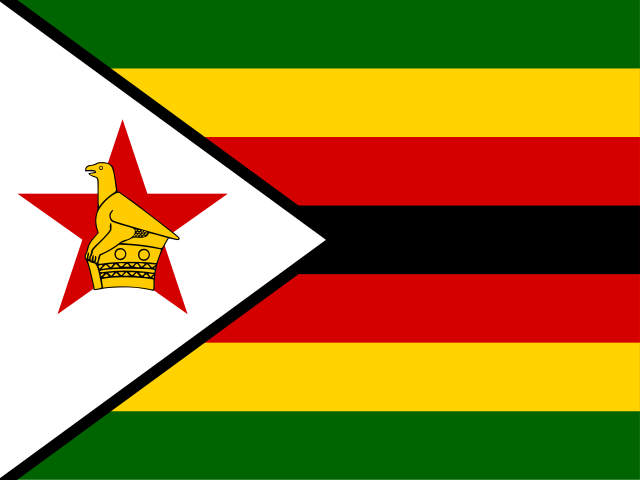
Issuer: Southern Rhodesia
Ruler: George VI
Currency:
(1932—1955)
Demonetization: 1 June 1965
Total mintage: 4,672,000
Material
References
KM: #Click to copy to clipboard15
Numista: #32159
Value
Bullion value: $37.71
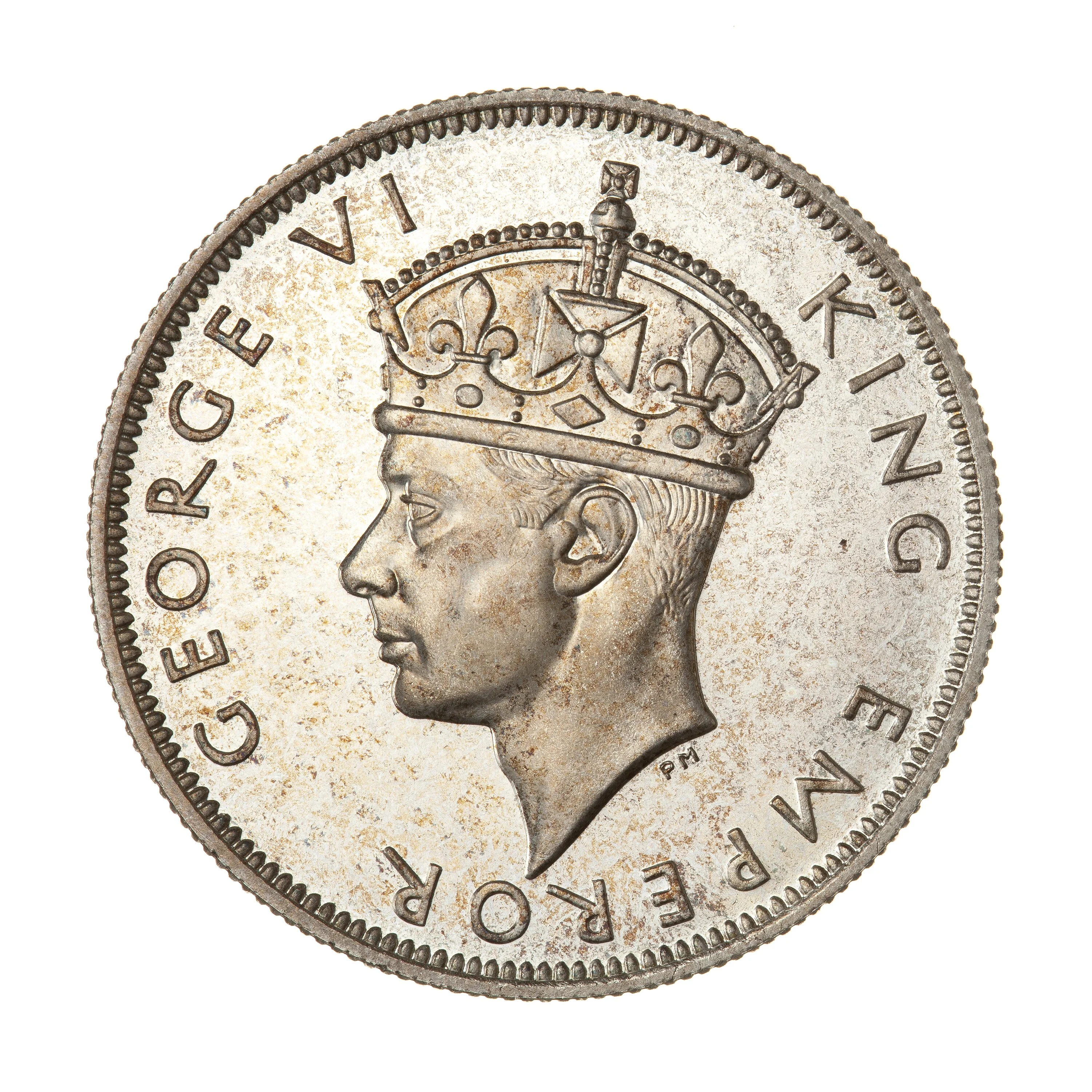
Obverse
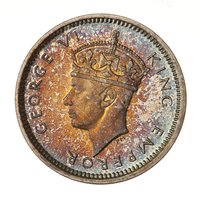
Description:
Portrait of George VI, King of the United Kingdom (1936–1952).
Inscription:
KING EMPEROR GEORGE VI
PM
PM
Translation:
KING EMPEROR GEORGE VI
PM
PM
Script: Latin
Language: English
Engraver: Percy Metcalfe
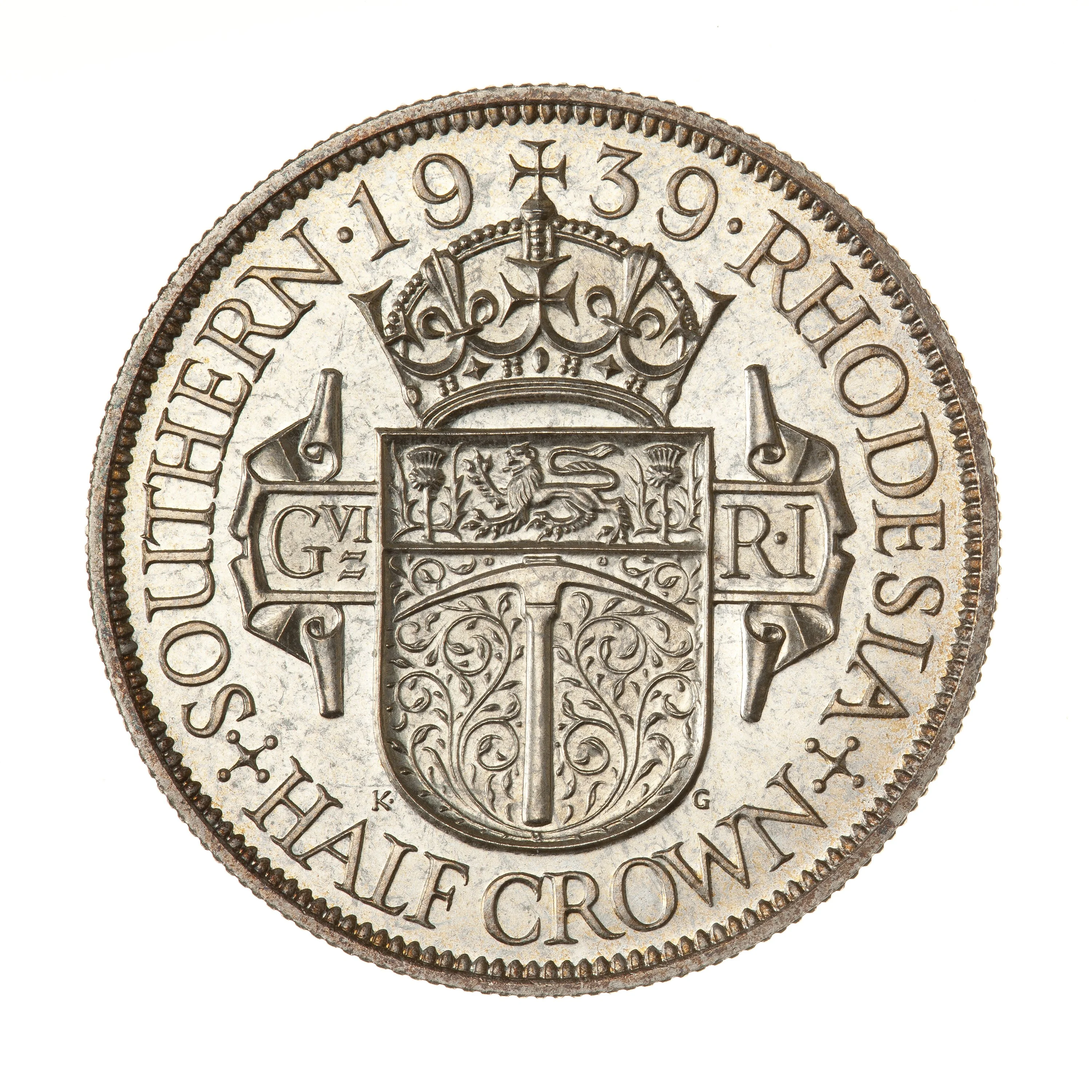
Reverse
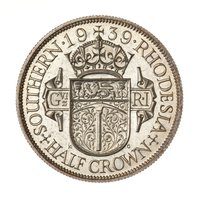
Description:
Crowned shield with pick, name above, value below.
Inscription:
SOUTHERN . 1942 . RHODESIA
GVI R.I
K G
+HALF CROWN+
GVI R.I
K G
+HALF CROWN+
Script: Latin
Engraver: George Kruger Gray
Edge
Reeded
Mints
| Name | Mark |
|---|---|
| Royal Mint (Tower Hill) | — |
Mintings
| Year | Mint Mark | Mintage | Quality | Collection |
|---|---|---|---|---|
| 1938 | — | 400,000 | ||
| 1938 | — | — | Proof | |
| 1939 | — | 224,000 | ||
| 1939 | — | — | Proof | |
| 1940 | — | 800,000 | ||
| 1940 | — | — | Proof | |
| 1941 | — | 1,240,000 | ||
| 1941 | — | — | Proof | |
| 1942 | — | 2,008,000 | ||
| 1942 | — | — | Proof |
Historical background
In 1938, the currency situation in Southern Rhodesia was firmly integrated within the broader sterling area and governed by the Southern Rhodesia Currency Board, established in 1938 to replace the earlier arrangement with the London-based Rhodesia Currency Board. This system operated on a strict "currency board" principle, where the Rhodesian pound (£R) was issued only when fully backed by sterling reserves held in London, ensuring a fixed and automatic parity of one-to-one with the British pound sterling. This provided monetary stability and facilitated seamless trade and capital flows with the United Kingdom, the colony's dominant economic partner.
The economy, heavily dependent on tobacco, gold, and mineral exports, was thus underpinned by a highly orthodox and conservative monetary framework. Local currency in circulation consisted of notes and coins issued by the Currency Board, but its supply was not actively managed to meet domestic economic conditions; instead, it expanded or contracted directly with the colony's balance of payments. A surplus with the outside world brought more sterling into the reserves, allowing more local currency to be issued, while a deficit would contract the money supply.
This system offered credibility and low inflation but provided no scope for independent monetary policy or discretionary response to local economic downturns. As the late 1930s saw growing settler aspirations for greater self-government, the rigid currency board arrangement reflected Southern Rhodesia's dual status: a internally self-governing colony with increasing political autonomy, yet one whose financial system remained fundamentally subordinate to the economic and imperial interests of Great Britain.
The economy, heavily dependent on tobacco, gold, and mineral exports, was thus underpinned by a highly orthodox and conservative monetary framework. Local currency in circulation consisted of notes and coins issued by the Currency Board, but its supply was not actively managed to meet domestic economic conditions; instead, it expanded or contracted directly with the colony's balance of payments. A surplus with the outside world brought more sterling into the reserves, allowing more local currency to be issued, while a deficit would contract the money supply.
This system offered credibility and low inflation but provided no scope for independent monetary policy or discretionary response to local economic downturns. As the late 1930s saw growing settler aspirations for greater self-government, the rigid currency board arrangement reflected Southern Rhodesia's dual status: a internally self-governing colony with increasing political autonomy, yet one whose financial system remained fundamentally subordinate to the economic and imperial interests of Great Britain.
🌟 Uncommon