


Obverse
Description:
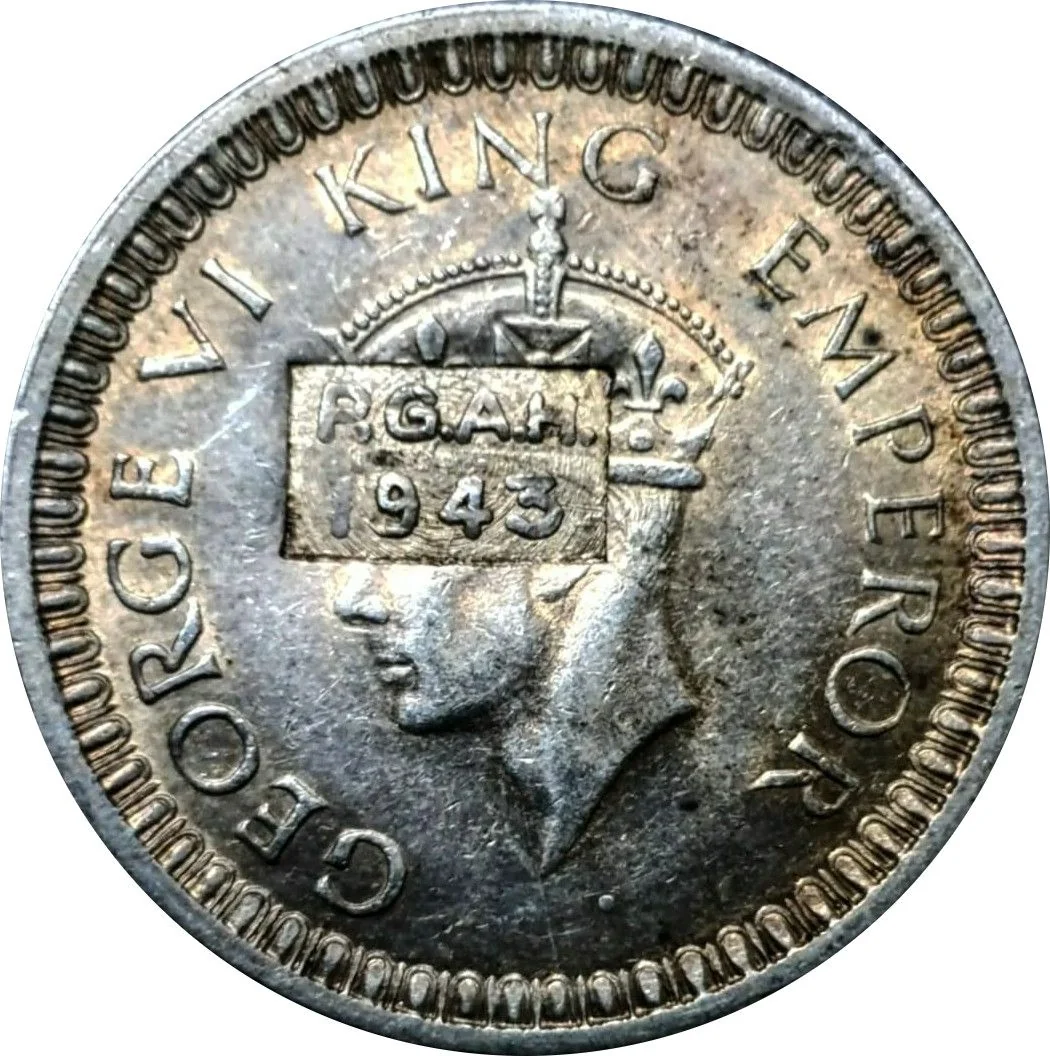
George VI left-facing bust. Small secondary head, large rim decoration, embossed "PGAH 1943."
Inscription:
GEORGE VI KING EMPEROR
Translation:
GEORGE VI KING EMPEROR
Language: English
Engraver: Percy Metcalfe
Reverse
Description:
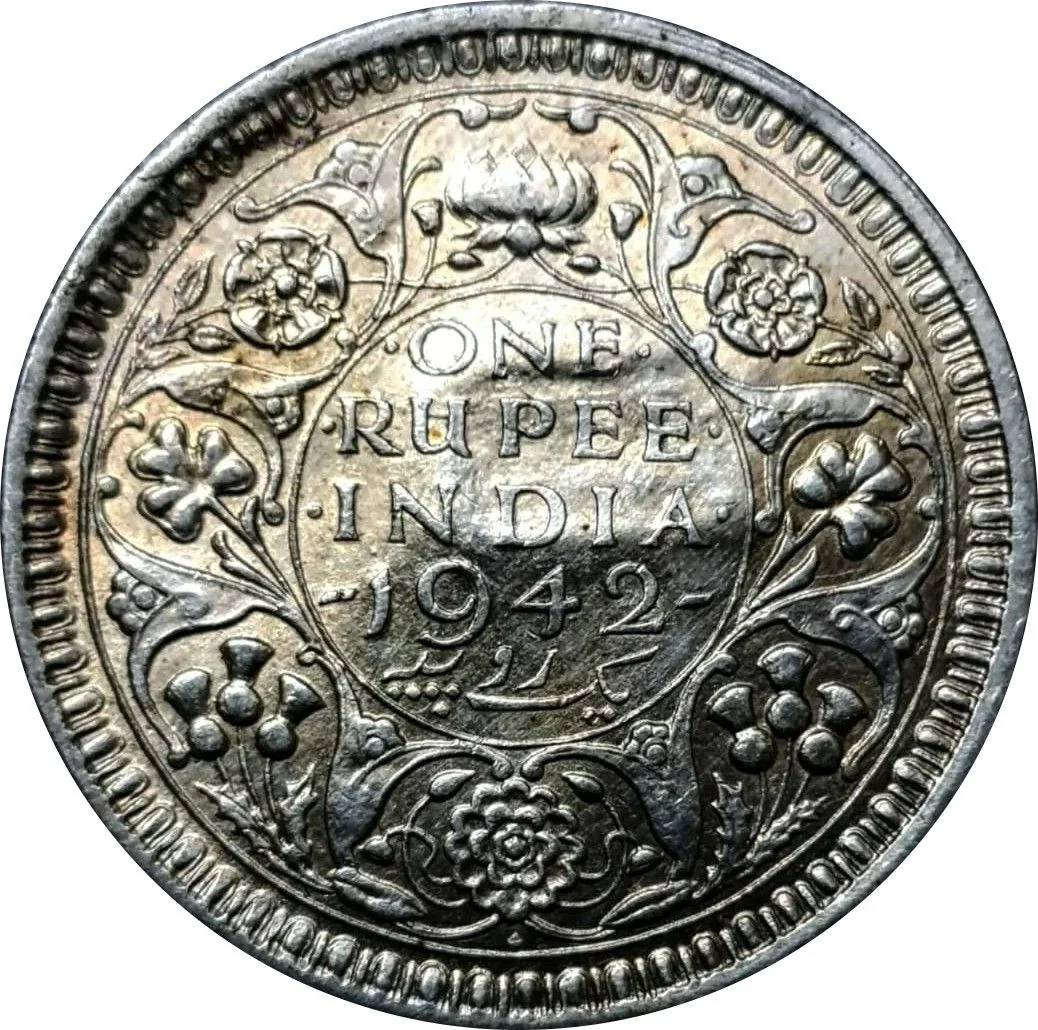
Inside, the date splits the legend in English and Urdu. Outside, a wreath of roses, thistle, shamrock, and lotus. All within a toothed border.
Inscription:
ONE
RUPEE
INDIA
1942
یک روپیہ
RUPEE
INDIA
1942
یک روپیہ
Translation:
ONE RUPEE INDIA 1942
Engraver: Percy Metcalfe
Edge
Security edge
Mints
| Name | Mark |
|---|---|
| Mumbai / Bombay | Dot |
Mintings
| Year | Mint Mark | Mintage | Quality | Collection |
|---|---|---|---|---|
| 1942 | — | — |
Historical background
In 1942, India's currency situation was dominated by the immense financial pressures of World War II. The British Indian government, as part of the Allied war effort, was incurring staggering expenditures on military operations, supply procurement, and support for troops across multiple fronts. This led to massive deficit financing, where the government essentially created new money to cover its costs, as traditional revenue streams like taxes were insufficient. Consequently, the money supply expanded rapidly, planting the seeds for significant inflationary pressures that would strain the domestic economy.
A key feature of the period was the proliferation of low-denomination paper currency, specifically the Indian One Rupee Note. Prior to the war, the one-rupee denomination was a silver coin, but the scarcity and rising cost of the metal forced the government to dematerialize it. Issued directly by the Government of India (rather than the Reserve Bank), these notes bore the portrait of King George VI and became a crucial, if symbolic, component of everyday transactions. Their introduction highlighted the wartime shift from precious metal to fiat money and the state's direct intervention in the monetary system to conserve resources and fund the war.
This inflationary environment was exacerbated by acute supply-side crises. The war disrupted trade and shipping, leading to severe shortages of essential commodities, particularly food grains in regions like Bengal. The combination of increased money chasing scarce goods resulted in rampant price inflation, causing widespread hardship and contributing to the devastating Bengal famine of 1943. Thus, the currency situation of 1942 was not merely a monetary phenomenon but a critical factor in a broader socio-economic catastrophe, directly linking wartime finance to civilian suffering.
A key feature of the period was the proliferation of low-denomination paper currency, specifically the Indian One Rupee Note. Prior to the war, the one-rupee denomination was a silver coin, but the scarcity and rising cost of the metal forced the government to dematerialize it. Issued directly by the Government of India (rather than the Reserve Bank), these notes bore the portrait of King George VI and became a crucial, if symbolic, component of everyday transactions. Their introduction highlighted the wartime shift from precious metal to fiat money and the state's direct intervention in the monetary system to conserve resources and fund the war.
This inflationary environment was exacerbated by acute supply-side crises. The war disrupted trade and shipping, leading to severe shortages of essential commodities, particularly food grains in regions like Bengal. The combination of increased money chasing scarce goods resulted in rampant price inflation, causing widespread hardship and contributing to the devastating Bengal famine of 1943. Thus, the currency situation of 1942 was not merely a monetary phenomenon but a critical factor in a broader socio-economic catastrophe, directly linking wartime finance to civilian suffering.
✨ Legendary