

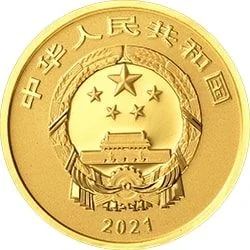
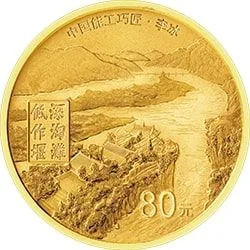
80 yuan – People's Republic of China
Add to wishlist
Non-circulating coins
Commemoration: The Chinese Master Artisan
China
Context
Year: 2021
Country: China
Issuer: People's Republic of China
Period:
(since 1949)
Currency:
(since 1955)
Total mintage: 10,000
Material
References
Numista: #319763
Value
Exchange value: 80 CNY
Bullion value: $767.38
Inflation-adjusted value: 82.28 CNY
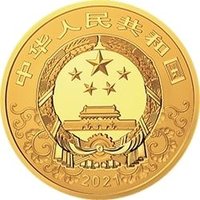
Obverse
Reverse
Edge
Mintings
| Year | Mint Mark | Mintage | Quality | Collection |
|---|---|---|---|---|
| 2021 | — | 10,000 | Proof |
Historical background
In 2021, the People's Republic of China's currency, the renminbi (RMB), experienced a period of significant strength and internationalization efforts against a backdrop of global economic recovery from the COVID-19 pandemic. The RMB appreciated notably against the US dollar, reaching its highest level in over three years. This strength was driven by robust export performance, sustained foreign capital inflows into China's financial markets, and a widening interest rate differential with other major economies. The People's Bank of China (PBOC) generally tolerated this appreciation but implemented measures, such as adjusting the reserve requirement ratio for foreign exchange deposits, to curb excessive one-way bets and maintain broad stability.
The year also marked steady progress in China's long-term strategy to internationalize the RMB, though it remained a gradual process. Key developments included the expansion of the digital yuan (e-CNY) pilot programs, testing its use in domestic retail transactions ahead of the Beijing Winter Olympics. Internationally, the RMB's share in global payments and as a reserve currency continued to grow modestly, supported by its inclusion in the IMF's Special Drawing Rights (SDR) basket. However, capital account controls and geopolitical tensions meant the USD retained its dominant global role, with China carefully managing the pace of financial opening to maintain monetary policy autonomy and financial stability.
Underlying these dynamics was the Chinese government's focus on balancing internal and external priorities. Policymakers navigated between allowing greater market influence on the exchange rate to support consumption and imports, while preventing volatility that could harm export-oriented manufacturers. This "managed float" regime operated within a controlled band, with the PBOC setting daily reference rates. The overall stance in 2021 was one of cautious confidence, using a stronger currency to combat imported inflation from rising global commodity prices, while ensuring it did not undermine economic recovery or trigger destabilizing capital flows.
The year also marked steady progress in China's long-term strategy to internationalize the RMB, though it remained a gradual process. Key developments included the expansion of the digital yuan (e-CNY) pilot programs, testing its use in domestic retail transactions ahead of the Beijing Winter Olympics. Internationally, the RMB's share in global payments and as a reserve currency continued to grow modestly, supported by its inclusion in the IMF's Special Drawing Rights (SDR) basket. However, capital account controls and geopolitical tensions meant the USD retained its dominant global role, with China carefully managing the pace of financial opening to maintain monetary policy autonomy and financial stability.
Underlying these dynamics was the Chinese government's focus on balancing internal and external priorities. Policymakers navigated between allowing greater market influence on the exchange rate to support consumption and imports, while preventing volatility that could harm export-oriented manufacturers. This "managed float" regime operated within a controlled band, with the PBOC setting daily reference rates. The overall stance in 2021 was one of cautious confidence, using a stronger currency to combat imported inflation from rising global commodity prices, while ensuring it did not undermine economic recovery or trigger destabilizing capital flows.

✨ Legendary