

20 cash – Sinkiang Province
Add to wishlist
China
Context
Material
References
Y: #
Numista: #31918
Obverse
Description:
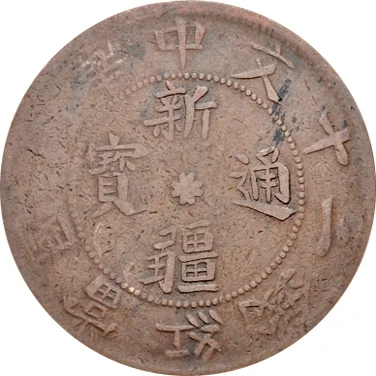
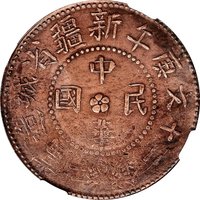
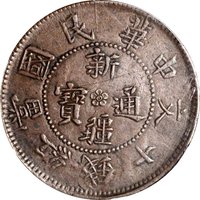
Four Chinese characters read vertically, centered around a flower, surrounded by more characters.
Inscription:
國民華中文十二錢紅當
新
寶通
疆
新
寶通
疆
Translation:
Twelve Red Cash from the Chinese People's Republic of Xinjiang, Currency Treasure.
Language: Chinese
Reverse
Description:
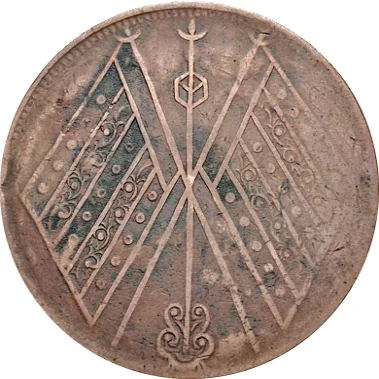
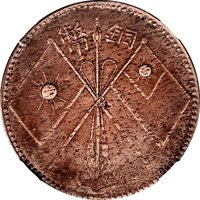
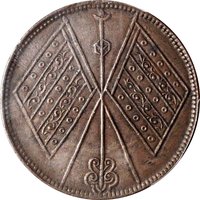
Crossed flags, central line, cube above, arabesque below.
Edge
Mintings
| Year | Mint Mark | Mintage | Quality | Collection |
|---|---|---|---|---|
| 1931 | — | — |
Historical background
In 1931, Sinkiang (Xinjiang) Province existed in a state of fractured political and monetary chaos under the nominal rule of Governor Jin Shuren. The province was effectively an independent warlord domain, geographically isolated from the central financial systems of both the Republic of China and the Soviet Union. This isolation, combined with Jin Shuren's corrupt and exploitative governance, led to a severe fiscal crisis. To fund his military and extravagant projects, Jin resorted to debasing the provincial currency, primarily the Xinjiang Provincial Bank Notes, printing excessive amounts without sufficient silver reserves, which triggered rampant inflation and a collapse in public confidence.
The currency situation was further complicated by the circulation of multiple forms of money. Alongside the devalued provincial paper notes, older silver taels and silver yuan coins (both Chinese and foreign) remained in use as stores of value, hoarded by the public. More significantly, substantial amounts of Soviet ruble notes and gold chervonets coins circulated, especially in northern Sinkiang, due to strong cross-border trade. This created a multi-currency environment where the unstable provincial notes traded at a steep discount to silver and Soviet currency, disrupting commerce and effectively ceding monetary sovereignty in key regions to Soviet influence.
This financial turmoil directly contributed to the widespread unrest that erupted in 1931. The economic hardship inflicted by hyperinflation, combined with heavy taxation and ethnic tensions, fueled revolts against Jin Shuren's regime. The Hami Rebellion, which began that year, was partly motivated by these economic grievances and marked the start of a decade of brutal warfare and warlord succession in Sinkiang. Thus, the currency crisis of 1931 was not merely a financial issue but a key catalyst for the political and military collapse that would soon engulf the province.
The currency situation was further complicated by the circulation of multiple forms of money. Alongside the devalued provincial paper notes, older silver taels and silver yuan coins (both Chinese and foreign) remained in use as stores of value, hoarded by the public. More significantly, substantial amounts of Soviet ruble notes and gold chervonets coins circulated, especially in northern Sinkiang, due to strong cross-border trade. This created a multi-currency environment where the unstable provincial notes traded at a steep discount to silver and Soviet currency, disrupting commerce and effectively ceding monetary sovereignty in key regions to Soviet influence.
This financial turmoil directly contributed to the widespread unrest that erupted in 1931. The economic hardship inflicted by hyperinflation, combined with heavy taxation and ethnic tensions, fueled revolts against Jin Shuren's regime. The Hami Rebellion, which began that year, was partly motivated by these economic grievances and marked the start of a decade of brutal warfare and warlord succession in Sinkiang. Thus, the currency crisis of 1931 was not merely a financial issue but a key catalyst for the political and military collapse that would soon engulf the province.
💎 Extremely Rare