

500 zlotys – Poland
Add to wishlist
Poland
Context
Material
Weight: 31.1 g
Gold Weight:: 31.10 g
Shape: Rectangular
Composition: 99.99% Gold
Standard: Silver ounce
Magnetic: No
Technique: Milled
Alignment: Medal alignment
flip
References
Y: #
Numista: #318305
Value
Exchange value: 500 PLN
Bullion value: $4841.37
Inflation-adjusted value: 713.12 PLN
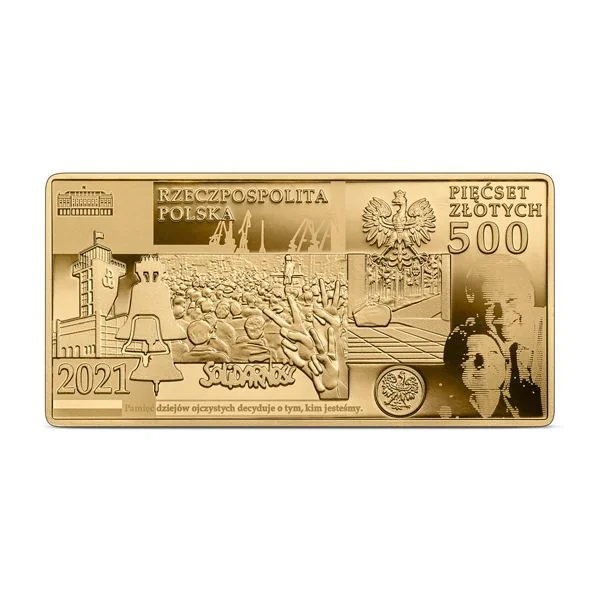
Obverse
Inscription:
RZECZPOLITA
POLSKA
PIĘĆSET
ZŁOTYCH
500
mw
2021
SOLIDARNOŚĆ
POLSKA
PIĘĆSET
ZŁOTYCH
500
mw
2021
SOLIDARNOŚĆ
Translation:
REPUBLIC
OF POLAND
FIVE HUNDRED
ZŁOTYCH
500
mw
2021
SOLIDARITY
OF POLAND
FIVE HUNDRED
ZŁOTYCH
500
mw
2021
SOLIDARITY
Script: Latin
Language: Polish
Designer: Robert Kotowicz
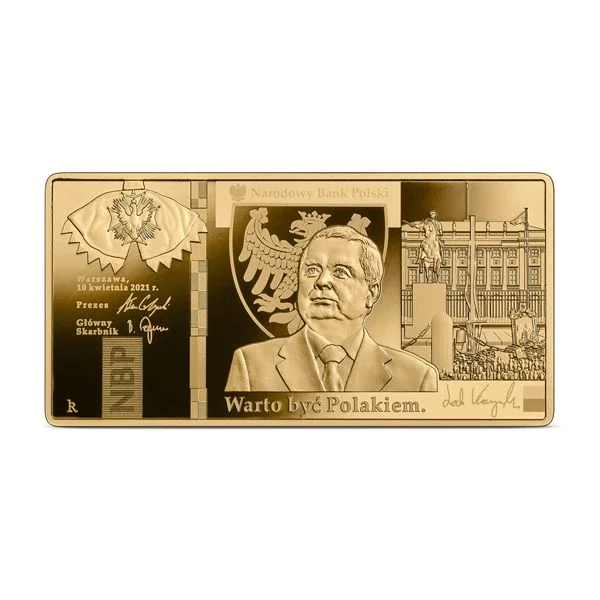
Reverse
Inscription:
Narodowy Bank Polski
Warszawa,
10 kwietnia 2021 r.
Prezes
Główny
Skarbnik
kR
NBP
Warto być Polakiem
Warszawa,
10 kwietnia 2021 r.
Prezes
Główny
Skarbnik
kR
NBP
Warto być Polakiem
Translation:
National Bank of Poland
Warsaw,
10 April 2021
Chairman
Chief
Treasurer
kR
NBP
It is worth being a Pole.
Warsaw,
10 April 2021
Chairman
Chief
Treasurer
kR
NBP
It is worth being a Pole.
Script: Latin
Language: Polish
Designer: Robert Kotowicz
Edge
Plain
Mints
| Name | Mark |
|---|---|
| Mint of Poland | (mw) |
Mintings
| Year | Mint Mark | Mintage | Quality | Collection |
|---|---|---|---|---|
| 2021 | mw | 1,500 | Proof |
Historical background
In 2021, Poland's currency, the złoty (PLN), navigated a year of significant volatility and strengthening pressure, largely influenced by the country's economic resilience and shifting monetary policy. The year began with the złoty trading at approximately 3.8 to the euro, but it embarked on a sustained appreciation trend, reaching a decade-high of around 4.45 PLN/EUR by November. This strength was primarily driven by Poland's robust post-pandemic economic recovery, with GDP growth forecasts repeatedly revised upwards, and by the National Bank of Poland (NBP) becoming the first central bank in the European Union to raise interest rates in October to combat surging inflation, which had soared well above the NBP's target band.
The currency's appreciation was a double-edged sword for the economy. On one hand, a stronger złoty helped to curb imported inflation by making foreign goods, like energy and raw materials, cheaper in local currency terms. On the other hand, it posed a challenge for the crucial export sector, making Polish goods more expensive on international markets and potentially eroding competitiveness. This created a complex policy dilemma for the NBP, which had to balance fighting domestic inflation—fueled by supply chain disruptions, rising energy costs, and strong consumer demand—with concerns about slowing export-led growth.
External factors also played a key role throughout the year. The złoty was sensitive to global risk sentiment and the broader strength of the US dollar. Furthermore, a major point of tension was the ongoing rule-of-law dispute with the European Commission, which blocked Poland's access to billions in EU recovery funds. This political risk acted as a dampener on the currency's gains, creating uncertainty for investors. By year's end, the złoty remained strong but susceptible to shifts in both domestic monetary policy, as the NBP signaled a continued tightening cycle, and the resolution of the EU fund stalemate.
The currency's appreciation was a double-edged sword for the economy. On one hand, a stronger złoty helped to curb imported inflation by making foreign goods, like energy and raw materials, cheaper in local currency terms. On the other hand, it posed a challenge for the crucial export sector, making Polish goods more expensive on international markets and potentially eroding competitiveness. This created a complex policy dilemma for the NBP, which had to balance fighting domestic inflation—fueled by supply chain disruptions, rising energy costs, and strong consumer demand—with concerns about slowing export-led growth.
External factors also played a key role throughout the year. The złoty was sensitive to global risk sentiment and the broader strength of the US dollar. Furthermore, a major point of tension was the ongoing rule-of-law dispute with the European Commission, which blocked Poland's access to billions in EU recovery funds. This political risk acted as a dampener on the currency's gains, creating uncertainty for investors. By year's end, the złoty remained strong but susceptible to shifts in both domestic monetary policy, as the NBP signaled a continued tightening cycle, and the resolution of the EU fund stalemate.
✨ Legendary