

1 Cash – Taiping Heavenly Kingdom
China
Context
Years: 1858–1864
Country: China 
Issuer: Taiping Heavenly Kingdom
Ruler: Hong Xiuquan
Currency:
(1853—1864)
Demonetized: Yes
Material
Diameter: 23 mm
Weight: 4.2 g
Shape: Round with a square hole
Composition: Brass
Magnetic: No
Technique: Cast
Alignment: Medal alignment

flip
References
Numista: #318078
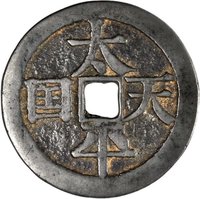
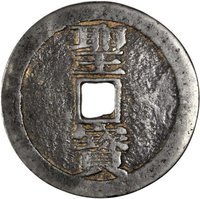
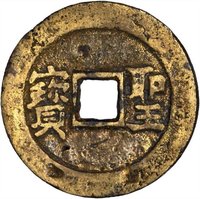
Obverse
Description:
Four Chinese characters read vertically, right to left.
Inscription:
天
寶 聖
國
寶 聖
國
Translation:
Heavenly
Treasure Sacred
State
Treasure Sacred
State
Scripts: Chinese (traditional, regular script)
Language: Classical Chinese
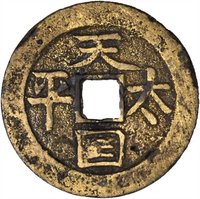
Reverse
Description:
Two Chinese characters read right to left.
Inscription:
平太
Translation:
Heita
Scripts: Chinese (traditional, regular script)
Language: Japanese
Edge
Plain
Mintings
| Year | Mint Mark | Mintage | Quality | Collection |
|---|---|---|---|---|
| — | — | — |
Historical background
By 1858, the currency situation within the Taiping Heavenly Kingdom was one of profound crisis and innovation, reflecting the rebellion's broader struggle for legitimacy and stability. Having established its capital at Nanjing in 1853, the Taiping leadership immediately sought to break from Qing monetary systems by issuing its own coinage. These coins, bearing inscriptions like "Taiping Tianguo" (Heavenly Kingdom of Great Peace) and "Shengsbao" (Holy Treasure), were a direct challenge to Qing authority and a vital tool for administering their controlled territories in central China. However, production was inconsistent, often limited to captured mints, and the coins circulated primarily in core areas around the Yangtze River basin.
The primary challenge was severe hyperinflation, driven by massive military expenditure and a reliance on printing paper currency. The Taiping issued "Tianchao Tianfu" (Heavenly Dynasty Treasury Notes) denominated in silver taels, but these were not backed by specie reserves. As the war drained resources and public confidence waned, these notes depreciated rapidly. By 1858, following years of brutal warfare including the recent internal strife of the Tianjing Incident (1856), the paper money was largely worthless outside of forced transactions. This forced the population and the Taiping's own administration to revert to using older Qing copper cash or silver bullion for everyday trade, undermining the rebel state's economic sovereignty.
Consequently, the currency landscape in 1858 was a fragmented and unstable duality. In Nanjing and key military strongholds, devalued Taiping paper notes and sporadic copper coins circulated under official decree. Yet in much of the countryside and in practical commercial dealings, the older Qing monetary system persisted by necessity. This failure to establish a trusted, unified currency severely hampered the Taiping's ability to pay troops, procure supplies, and build a sustainable economy, becoming a critical weakness as the war entered a prolonged and costly phase against Qing forces now reinforced by regional armies.
The primary challenge was severe hyperinflation, driven by massive military expenditure and a reliance on printing paper currency. The Taiping issued "Tianchao Tianfu" (Heavenly Dynasty Treasury Notes) denominated in silver taels, but these were not backed by specie reserves. As the war drained resources and public confidence waned, these notes depreciated rapidly. By 1858, following years of brutal warfare including the recent internal strife of the Tianjing Incident (1856), the paper money was largely worthless outside of forced transactions. This forced the population and the Taiping's own administration to revert to using older Qing copper cash or silver bullion for everyday trade, undermining the rebel state's economic sovereignty.
Consequently, the currency landscape in 1858 was a fragmented and unstable duality. In Nanjing and key military strongholds, devalued Taiping paper notes and sporadic copper coins circulated under official decree. Yet in much of the countryside and in practical commercial dealings, the older Qing monetary system persisted by necessity. This failure to establish a trusted, unified currency severely hampered the Taiping's ability to pay troops, procure supplies, and build a sustainable economy, becoming a critical weakness as the war entered a prolonged and costly phase against Qing forces now reinforced by regional armies.
✨ Legendary