

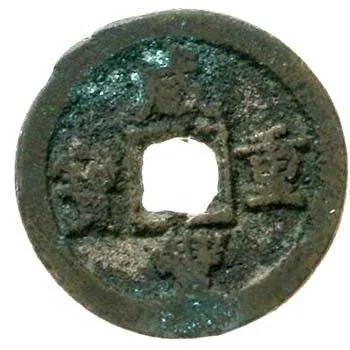
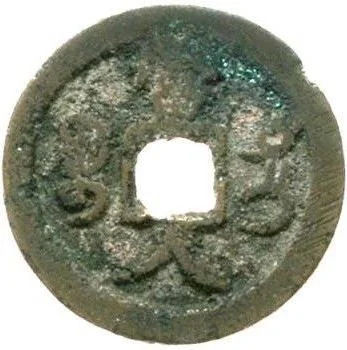
8 Cash – South Xinjiang
China
Context
Year: 1857
Country: China 
Issuer: South Xinjiang
Ruler: Xianfeng
Currency:
(1759—1909)
Demonetized: Yes
Material
Diameter: 28 mm
Weight: 6.85 g
Shape: Round with a square hole
Composition: Copper
Magnetic: No
Technique: Cast
Alignment: Medal alignment
flip
References
Numista: #317950
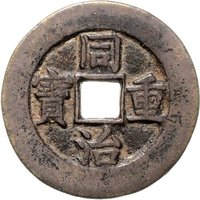
Obverse
Description:
Four Chinese characters read vertically, right to left.
Inscription:
咸
寶 重
豐
寶 重
豐
Translation:
Xianfeng
Treasured Coin
Valuable
Treasured Coin
Valuable
Scripts: Chinese (traditional, regular script)
Language: Chinese
Reverse
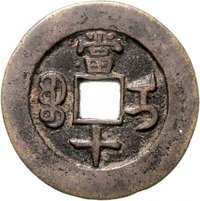
Description:
Chinese ideograms top and bottom, two Manchu words flank the hole vertically.
Inscription:
當
ᠪᠣᠣ ᡩᡳ
八
ᠪᠣᠣ ᡩᡳ
八
Translation:
Great Qing
Eight
Eight
Languages: Classical Chinese, Manchu
Edge
Plain
Mints
| Name | Mark |
|---|---|
| Urumchi Mint | — |
Mintings
| Year | Mint Mark | Mintage | Quality | Collection |
|---|---|---|---|---|
| 1857 | — | — |
Historical background
In 1857, the currency situation in South Xinjiang (the Tarim Basin region) was a direct manifestation of the profound political and social crisis engulfing the Qing Empire. The area was reeling from the devastating effects of the Dungan Revolt (Tongzhi Hui Revolt), which had erupted in Shaanxi and Gansu and spread violently into Xinjiang. This uprising shattered Qing administrative control, severed vital trade routes like the southern Silk Road, and caused widespread economic collapse. With the Qing state apparatus in disarray, its official currency system—centered on Xinjiang red cash coins minted with local characteristics—ceased to function effectively in many areas. The breakdown of authority and commerce led to severe currency shortages, crippling local economies and daily transactions.
In this vacuum, a chaotic and inflationary multi-currency environment emerged. Older Qing coins remained in circulation but their value became unstable. More significantly, hand-stamped pul coins, often crude copper pieces issued by local Muslim rebel leaders or city authorities, flooded the market. These were of wildly inconsistent weight and purity, leading to drastic depreciation and loss of public trust. Concurrently, traditional silver yamboo ingots (sycee), valued by weight, became a preferred but scarce store of value for larger transactions, highlighting a retreat to bullion in times of uncertainty. The co-existence of these devalued and competing currencies created a complex and unreliable monetary landscape, further hindering any residual trade.
Ultimately, the monetary chaos of 1857 was a symptom of the region's descent into warlordism and conflict, which would culminate in the Yakub Beg's invasion and establishment of the Kashgaria state several years later. The inability of the Qing to project power or economic stability allowed local issuances to proliferate, eroding the unified fiscal sovereignty that characterized imperial rule. This period thus represents a critical fracture point where Xinjiang's economy became localized and militarized, a situation only forcibly re-integrated after the Qing reconquest in the late 1870s.
In this vacuum, a chaotic and inflationary multi-currency environment emerged. Older Qing coins remained in circulation but their value became unstable. More significantly, hand-stamped pul coins, often crude copper pieces issued by local Muslim rebel leaders or city authorities, flooded the market. These were of wildly inconsistent weight and purity, leading to drastic depreciation and loss of public trust. Concurrently, traditional silver yamboo ingots (sycee), valued by weight, became a preferred but scarce store of value for larger transactions, highlighting a retreat to bullion in times of uncertainty. The co-existence of these devalued and competing currencies created a complex and unreliable monetary landscape, further hindering any residual trade.
Ultimately, the monetary chaos of 1857 was a symptom of the region's descent into warlordism and conflict, which would culminate in the Yakub Beg's invasion and establishment of the Kashgaria state several years later. The inability of the Qing to project power or economic stability allowed local issuances to proliferate, eroding the unified fiscal sovereignty that characterized imperial rule. This period thus represents a critical fracture point where Xinjiang's economy became localized and militarized, a situation only forcibly re-integrated after the Qing reconquest in the late 1870s.

✨ Legendary