

50 lire – San Marino
Add to wishlist
San Marino
Context
Year: 1990
Issuer: San Marino
Period:
(since 301)
Currency:
(1864—2001)
Demonetization: 1 March 2002
Total mintage: 52,000
Material
Diameter: 16.55 mm
Weight: 2.7 g
Shape: Round
Composition: Stainless steel
Technique: Milled
Alignment: Coin alignment
flip
References
KM: #
Numista: #13663
Value
Exchange value: 50 SML
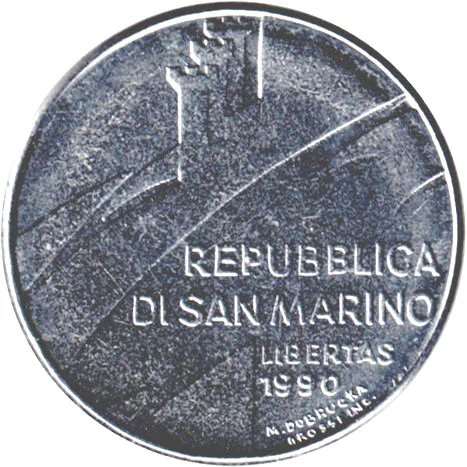
Obverse
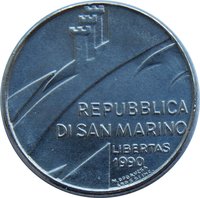
Inscription:
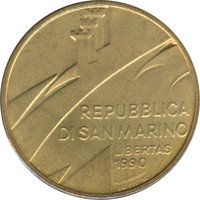
REPUBBLICA DI SAN MARINO
LIBERTAS
1990
M.DOBRUCKA
GROSSI INC.
LIBERTAS
1990
M.DOBRUCKA
GROSSI INC.
Script: Latin
Engravers: Magdalena Dobrucka, Sergio Grossi
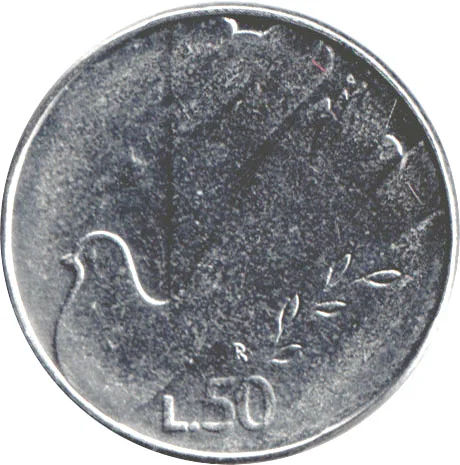
Reverse
Edge
Plain
Mints
| Name | Mark |
|---|---|
| Rome | R |
Mintings
| Year | Mint Mark | Mintage | Quality | Collection |
|---|---|---|---|---|
| 1990 | R | 52,000 |
Historical background
In 1990, the currency situation in the Republic of San Marino was defined by its long-standing and exclusive use of the Italian Lira (ITL). As a microstate completely surrounded by Italy, San Marino operated under a series of monetary conventions, most notably the 1939 agreement with Italy, which formalized a customs union and granted San Marino the right to mint its own coinage. These Sammarinese coins, denominated in Lire, were legal tender within the republic and, crucially, also circulated in Italy due to their fixed parity with the Italian currency. However, the Italian Lira issued by the Banca d'Italia remained the dominant circulating medium for both daily transactions and larger financial operations.
This arrangement provided monetary stability but also meant San Marino's economy was directly tethered to Italy's, with no independent monetary policy. The year 1990 fell within a turbulent period for the Lira, which was part of the European Exchange Rate Mechanism (ERM). The Lira faced significant speculative pressures and high inflation, challenges which San Marino passively endured. Consequently, while Sammarinese authorities managed fiscal policy and issued distinctive collector coins, they had no central bank to control money supply or interest rates, leaving the republic vulnerable to the economic decisions made in Rome.
Looking forward, the situation in 1990 was on the cusp of major change due to broader European integration. Discussions on European Economic and Monetary Union were advancing, setting the stage for the eventual introduction of the Euro. San Marino, recognizing the inevitability of this shift and its deep economic ties to Italy, began preliminary diplomatic efforts to secure a similar arrangement with the future single currency. Thus, 1990 represented the final decade of the Lira's reign, a period of passive dependence on Italian monetary management while laying the groundwork for the negotiations that would lead to San Marino's right to issue its own Euro coins in 2002.
This arrangement provided monetary stability but also meant San Marino's economy was directly tethered to Italy's, with no independent monetary policy. The year 1990 fell within a turbulent period for the Lira, which was part of the European Exchange Rate Mechanism (ERM). The Lira faced significant speculative pressures and high inflation, challenges which San Marino passively endured. Consequently, while Sammarinese authorities managed fiscal policy and issued distinctive collector coins, they had no central bank to control money supply or interest rates, leaving the republic vulnerable to the economic decisions made in Rome.
Looking forward, the situation in 1990 was on the cusp of major change due to broader European integration. Discussions on European Economic and Monetary Union were advancing, setting the stage for the eventual introduction of the Euro. San Marino, recognizing the inevitability of this shift and its deep economic ties to Italy, began preliminary diplomatic efforts to secure a similar arrangement with the future single currency. Thus, 1990 represented the final decade of the Lira's reign, a period of passive dependence on Italian monetary management while laying the groundwork for the negotiations that would lead to San Marino's right to issue its own Euro coins in 2002.
🌱 Fairly Common