

10 Đồng – South Vietnam
Circulating commemorative coins
Commemoration: FAO
Vietnam
Context
Year: 1974
Country: Vietnam 
Issuer: South Vietnam
Period:
(1967—1976)
Currency:
(1953—1975)
Demonetized: Yes
Total mintage: 30,000,000
Material
References
KM: #Click to copy to clipboard13
Numista: #3178
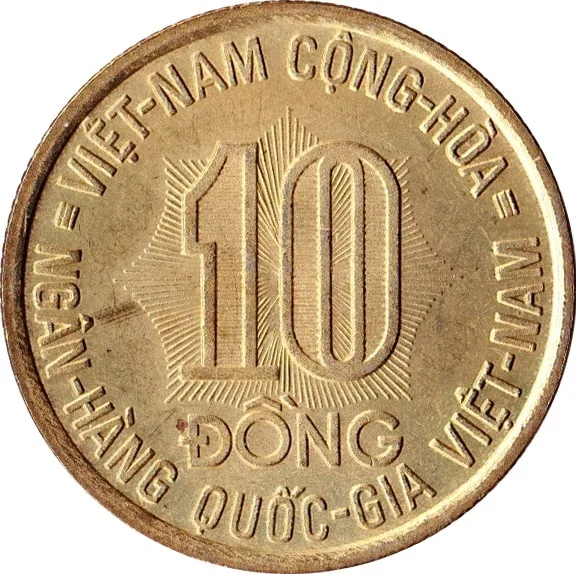
Obverse
Description:
Denomination
Inscription:
VIỆT-NAM CỘNG-HÒA
10
ĐỒNG
NGÂN-HÀNG QUỐC-GIA VIỆT-NAM
10
ĐỒNG
NGÂN-HÀNG QUỐC-GIA VIỆT-NAM
Translation:
REPUBLIC OF VIET-NAM
10
DONG
NATIONAL BANK OF VIET-NAM
10
DONG
NATIONAL BANK OF VIET-NAM
Script: Latin
Language: Vietnamese
Reverse
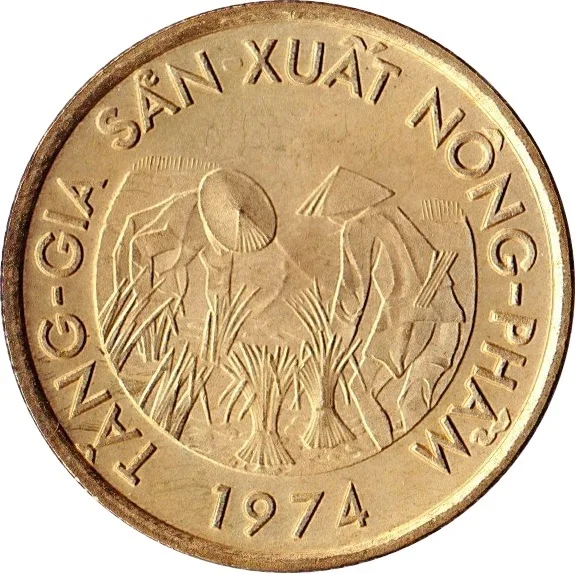
Description:
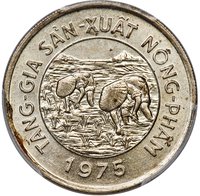
Farmers in rice fields.
Inscription:
TĂNG-GIA SẢN-XUẤT NÔNG-PHẨM
1974
1974
Translation:
Increase Agricultural Production
Script: Latin
Language: Vietnamese
Edge
Reeded
Categories
| Agriculture |
| Organization> FAO |
Mints
| Name | Mark |
|---|---|
| Staatliche Münze Baden-Württemberg | — |
Mintings
| Year | Mint Mark | Mintage | Quality | Collection |
|---|---|---|---|---|
| 1974 | — | 30,000,000 |
Historical background
By 1974, the economic and currency situation in South Vietnam was in a state of advanced decay, directly tied to the war effort and collapsing government credibility. The primary currency, the South Vietnamese piastre (đồng), was suffering from hyperinflation, with annual rates estimated between 200% and 400%. This spiral was driven by the massive printing of money to finance both the war and a bloated government bureaucracy, as U.S. military and economic aid began its sharp decline following the Paris Peace Accords. The government of President Nguyễn Văn Thiệu, lacking a broad tax base and facing a shrinking economy, resorted to the printing press to cover its deficits, flooding the market with currency of little value.
The crisis manifested in severe hardship for the urban population. Salaries for soldiers and civil servants became nearly worthless within days of being paid, destroying morale and fueling rampant corruption as people struggled to survive. A vast black market for U.S. dollars thrived, becoming the preferred medium for any significant transaction, from business to bribes. The official exchange rate was artificially pegged, but the black market rate told the true story: while the official rate was around 700 piastres to the dollar, the black market rate soared to well over 1,000 and continued to climb, demonstrating a complete lack of public confidence in the government's financial management.
This monetary collapse was both a cause and a symptom of South Vietnam's impending political-military defeat. The inflation eroded the social fabric, creating a gaping divide between a small elite with access to dollars and the desperate majority. It crippled the Army of the Republic of Vietnam's (ARVN) fighting capability, as soldiers were often forced to abandon their posts to provide for their families. By the final months of 1974 and into 1975, the worthless currency symbolized a state that had lost its fundamental ability to function, undermining any last vestiges of public support and accelerating the final offensive that would end the war in April 1975.
The crisis manifested in severe hardship for the urban population. Salaries for soldiers and civil servants became nearly worthless within days of being paid, destroying morale and fueling rampant corruption as people struggled to survive. A vast black market for U.S. dollars thrived, becoming the preferred medium for any significant transaction, from business to bribes. The official exchange rate was artificially pegged, but the black market rate told the true story: while the official rate was around 700 piastres to the dollar, the black market rate soared to well over 1,000 and continued to climb, demonstrating a complete lack of public confidence in the government's financial management.
This monetary collapse was both a cause and a symptom of South Vietnam's impending political-military defeat. The inflation eroded the social fabric, creating a gaping divide between a small elite with access to dollars and the desperate majority. It crippled the Army of the Republic of Vietnam's (ARVN) fighting capability, as soldiers were often forced to abandon their posts to provide for their families. By the final months of 1974 and into 1975, the worthless currency symbolized a state that had lost its fundamental ability to function, undermining any last vestiges of public support and accelerating the final offensive that would end the war in April 1975.
🌱 Very Common