

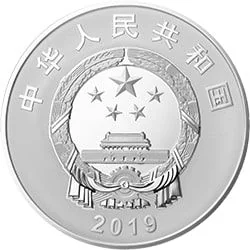
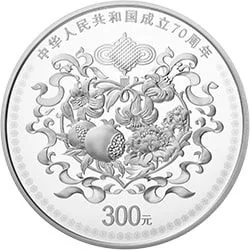
300 yuan (People's Republic) – People's Republic of China
Add to wishlist
Non-circulating coins
Commemoration: 70th Anniversary People's Republic
China
Context
Year: 2019
Country: China
Issuer: People's Republic of China
Period:
(since 1949)
Currency:
(since 1955)
Total mintage: 5,000
Material
Diameter: 100 mm
Weight: 1000 g
Silver Weight:: 999.00 g
Shape: Round
Composition: 99.9% Silver
Standard: Silver kilo
Magnetic: No
Technique: Milled
References
Numista: #317433
Value
Exchange value: 300 CNY
Bullion value: $2431.28
Inflation-adjusted value: 325.20 CNY
Mintings
| Year | Mint Mark | Mintage | Quality | Collection |
|---|---|---|---|---|
| 2019 | — | 5,000 | Proof |
Historical background
In 2019, the People's Republic of China faced a complex currency environment shaped by both domestic economic pressures and external trade tensions. The year was dominated by the ongoing trade dispute with the United States, which placed significant downward pressure on the Chinese yuan (CNY). As tariffs escalated, market concerns about economic slowdown and capital outflows intensified, leading the currency to weaken beyond the psychologically important threshold of 7 CNY per US dollar in August—a level not seen since the 2008 financial crisis. This move, interpreted by many as a deliberate devaluation to offset tariff impacts, triggered a formal designation of China as a "currency manipulator" by the US Treasury, further heightening global financial market volatility.
The Chinese government and the People's Bank of China (PBOC) pursued a delicate balancing act throughout the year. Their primary objectives were to manage the depreciation to support exporters without triggering a destabilizing capital flight or a full-blown currency war. The PBOC utilized a combination of tools, including setting daily mid-point rates stronger than market expectations and issuing offshore central bank bills to tighten yuan liquidity. These measures aimed to stabilize expectations and demonstrate control, asserting that the breach of the 7.0 level was a result of market forces and not a policy tool, thereby maintaining that the currency regime remained managed and stable.
Ultimately, 2019 highlighted the challenges of China's transition towards a more market-oriented exchange rate while retaining state control. The situation underscored the yuan's growing sensitivity to global geopolitical currents and the Chinese leadership's prioritization of financial stability. By year-end, the Phase One trade deal with the US in December helped alleviate immediate pressures, with the yuan strengthening back below 7.0. However, the episode left a lasting mark, reinforcing the narrative of currency stability as a core component of China's broader economic sovereignty and its intricate interplay with global finance.
The Chinese government and the People's Bank of China (PBOC) pursued a delicate balancing act throughout the year. Their primary objectives were to manage the depreciation to support exporters without triggering a destabilizing capital flight or a full-blown currency war. The PBOC utilized a combination of tools, including setting daily mid-point rates stronger than market expectations and issuing offshore central bank bills to tighten yuan liquidity. These measures aimed to stabilize expectations and demonstrate control, asserting that the breach of the 7.0 level was a result of market forces and not a policy tool, thereby maintaining that the currency regime remained managed and stable.
Ultimately, 2019 highlighted the challenges of China's transition towards a more market-oriented exchange rate while retaining state control. The situation underscored the yuan's growing sensitivity to global geopolitical currents and the Chinese leadership's prioritization of financial stability. By year-end, the Phase One trade deal with the US in December helped alleviate immediate pressures, with the yuan strengthening back below 7.0. However, the episode left a lasting mark, reinforcing the narrative of currency stability as a core component of China's broader economic sovereignty and its intricate interplay with global finance.



✨ Legendary