

40 dinars – Jordan
Add to wishlist
Non-circulating coins
Commemoration: 15th Hijrah Century
Jordan
Context
Year: 1980
Islamic (Hijri) Year:: 1400
Issuer: Jordan
Ruler: Hussein bin Talal
Currency:
(since 1949)
Total mintage: 9,500
Material
References
KM: #
Numista: #102293
Value
Exchange value: 40 JOD
Bullion value: $2043.17
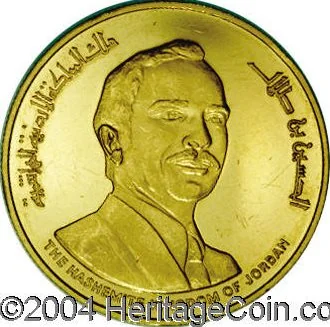
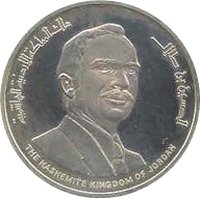
Obverse
Description:
King Hussein bust in profile.
Inscription:
ملك المملكة الاردنية الهاشمية
الحسين بن طلالـ
THE HASHEMITE KINGDOM OF JORDAN
الحسين بن طلالـ
THE HASHEMITE KINGDOM OF JORDAN
Translation:
King of the Hashemite Kingdom of Jordan
Al-Hussein bin Talal
Al-Hussein bin Talal
Language: Arabic
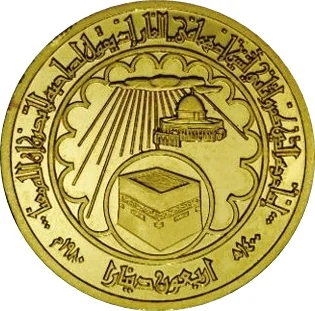
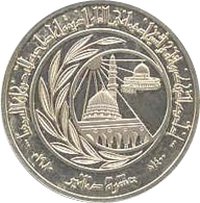
Reverse
Description:
Quranic verse above. Central circle with the Dome of the Rock, Kaaba, sun, and clouds. Arabic dates and value below.
Inscription:
··· إذ أخرجك الذين كفروا ثاني اثنين إذ هما في الغار إذ يقول لصاحبه لا تحزن إن الله معنا ···
١٤٠٠هـ اربعون دينارا ١٩٨٠م
١٤٠٠هـ اربعون دينارا ١٩٨٠م
Translation:
"...When the disbelievers drove him out; he was one of two; when they were in the cave; when he said to his companion: 'Do not grieve; indeed, Allah is with us'..."
1400H Forty Dinars 1980AD
1400H Forty Dinars 1980AD
Language: Arabic
Edge
Reeded
Categories
| Building> Religious building |
Mintings
| Year | Mint Mark | Mintage | Quality | Collection |
|---|---|---|---|---|
| 1980 | — | 9,500 | Proof |
Historical background
In 1980, Jordan's currency, the Jordanian Dinar (JOD), was in a period of notable strength and stability, largely insulated from the regional economic turbulence of the decade. This stability was primarily anchored by two key factors: substantial foreign aid inflows and robust worker remittances. Financially supported by grants from Arab Gulf states, particularly following the 1978 Baghdad Summit, and benefiting from the earnings of Jordanian expatriates working in oil-rich neighboring countries, Jordan maintained a comfortable level of foreign reserves. This external support allowed the Central Bank of Jordan to effectively peg the dinar to the U.S. Dollar at a fixed and strong exchange rate, a policy that fostered confidence in the currency.
However, this apparent stability masked underlying vulnerabilities and mounting pressures. The Jordanian economy was highly import-dependent for food, energy, and manufactured goods, making it susceptible to global price shocks. Furthermore, the economy was beginning to feel the strain of large public sector expenditures and ambitious development projects, which contributed to a growing budget deficit. The fixed exchange rate, while a symbol of strength, also began to raise concerns about competitiveness, as it made Jordanian exports relatively more expensive on the international market.
By the close of 1980, the foundations that supported the dinar's strength were starting to weaken. The outbreak of the Iran-Iraq War in September created profound regional uncertainty, threatening the flow of Gulf aid and disrupting trade routes. Concurrently, a global recession and a dip in oil prices began to reduce the demand for Jordanian migrant labor, foreshadowing a decline in critical remittance income. Consequently, while the currency situation was formally stable, Jordan was poised on the brink of a severe economic crisis that would fully materialize in the mid-1980s, testing the resilience of the dinar and necessitating a major economic adjustment program.
However, this apparent stability masked underlying vulnerabilities and mounting pressures. The Jordanian economy was highly import-dependent for food, energy, and manufactured goods, making it susceptible to global price shocks. Furthermore, the economy was beginning to feel the strain of large public sector expenditures and ambitious development projects, which contributed to a growing budget deficit. The fixed exchange rate, while a symbol of strength, also began to raise concerns about competitiveness, as it made Jordanian exports relatively more expensive on the international market.
By the close of 1980, the foundations that supported the dinar's strength were starting to weaken. The outbreak of the Iran-Iraq War in September created profound regional uncertainty, threatening the flow of Gulf aid and disrupting trade routes. Concurrently, a global recession and a dip in oil prices began to reduce the demand for Jordanian migrant labor, foreshadowing a decline in critical remittance income. Consequently, while the currency situation was formally stable, Jordan was poised on the brink of a severe economic crisis that would fully materialize in the mid-1980s, testing the resilience of the dinar and necessitating a major economic adjustment program.
✨ Legendary