

½ Anna – India - British
India
Context
Year: 1940
Country: India 
Issuer: India - British
Ruler: George VI
Currency:
(1770—1947)
Demonetized: Yes
Material
Weight: 2.87 g
Shape: Square with rounded corners
Composition: Copper-nickel
Technique: Milled
Alignment: Medal alignment
flip
References
KM: #Click to copy to clipboard534
Numista: #315652
Obverse
Description:
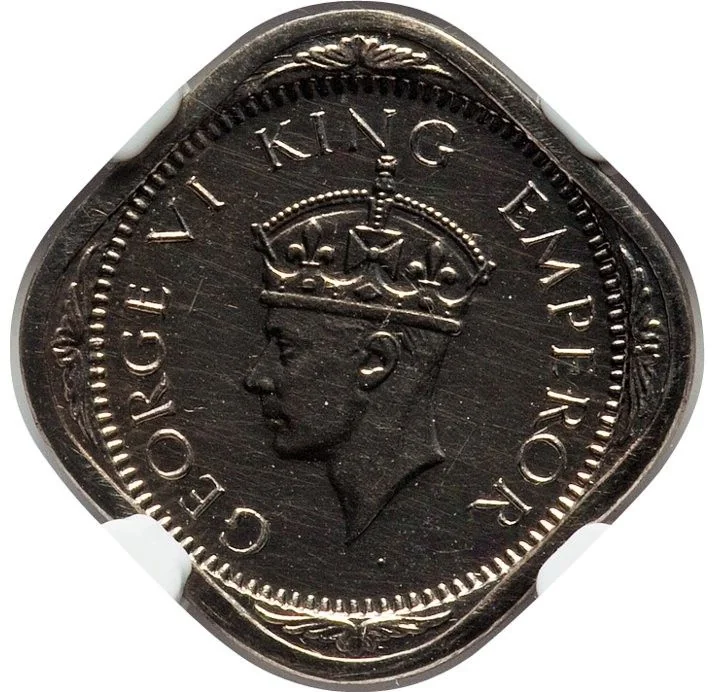
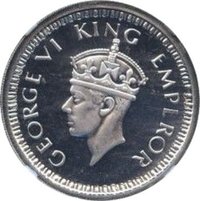
King George VI left-facing portrait, English legend, within toothed border.
Inscription:
GEORGE VI KING EMPEROR
Translation:
GEORGE VI KING EMPEROR
Language: English
Engraver: Percy Metcalfe
Reverse
Description:
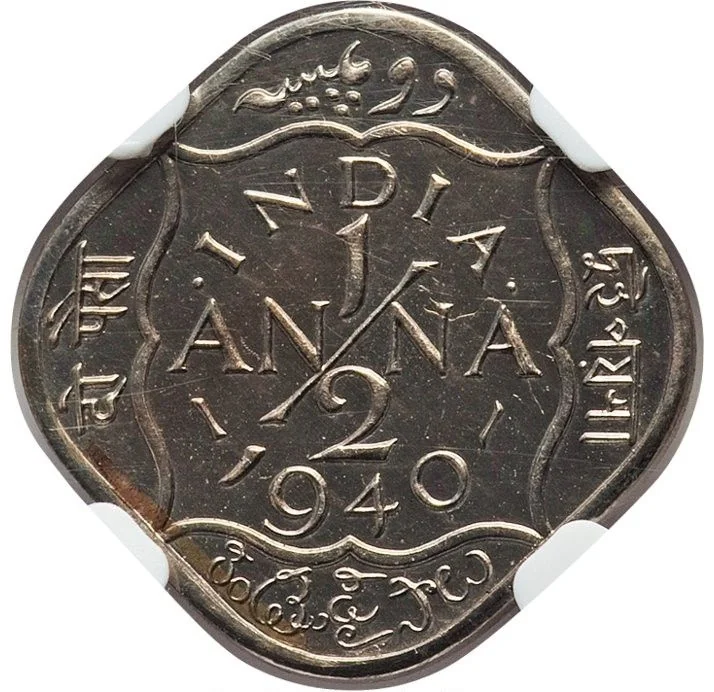
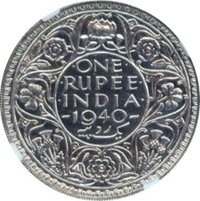
Country, denomination, and date in decorative outline. Value "two pice" (½ anna) in Urdu, Bengali, Telugu, and Devnagari within a plain border.
Inscription:
دو پیسہ
दॊ पैस দহ পহ়াযা
INDIA
AN ½ NA
1940
రెండు బైఎఅ
दॊ पैस দহ পহ়াযা
INDIA
AN ½ NA
1940
రెండు బైఎఅ
Translation:
Two Paisa
Two Paisa
Two Paisa
INDIA
HALF ANNA
1940
Two Baisa
Two Paisa
Two Paisa
INDIA
HALF ANNA
1940
Two Baisa
Edge
Plain
Mints
| Name | Mark |
|---|---|
| Kolkata / Calcutta / Murshidabad | — |
Mintings
| Year | Mint Mark | Mintage | Quality | Collection |
|---|---|---|---|---|
| 1940 | — | — | Proof | |
| 1940 | — | — | Prooflike |
Historical background
By 1940, the currency situation in British India was a complex system entirely subordinated to the strategic and financial demands of the Second World War. The rupee was not a fiat currency but operated under a "Sterling Exchange Standard," managed by the Reserve Bank of India (established in 1935). The core principle was that rupees in circulation were backed by sterling reserves held in London, with a fixed exchange rate of 1 rupee = 1 shilling 6 pence. This system inherently linked India's monetary stability to Britain's financial health and policies.
The outbreak of war in 1939 triggered immediate and profound changes. Britain invoked India's vast resources, leading to massive wartime expenditures by the Government of India for the Allied war effort. These expenditures, known as "sterling balances," were credited to London and created a huge and growing sterling debt owed to India. Domestically, this was financed through rapid rupee expansion, leading to significant inflationary pressures. The link to sterling was formally maintained, but the mechanism became strained as India's sterling credits in London were effectively blocked and unavailable for financing essential imports.
Consequently, the early 1940s saw a deteriorating economic environment within India. Inflation accelerated due to the expanding money supply, scarcity of consumer goods (as imports dwindled and production shifted to war materials), and speculative hoarding. While the official currency system appeared stable on paper, the reality for the Indian populace was rising prices, shortages, and economic hardship. This wartime financial strain, which effectively forced India to fund Britain's war through inflationary finance, became a major point of contention and fueled the growing nationalist critique of colonial economic exploitation.
The outbreak of war in 1939 triggered immediate and profound changes. Britain invoked India's vast resources, leading to massive wartime expenditures by the Government of India for the Allied war effort. These expenditures, known as "sterling balances," were credited to London and created a huge and growing sterling debt owed to India. Domestically, this was financed through rapid rupee expansion, leading to significant inflationary pressures. The link to sterling was formally maintained, but the mechanism became strained as India's sterling credits in London were effectively blocked and unavailable for financing essential imports.
Consequently, the early 1940s saw a deteriorating economic environment within India. Inflation accelerated due to the expanding money supply, scarcity of consumer goods (as imports dwindled and production shifted to war materials), and speculative hoarding. While the official currency system appeared stable on paper, the reality for the Indian populace was rising prices, shortages, and economic hardship. This wartime financial strain, which effectively forced India to fund Britain's war through inflationary finance, became a major point of contention and fueled the growing nationalist critique of colonial economic exploitation.
💎 Extremely Rare