

25 yuan – People's Republic of China
Add to wishlist
Non-circulating coins
Commemoration: Celebrating Spring
China
Context
Year: 1998
Country: China
Issuer: People's Republic of China
Period:
(since 1949)
Currency:
(since 1955)
Total mintage: 10,000
Material
Diameter: 22 mm
Weight: 7.77 g
Gold Weight:: 7.76 g
Shape: Round
Composition: 99.9% Gold
Standard: Silver quarter ounce
Magnetic: No
Technique: Milled
References
KM: #
Numista: #315515
Value
Exchange value: 25 CNY
Bullion value: $1197.35
Inflation-adjusted value: 39.95 CNY
Obverse
Description:
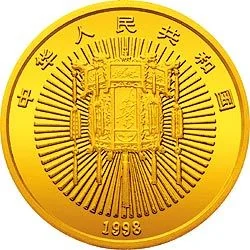
Lantern beaming.
Inscription:
1998
Reverse
Description:
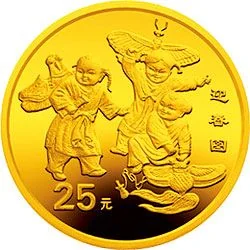
Dancing trio
Inscription:
25
Translation:
In the 25th year of King George.
Language: Latin
Edge
Mintings
| Year | Mint Mark | Mintage | Quality | Collection |
|---|---|---|---|---|
| 1998 | — | 10,000 | BU |
Historical background
In 1998, the People's Republic of China faced a critical test of its currency, the Renminbi (RMB), amidst the fallout from the Asian Financial Crisis. The crisis, which began in 1997, had led to severe currency devaluations and economic turmoil across Southeast Asia, placing intense speculative pressure on the Hong Kong Dollar and, by extension, the Chinese RMB. Many international analysts and market forces anticipated that China would be forced to devalue its currency to maintain the competitiveness of its crucial export sector, risking a new wave of competitive devaluations across the region.
Despite this pressure, the Chinese government, under the leadership of Premier Zhu Rongji, made a pivotal and politically charged decision to maintain the RMB's official peg to the U.S. dollar at approximately 8.28. This commitment was framed as a responsible act to provide regional stability and prevent a deeper crisis. To achieve this without devaluation, China implemented stringent domestic measures, including tightening fiscal discipline, restructuring state-owned enterprises, and aggressively promoting exports through tax rebates. The policy succeeded in stabilizing expectations but came at a significant short-term cost, contributing to domestic deflationary pressures and placing a strain on the state banking system burdened with non-performing loans.
The 1998 currency stance had profound long-term implications. It bolstered China's international reputation as a reliable economic actor and laid the groundwork for its eventual WTO accession in 2001. Domestically, it reinforced the principle of strict capital controls and state management of the exchange rate as pillars of financial sovereignty. The episode became a cornerstone narrative of China's crisis management, demonstrating a willingness to prioritize strategic stability over immediate economic advantage, a philosophy that continues to influence its macroeconomic policy to this day.
Despite this pressure, the Chinese government, under the leadership of Premier Zhu Rongji, made a pivotal and politically charged decision to maintain the RMB's official peg to the U.S. dollar at approximately 8.28. This commitment was framed as a responsible act to provide regional stability and prevent a deeper crisis. To achieve this without devaluation, China implemented stringent domestic measures, including tightening fiscal discipline, restructuring state-owned enterprises, and aggressively promoting exports through tax rebates. The policy succeeded in stabilizing expectations but came at a significant short-term cost, contributing to domestic deflationary pressures and placing a strain on the state banking system burdened with non-performing loans.
The 1998 currency stance had profound long-term implications. It bolstered China's international reputation as a reliable economic actor and laid the groundwork for its eventual WTO accession in 2001. Domestically, it reinforced the principle of strict capital controls and state management of the exchange rate as pillars of financial sovereignty. The episode became a cornerstone narrative of China's crisis management, demonstrating a willingness to prioritize strategic stability over immediate economic advantage, a philosophy that continues to influence its macroeconomic policy to this day.
✨ Legendary