

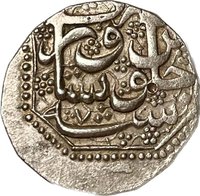
2 Mohurs – Afghanistan
Afghanistan
Context
Year: 1810
Islamic (Hijri) Year: 1225
Issuer: Afghanistan 
Ruler: Mahmud Shah
Currency:
(1747—1891)
Demonetized: Yes
Material
Diameter: 24 mm
Weight: 21.74 g
Gold weight: 21.74 g
Shape: Irregular round
Composition: Gold
Magnetic: No
References
KM: #Click to copy to clipboard607
Numista: #315502
Value
Bullion value: $3626.19
Obverse
Description:
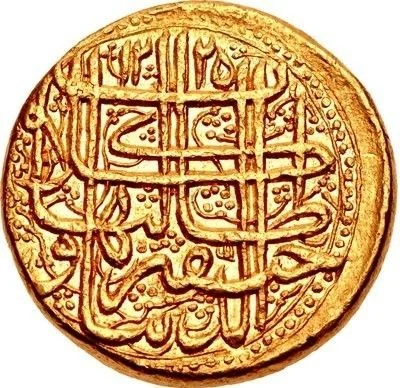
Mint formula and RY date within linear quadrate border; Shah Nur al-Din invocation around; floral background.
Script: Arabic
Reverse
Description:
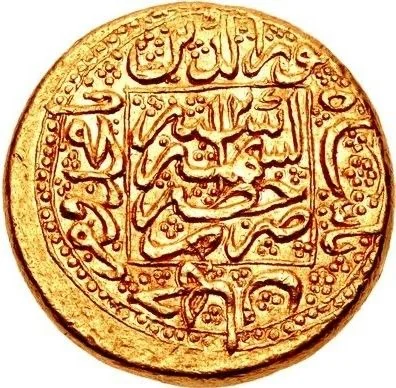
"The world is carrion; those who chase it are dogs."
Script: Arabic
Edge
Mintings
| Year | Mint Mark | Mintage | Quality | Collection |
|---|---|---|---|---|
| 1810 | — | — |
Historical background
In 1810, Afghanistan was not a unified nation-state but a patchwork of competing principalities and tribal confederacies, most notably the Durrani Empire, which was in a state of severe fragmentation following the death of its founder, Ahmad Shah Durrani, in 1772. The empire's authority had waned, and effective power was contested between rival branches of the Durrani dynasty in Kabul, Kandahar, and Herat, alongside powerful independent feudal lords and tribal khans. Consequently, there was no single, centralized monetary system. Instead, the currency landscape was a complex mosaic of local and regional coinages, often issued by autonomous rulers to assert their sovereignty and facilitate local trade.
The primary circulating medium was the silver rupee, which took various forms depending on the minting authority. The most influential of these was the Kabuli rupee, struck by the Sadozai and later Barakzai rulers in Kabul, but its weight and purity were not standardized across regions. Simultaneously, the Kandahari rupee and the Herati rupee circulated within their respective spheres of influence, each with slightly different specifications. Alongside these, a plethora of older Mughal, Safavid, and even Durrani coins from the empire's zenith remained in use, valued by their intrinsic silver content. For smaller transactions, copper paisa and dam coins were prevalent. The lack of standardization meant money changers (sarrafs) played a crucial role in the bazaars, assessing and exchanging the bewildering variety of coins.
This monetary fragmentation directly reflected the political instability of the era. The value and acceptance of any coin relied heavily on the reputation and current power of the ruler who issued it. Trade, particularly along the vital caravan routes between India, Persia, and Central Asia, required constant negotiation and exchange. The situation would begin to stabilize only decades later with the consolidation of power under Emir Dost Mohammad Khan (ruling from 1826), who worked to impose greater uniformity, notably by standardizing the Kabuli rupee as the principal coinage, laying the groundwork for a more unified national currency.
The primary circulating medium was the silver rupee, which took various forms depending on the minting authority. The most influential of these was the Kabuli rupee, struck by the Sadozai and later Barakzai rulers in Kabul, but its weight and purity were not standardized across regions. Simultaneously, the Kandahari rupee and the Herati rupee circulated within their respective spheres of influence, each with slightly different specifications. Alongside these, a plethora of older Mughal, Safavid, and even Durrani coins from the empire's zenith remained in use, valued by their intrinsic silver content. For smaller transactions, copper paisa and dam coins were prevalent. The lack of standardization meant money changers (sarrafs) played a crucial role in the bazaars, assessing and exchanging the bewildering variety of coins.
This monetary fragmentation directly reflected the political instability of the era. The value and acceptance of any coin relied heavily on the reputation and current power of the ruler who issued it. Trade, particularly along the vital caravan routes between India, Persia, and Central Asia, required constant negotiation and exchange. The situation would begin to stabilize only decades later with the consolidation of power under Emir Dost Mohammad Khan (ruling from 1826), who worked to impose greater uniformity, notably by standardizing the Kabuli rupee as the principal coinage, laying the groundwork for a more unified national currency.

✨ Legendary