

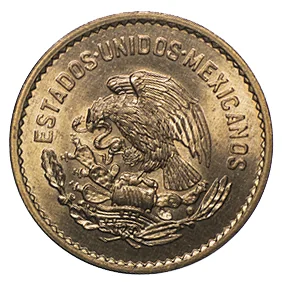
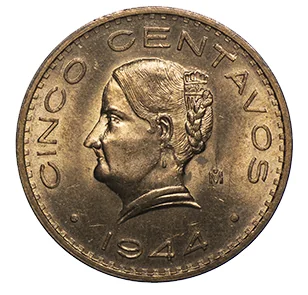
5 Centavos – Mexico
Mexico
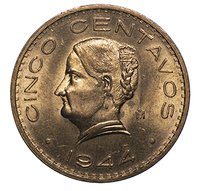
Obverse
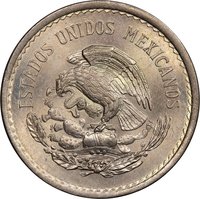
Reverse
Edge
Plain
Categories
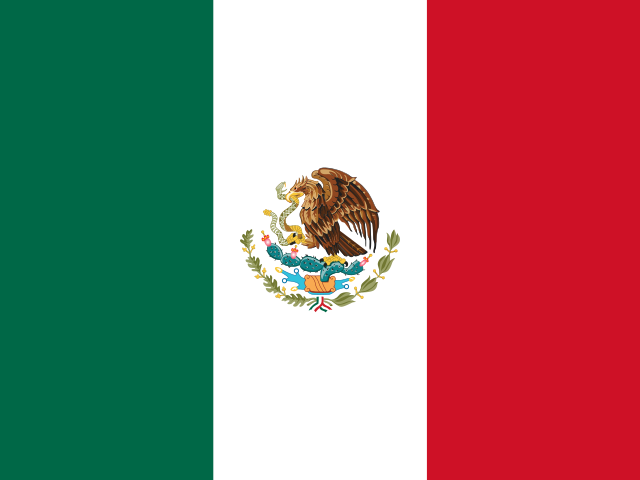
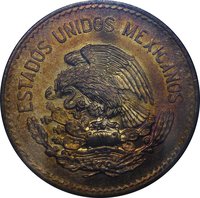
| Symbols> Coat of Arms |
Mints
| Name | Mark |
|---|---|
| Mexican Mint | (Mo) |
Mintings
| Year | Mint Mark | Mintage | Quality | Collection |
|---|---|---|---|---|
| 1942 | Mo | 900,000 | ||
| 1943 | Mo | 54,660,000 | ||
| 1944 | Mo | 53,463,000 | ||
| 1945 | Mo | 44,262,000 | ||
| 1946 | Mo | 49,054,000 | ||
| 1951 | Mo | 50,758,000 | ||
| 1952 | Mo | 17,674,000 | ||
| 1953 | Mo | 31,568,000 | ||
| 1954 | Mo | 58,680,000 | ||
| 1955 | Mo | 31,114,000 |
Historical background
In 1942, Mexico's currency situation was fundamentally shaped by its entry into World War II on the side of the Allies. This geopolitical shift solidified a crucial economic partnership with the United States, leading to the Bracero Program and the Mexican-American Commission for Economic Cooperation. These agreements provided a vital influx of U.S. dollars through labor remittances, exports, and direct financial assistance. This dollar inflow helped stabilize the Mexican peso and bolstered the country's foreign reserves, which was essential for managing its currency.
Domestically, the administration of President Manuel Ávila Camacho pursued a policy of "stabilizing development," prioritizing industrial growth and controlling inflation. The Banco de México, as the central bank, maintained a fixed exchange rate pegged to the U.S. dollar, a regime established in the 1930s. This peg provided predictability for trade and investment, which was especially important as Mexico became a key supplier of raw materials and labor to the Allied war effort. However, this stability was managed amidst underlying inflationary pressures from increased government spending and global supply disruptions.
Despite the stabilizing measures, the economy faced significant strains. Wartime demands led to import shortages of consumer goods and machinery, creating inflationary bottlenecks. Furthermore, government expenditure on infrastructure and nascent industries increased the money supply. While the fixed exchange rate and dollar inflows provided a veneer of stability, they masked these internal pressures. The currency situation of 1942 was thus a balancing act: externally supported by a strategic alliance, but internally challenged by the inflationary and disruptive realities of a wartime economy transitioning toward industrialization.
Domestically, the administration of President Manuel Ávila Camacho pursued a policy of "stabilizing development," prioritizing industrial growth and controlling inflation. The Banco de México, as the central bank, maintained a fixed exchange rate pegged to the U.S. dollar, a regime established in the 1930s. This peg provided predictability for trade and investment, which was especially important as Mexico became a key supplier of raw materials and labor to the Allied war effort. However, this stability was managed amidst underlying inflationary pressures from increased government spending and global supply disruptions.
Despite the stabilizing measures, the economy faced significant strains. Wartime demands led to import shortages of consumer goods and machinery, creating inflationary bottlenecks. Furthermore, government expenditure on infrastructure and nascent industries increased the money supply. While the fixed exchange rate and dollar inflows provided a veneer of stability, they masked these internal pressures. The currency situation of 1942 was thus a balancing act: externally supported by a strategic alliance, but internally challenged by the inflationary and disruptive realities of a wartime economy transitioning toward industrialization.
🌱 Very Common