

10 yuan – People's Republic of China
Add to wishlist
Non-circulating coins
Commemoration: Bronze Ware
China
Context
Year: 2014
Country: China
Issuer: People's Republic of China
Period:
(since 1949)
Currency:
(since 1955)
Total mintage: 60,000
Material
Diameter: 40 mm
Weight: 31.1 g
Silver Weight:: 31.07 g
Shape: Round
Composition: 99.9% Silver
Standard: Silver ounce
Magnetic: No
Technique: Milled
References
Numista: #311835
Value
Exchange value: 10 CNY
Bullion value: $79.49
Inflation-adjusted value: 11.85 CNY
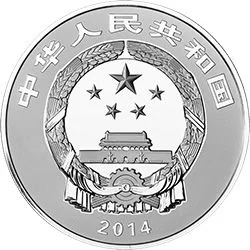
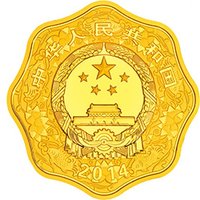
Obverse
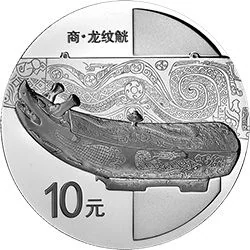
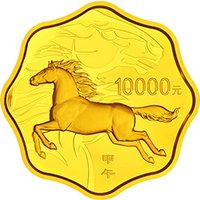
Reverse
Description:
Shang Dynasty bronze wine vessel shaped like a dragon-headed horn.
Inscription:
10
Script: Chinese
Edge
Mintings
| Year | Mint Mark | Mintage | Quality | Collection |
|---|---|---|---|---|
| 2014 | — | 60,000 | Proof |
Historical background
In 2014, the People's Republic of China was navigating a critical juncture in its currency policy, marked by a strategic shift towards greater internationalization of the Renminbi (RMB) while carefully managing domestic financial risks. The year was significant for the RMB's growing prominence on the global stage, as China actively expanded its use in cross-border trade settlement and promoted bilateral currency swap agreements with other central banks. A landmark event was the opening of several new offshore RMB clearing centers in major financial hubs like London, Frankfurt, and Seoul, accelerating the currency's path towards becoming a truly global reserve currency. This push was underpinned by China's desire to reduce its dependence on the US dollar in international trade and to gain greater influence within the global financial system.
Domestically, the currency situation was characterized by controlled reform and cautious liberalization. The People's Bank of China (PBOC) maintained a tightly managed floating exchange rate regime, but notably widened the RMB's daily trading band against the US dollar from +/-1% to +/-2% in March 2014. This move was a deliberate step to introduce more market-driven volatility and two-way risk, moving away from the long-standing pattern of steady, one-way appreciation. However, this liberalization occurred against a backdrop of economic slowing, with GDP growth easing to 7.3%—its lowest rate in 24 years—and rising concerns over local government debt and shadow banking, which necessitated a stable and controlled financial environment.
The year also saw the beginning of a subtle but important shift in the RMB's valuation trend. After nearly a decade of consistent appreciation, which had helped boost domestic purchasing power but hurt export competitiveness, the RMB experienced periods of depreciation pressure in 2014. This was driven by a strengthening US dollar and market expectations of divergent monetary policies between the US Federal Reserve and the PBOC. By year's end, the RMB had depreciated by about 2.5% against the dollar, its first annual loss since 2009. This shift signaled that Chinese authorities were becoming more tolerant of currency weakness to support the slowing economy, setting the stage for the more significant depreciation pressures and capital outflow challenges that would emerge in the following years.
Domestically, the currency situation was characterized by controlled reform and cautious liberalization. The People's Bank of China (PBOC) maintained a tightly managed floating exchange rate regime, but notably widened the RMB's daily trading band against the US dollar from +/-1% to +/-2% in March 2014. This move was a deliberate step to introduce more market-driven volatility and two-way risk, moving away from the long-standing pattern of steady, one-way appreciation. However, this liberalization occurred against a backdrop of economic slowing, with GDP growth easing to 7.3%—its lowest rate in 24 years—and rising concerns over local government debt and shadow banking, which necessitated a stable and controlled financial environment.
The year also saw the beginning of a subtle but important shift in the RMB's valuation trend. After nearly a decade of consistent appreciation, which had helped boost domestic purchasing power but hurt export competitiveness, the RMB experienced periods of depreciation pressure in 2014. This was driven by a strengthening US dollar and market expectations of divergent monetary policies between the US Federal Reserve and the PBOC. By year's end, the RMB had depreciated by about 2.5% against the dollar, its first annual loss since 2009. This shift signaled that Chinese authorities were becoming more tolerant of currency weakness to support the slowing economy, setting the stage for the more significant depreciation pressures and capital outflow challenges that would emerge in the following years.
✨ Legendary