

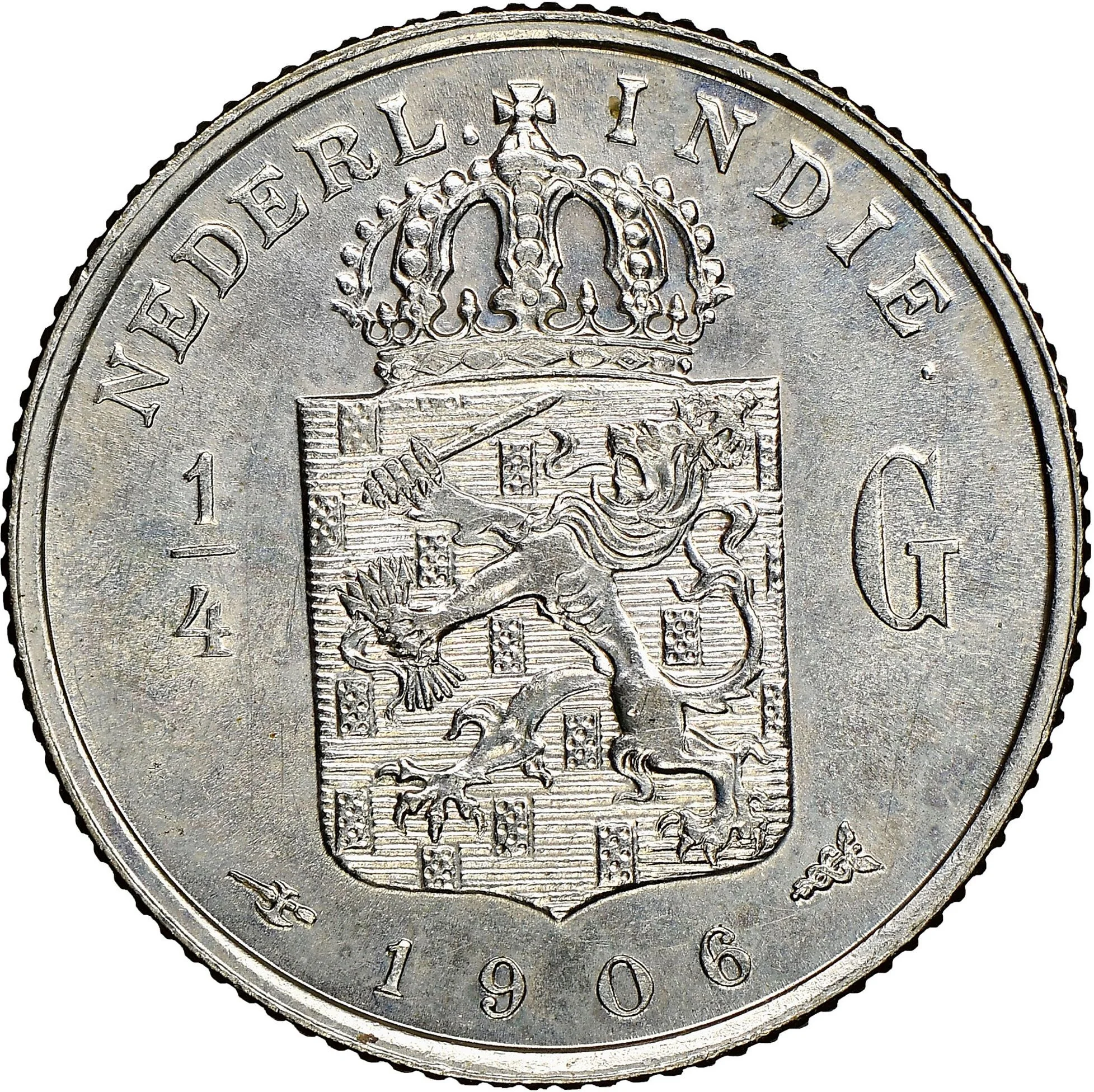
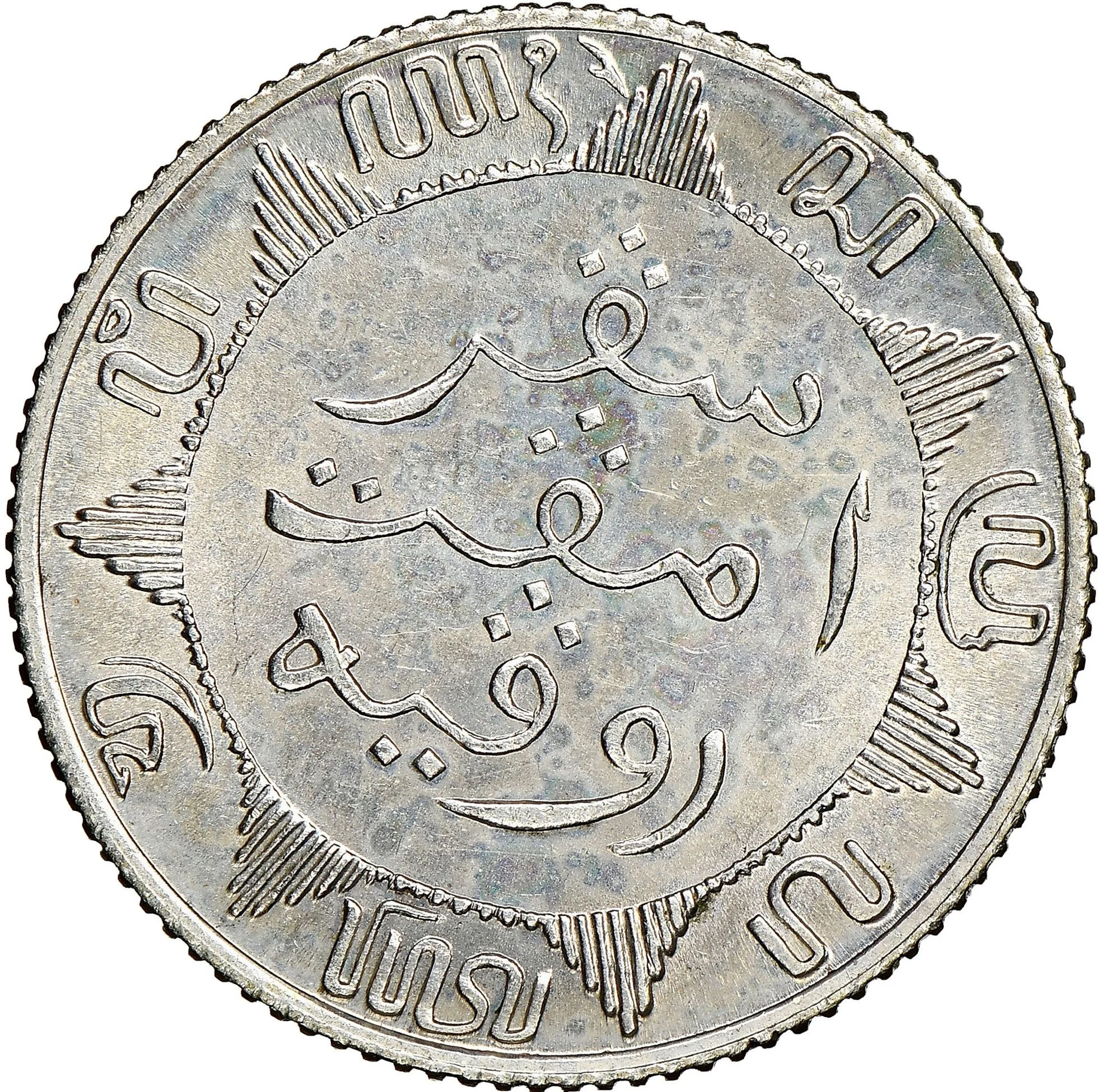
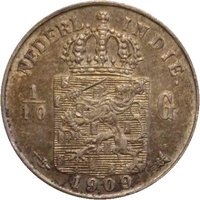
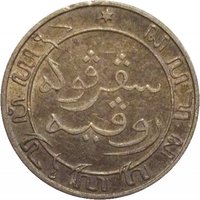
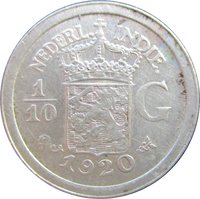
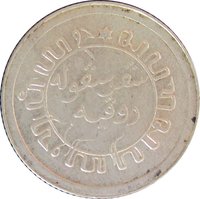
¼ gulden – Netherlands East Indies
Add to wishlist
Indonesia
Context
Years: 1903–1909
Country: Indonesia
Issuer: Netherlands East Indies
Ruler: Wilhelmina
Currency:
(1854—1948)
Demonetization: 1 January 1952
Total mintage: 20,400,000
Material
References
KM: #
Numista: #31128
Value
Bullion value: $5.85
Obverse
Reverse
Edge
Reeded
Categories
| Symbols> Coat of Arms |
Mints
| Name | Mark |
|---|---|
| Royal Dutch Mint | — |
Mintings
| Year | Mint Mark | Mintage | Quality | Collection |
|---|---|---|---|---|
| 1903 | — | 2,000,000 | ||
| 1903 | — | — | Proof | |
| 1904 | — | 2,000,000 | ||
| 1904 | — | — | Proof | |
| 1905 | — | 2,000,000 | ||
| 1905 | — | — | Proof | |
| 1906 | — | 4,000,000 | ||
| 1907 | — | — | Proof | |
| 1907 | — | 4,400,000 | ||
| 1908 | — | 2,000,000 | ||
| 1909 | — | 4,000,000 | ||
| 1909 | — | — | Proof |
Historical background
By 1903, the currency situation in the Netherlands East Indies (NEI) was characterized by a managed bimetallic system, firmly under the control of the Javasche Bank, the colony's central bank. The official monetary unit was the silver gulden (or guilder), but the system also formally recognized gold coins at a fixed legal ratio. However, the global decline in the price of silver during the late 19th century had created a significant problem: the intrinsic silver value of the gulden coin had fallen below its face value. This led to the widespread export and melting down of silver guilders for profit, causing a chronic shortage of physical coinage in the colony for everyday transactions.
To address this acute currency shortage, the colonial government relied heavily on the issuance of paper money by the Javasche Bank, which circulated alongside token copper and low-value silver coins. More notably, the administration introduced a distinctive and expedient solution: the staatsspaarkasbiljetten (state savings bank notes). These were essentially emergency paper tokens, issued in low denominations to facilitate small-scale commerce and pay government employees. Their proliferation underscored the gap between the official bimetallic standard and the practical reality of a silver-depleted circulating medium.
Consequently, the system in 1903 was in a state of functional transition. While officially on a silver standard with a gold peg, the practical circulation was dominated by fiduciary paper and token coinage. This unstable environment set the stage for a major monetary reform. In fact, the pressures of 1903 culminated in the pivotal Currency Act of 1904, which would formally close the era of bimetallism. This act demonetized silver as a standard and definitively placed the NEI on a gold exchange standard, firmly tying the value of the gulden to the Dutch gold guilder and stabilizing the currency system for the subsequent decades.
To address this acute currency shortage, the colonial government relied heavily on the issuance of paper money by the Javasche Bank, which circulated alongside token copper and low-value silver coins. More notably, the administration introduced a distinctive and expedient solution: the staatsspaarkasbiljetten (state savings bank notes). These were essentially emergency paper tokens, issued in low denominations to facilitate small-scale commerce and pay government employees. Their proliferation underscored the gap between the official bimetallic standard and the practical reality of a silver-depleted circulating medium.
Consequently, the system in 1903 was in a state of functional transition. While officially on a silver standard with a gold peg, the practical circulation was dominated by fiduciary paper and token coinage. This unstable environment set the stage for a major monetary reform. In fact, the pressures of 1903 culminated in the pivotal Currency Act of 1904, which would formally close the era of bimetallism. This act demonetized silver as a standard and definitively placed the NEI on a gold exchange standard, firmly tying the value of the gulden to the Dutch gold guilder and stabilizing the currency system for the subsequent decades.
🌟 Uncommon