

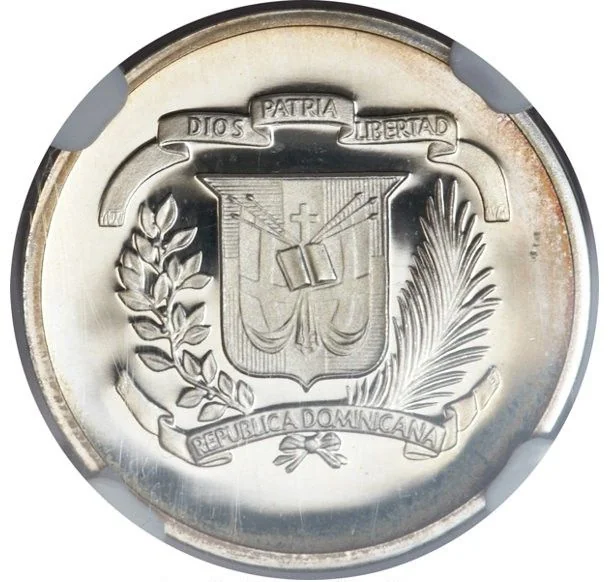
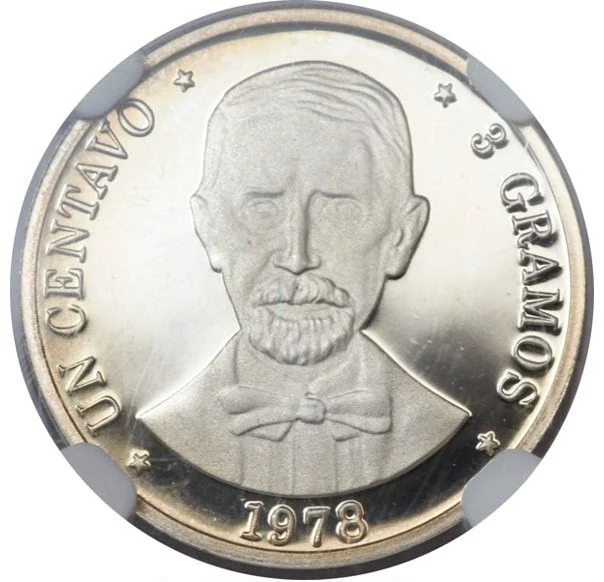
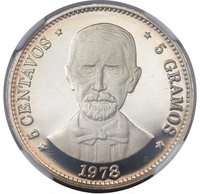
1 Centavo – Dominican Republic
Dominican Republic
Context
Years: 1978–1981
Issuer: Dominican Republic 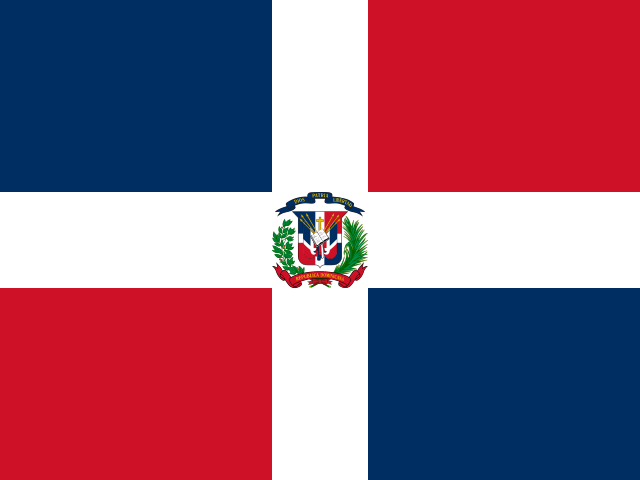
Period:
(since 1966)
Currency:
(since 1937)
Demonetized: Yes
Total mintage: 60
Material
References
KM: #Click to copy to clipboardPn29
Numista: #310971
Value
Exchange value: 0.01 DOP
Bullion value: $9.07
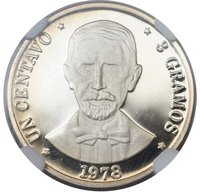
Obverse
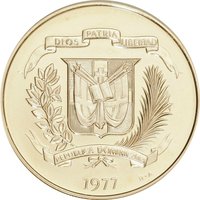
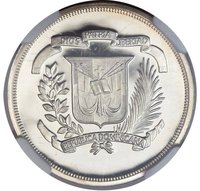
Reverse
Edge
Plain
Categories
| Symbols> Coat of Arms |
| Person> Politician |
Mints
| Name | Mark |
|---|---|
| United States Mint of San Francisco | — |
Mintings
| Year | Mint Mark | Mintage | Quality | Collection |
|---|---|---|---|---|
| 1978 | — | 15 | Proof | |
| 1979 | — | 15 | Proof | |
| 1980 | — | 15 | Proof | |
| 1981 | — | 15 | Proof |
Historical background
In 1978, the Dominican Republic was navigating a precarious economic landscape under the presidency of Joaquín Balaguer, who had been in power for most of the previous twelve years. The country's currency, the Dominican peso (DOP), was officially pegged to the U.S. dollar at a fixed rate of 1 peso = 1 dollar. However, this official parity was largely artificial and unsustainable, maintained through strict exchange controls and significant foreign borrowing. A thriving black market for dollars existed, where the peso traded at a substantial discount, revealing a significant gap between the government's stated value and the market's reality. This situation reflected underlying economic strains, including high public spending, trade deficits, and inflationary pressures.
The economy was heavily dependent on sugar exports, whose prices were volatile, and the country faced rising costs for crucial oil imports following the 1973 and 1979 oil shocks. To finance development projects and cover budget shortfalls, the Balaguer administration had accumulated substantial external debt. By 1978, debt servicing was consuming a large portion of export earnings, putting severe pressure on foreign reserves needed to defend the fixed exchange rate. The overvalued official peso hurt the competitiveness of non-sugar exports and encouraged capital flight, as individuals and businesses sought to move money into more stable foreign currencies.
The political context of 1978 was pivotal, with the election of Antonio Guzmán of the opposition PRD party marking the end of Balaguer's rule and a rare democratic transition. This shift created immediate uncertainty in currency markets. While the fixed exchange rate was maintained on paper, confidence wavered, and pressure on the peso intensified. The incoming Guzmán administration inherited an economy with dwindling reserves and a currency regime on the brink, setting the stage for the difficult economic adjustments and eventual devaluations that would characterize the early 1980s.
The economy was heavily dependent on sugar exports, whose prices were volatile, and the country faced rising costs for crucial oil imports following the 1973 and 1979 oil shocks. To finance development projects and cover budget shortfalls, the Balaguer administration had accumulated substantial external debt. By 1978, debt servicing was consuming a large portion of export earnings, putting severe pressure on foreign reserves needed to defend the fixed exchange rate. The overvalued official peso hurt the competitiveness of non-sugar exports and encouraged capital flight, as individuals and businesses sought to move money into more stable foreign currencies.
The political context of 1978 was pivotal, with the election of Antonio Guzmán of the opposition PRD party marking the end of Balaguer's rule and a rare democratic transition. This shift created immediate uncertainty in currency markets. While the fixed exchange rate was maintained on paper, confidence wavered, and pressure on the peso intensified. The incoming Guzmán administration inherited an economy with dwindling reserves and a currency regime on the brink, setting the stage for the difficult economic adjustments and eventual devaluations that would characterize the early 1980s.
✨ Legendary