

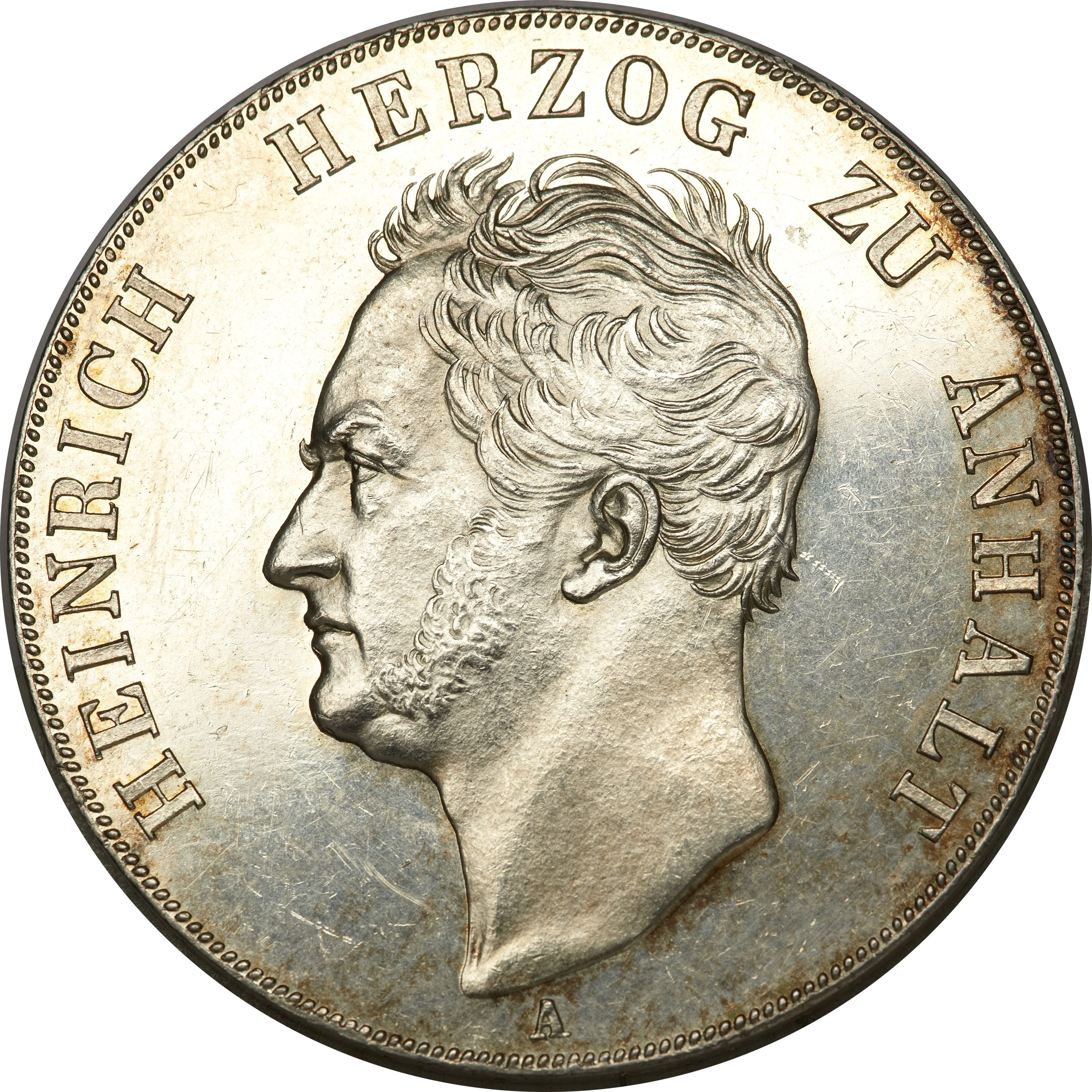
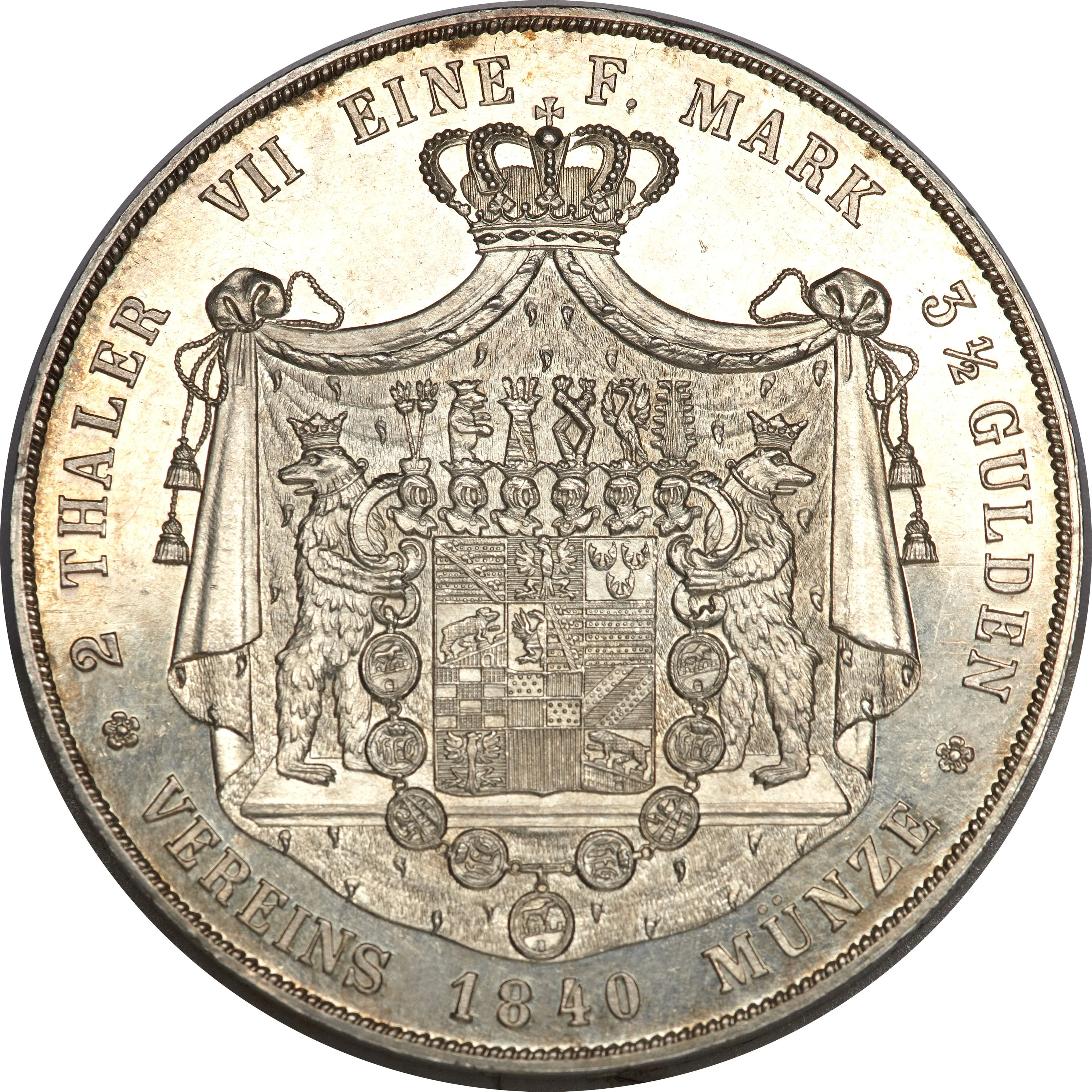
2 Reichsthaler – Anhalt-Köthen
Germany
Context
Year: 1840
Country: Germany 
Issuer: Anhalt-Köthen
Ruler: Henry
Currency:
Subdivision: 2 Reichsthaler = 3½ Gulden = ⅐ Cologne Mark
Demonetized: Yes
Total mintage: 3,100
Material
References
KM: #Click to copy to clipboard39
Numista: #31031
Value
Bullion value: $94.03
Obverse
Reverse
Edge
Plain with inscription.
Legend:
GOTT SEGNE ANHALT
Mints
| Name | Mark |
|---|---|
| Berlin | A |
Mintings
| Year | Mint Mark | Mintage | Quality | Collection |
|---|---|---|---|---|
| 1840 | A | 3,100 |
Historical background
In 1840, the Duchy of Anhalt-Köthen, like many other small German states, operated within a complex and fragmented monetary landscape. It was part of the Dresden Coinage Convention of 1838, a key agreement among several Thaler-using states in northern and central Germany aimed at standardizing currency. This convention established the "Vereinsthaler" as a common accounting unit, divided into 30 "Neugroschen" (each worth 10 "Pfennige"). For Anhalt-Köthen, this meant its currency was officially aligned with a broader regional system, promoting stability and facilitating trade with neighboring signatories like Prussia and Saxony.
However, the practical situation on the ground remained intricate. While the convention provided a framework, older local coinage often remained in circulation alongside the newer Vereinsthaler-based issues. Furthermore, the duchy's economy was still influenced by the legacy of the earlier "Conventionsmünze" standard and the persistent circulation of coins from other German states. This created a reality where merchants and citizens had to be familiar with multiple exchange rates and coin values, a common inconvenience in the pre-unification German Confederation.
The monetary system in Anhalt-Köthen in 1840 thus represented a transitional phase. It had moved decisively away from purely local isolation by adopting a progressive, standardized system through the Dresden Convention, which laid important groundwork for future German monetary union. Yet, it had not fully escaped the daily complexities of the Kleinstaaterei era, where political fragmentation was mirrored by a diversity of physical currency in everyday use. This background of formal standardization amidst lingering practical multiplicity characterized the duchy's financial environment on the eve of the industrial and political transformations that would later sweep through Germany.
However, the practical situation on the ground remained intricate. While the convention provided a framework, older local coinage often remained in circulation alongside the newer Vereinsthaler-based issues. Furthermore, the duchy's economy was still influenced by the legacy of the earlier "Conventionsmünze" standard and the persistent circulation of coins from other German states. This created a reality where merchants and citizens had to be familiar with multiple exchange rates and coin values, a common inconvenience in the pre-unification German Confederation.
The monetary system in Anhalt-Köthen in 1840 thus represented a transitional phase. It had moved decisively away from purely local isolation by adopting a progressive, standardized system through the Dresden Convention, which laid important groundwork for future German monetary union. Yet, it had not fully escaped the daily complexities of the Kleinstaaterei era, where political fragmentation was mirrored by a diversity of physical currency in everyday use. This background of formal standardization amidst lingering practical multiplicity characterized the duchy's financial environment on the eve of the industrial and political transformations that would later sweep through Germany.
✨ Legendary