

5 Pounds (coronation of Queen Elizabeth II) – United Kingdom
Non-circulating coins
Commemoration: 40th anniversary of coronation of Queen Elizabeth II
United Kingdom
Context
Year: 1993
Issuer: United Kingdom 
Ruler: Elizabeth II
Currency:
(since 1971)
Total mintage: 1,900,735
Material

References
KM: #Click to copy to clipboard965
Numista: #13621
Value
Exchange value: 5 GBP = $6.77
Inflation-adjusted value: 13.22 GBP
Obverse
Description:
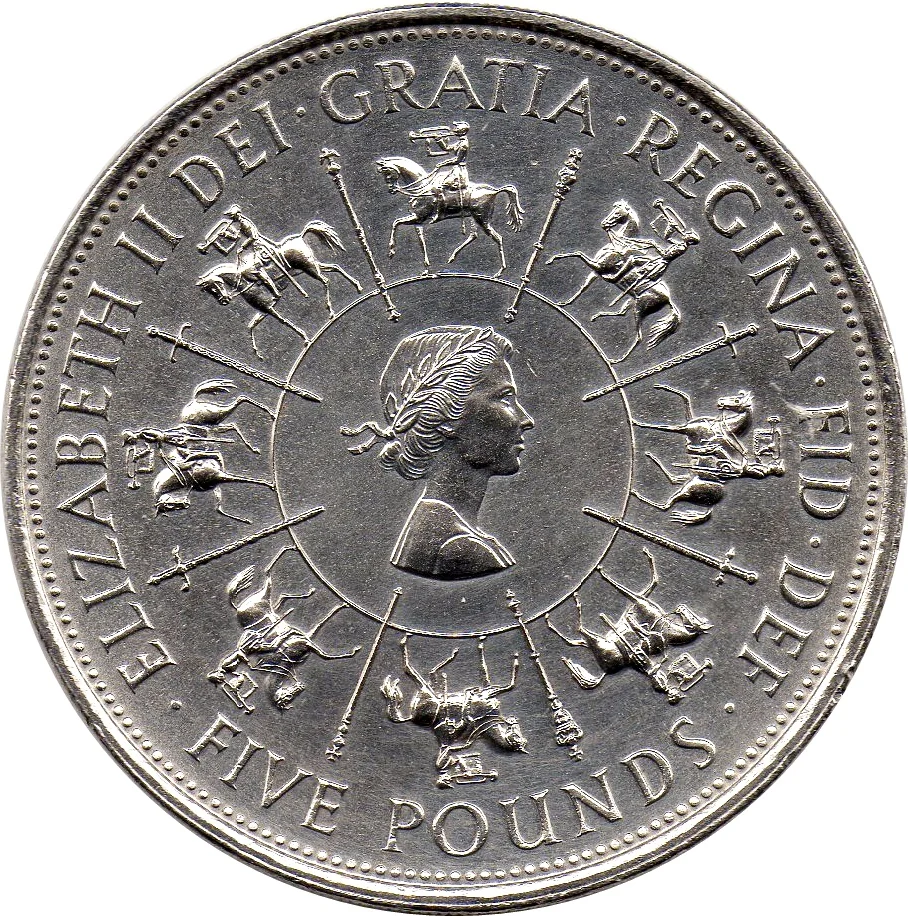
Centered is a young portrait of the Queen, encircled by mounted trumpeters alternating with royal sceptres and swords.
Inscription:
ELIZABETH II DEI·GRATIA REGINA·FID·DEF
· FIVE POUNDS ·
· FIVE POUNDS ·
Translation:
ELIZABETH II BY THE GRACE OF GOD QUEEN DEFENDER OF THE FAITH
FIVE POUNDS
FIVE POUNDS
Script: Latin
Engraver: Raphael David Maklouf
Reverse
Description:
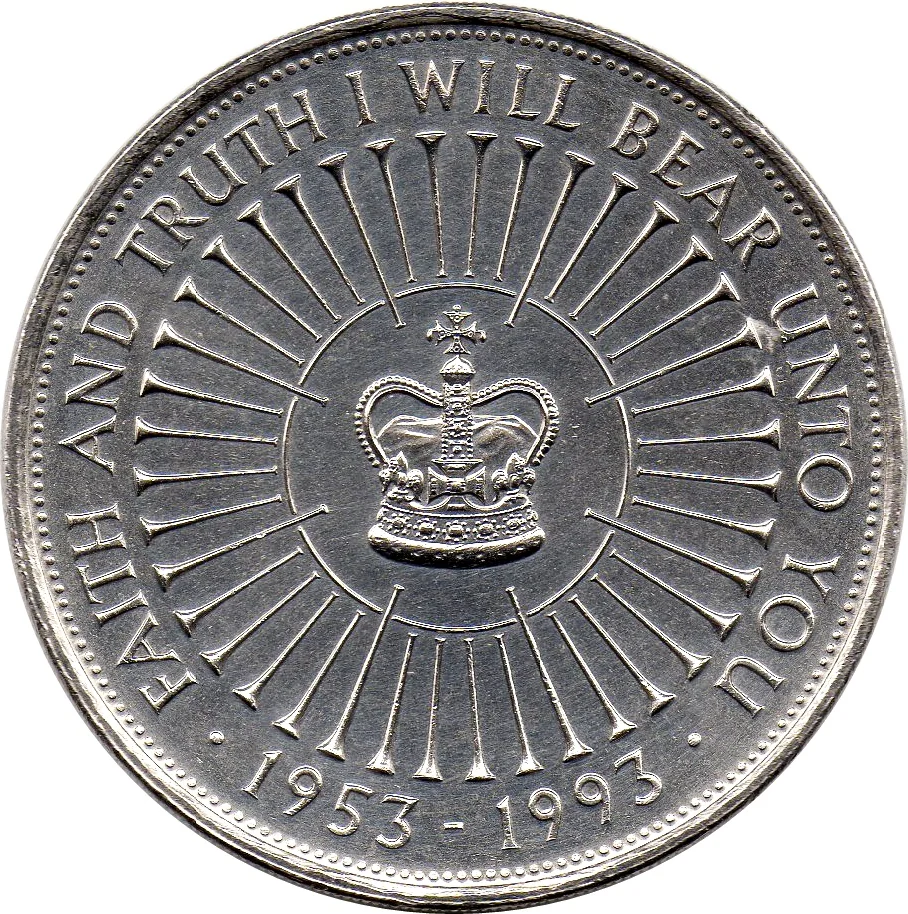
St Edward's Crown, encircled by trumpets, within legend and above dates.
Inscription:
FAITH AND TRUTH I WILL BEAR UNTO YOU
· 1953 - 1993 ·
· 1953 - 1993 ·
Script: Latin
Engraver: Robert Elderton
Edge
Reeded
Categories
| Event> Coronation |
Mints
| Name | Mark |
|---|---|
| Royal Mint | — |
Mintings
| Year | Mint Mark | Mintage | Quality | Collection |
|---|---|---|---|---|
| 1993 | — | 1,834,655 | ||
| 1993 | — | 66,080 | Proof | |
| 1993 | — | — | BU |
Historical background
In 1993, the United Kingdom's currency situation was fundamentally defined by the aftermath of "Black Wednesday" on 16 September 1992. This event saw the pound sterling crash out of the European Exchange Rate Mechanism (ERM), a system designed to reduce exchange rate variability and achieve monetary stability in Europe ahead of a potential single currency. The UK had joined the ERM in 1990 at a central rate of DM 2.95 to the pound, but this rate was widely considered overvalued, putting immense strain on the economy through high interest rates during a recession. Despite the Bank of England spending billions in foreign reserves in a futile defence, speculative pressure, most notably from figures like George Soros, forced the government to withdraw and allow the pound to float freely.
The immediate consequence was a sharp devaluation of sterling, which fell by approximately 15% in the following months. Politically, it was a catastrophic blow to the credibility of the Conservative government under Prime Minister John Major and Chancellor Norman Lamont, shattering their reputation for economic competence. However, economically, the devaluation proved to be a perverse blessing. It provided a substantial stimulus to exports by making British goods cheaper abroad, and it freed the government and the newly independent Bank of England (granted operational independence in 1997) to set interest rates based on domestic inflation targets rather than the need to defend a fixed exchange rate.
Therefore, by the end of 1993, the UK found itself outside the core European monetary integration project, with a floating currency and an inflation-targeting monetary policy framework beginning to take shape. The period marked a definitive pivot away from exchange rate anchors and towards a domestic focus for economic policy. This new paradigm, born from the trauma of Black Wednesday, laid the groundwork for the macroeconomic stability and growth that characterised the latter half of the 1990s, setting the stage for the Bank of England's full operational independence later in the decade.
The immediate consequence was a sharp devaluation of sterling, which fell by approximately 15% in the following months. Politically, it was a catastrophic blow to the credibility of the Conservative government under Prime Minister John Major and Chancellor Norman Lamont, shattering their reputation for economic competence. However, economically, the devaluation proved to be a perverse blessing. It provided a substantial stimulus to exports by making British goods cheaper abroad, and it freed the government and the newly independent Bank of England (granted operational independence in 1997) to set interest rates based on domestic inflation targets rather than the need to defend a fixed exchange rate.
Therefore, by the end of 1993, the UK found itself outside the core European monetary integration project, with a floating currency and an inflation-targeting monetary policy framework beginning to take shape. The period marked a definitive pivot away from exchange rate anchors and towards a domestic focus for economic policy. This new paradigm, born from the trauma of Black Wednesday, laid the groundwork for the macroeconomic stability and growth that characterised the latter half of the 1990s, setting the stage for the Bank of England's full operational independence later in the decade.


🌱 Common