

½ Peso – Dominican Republic
Circulating commemorative coins
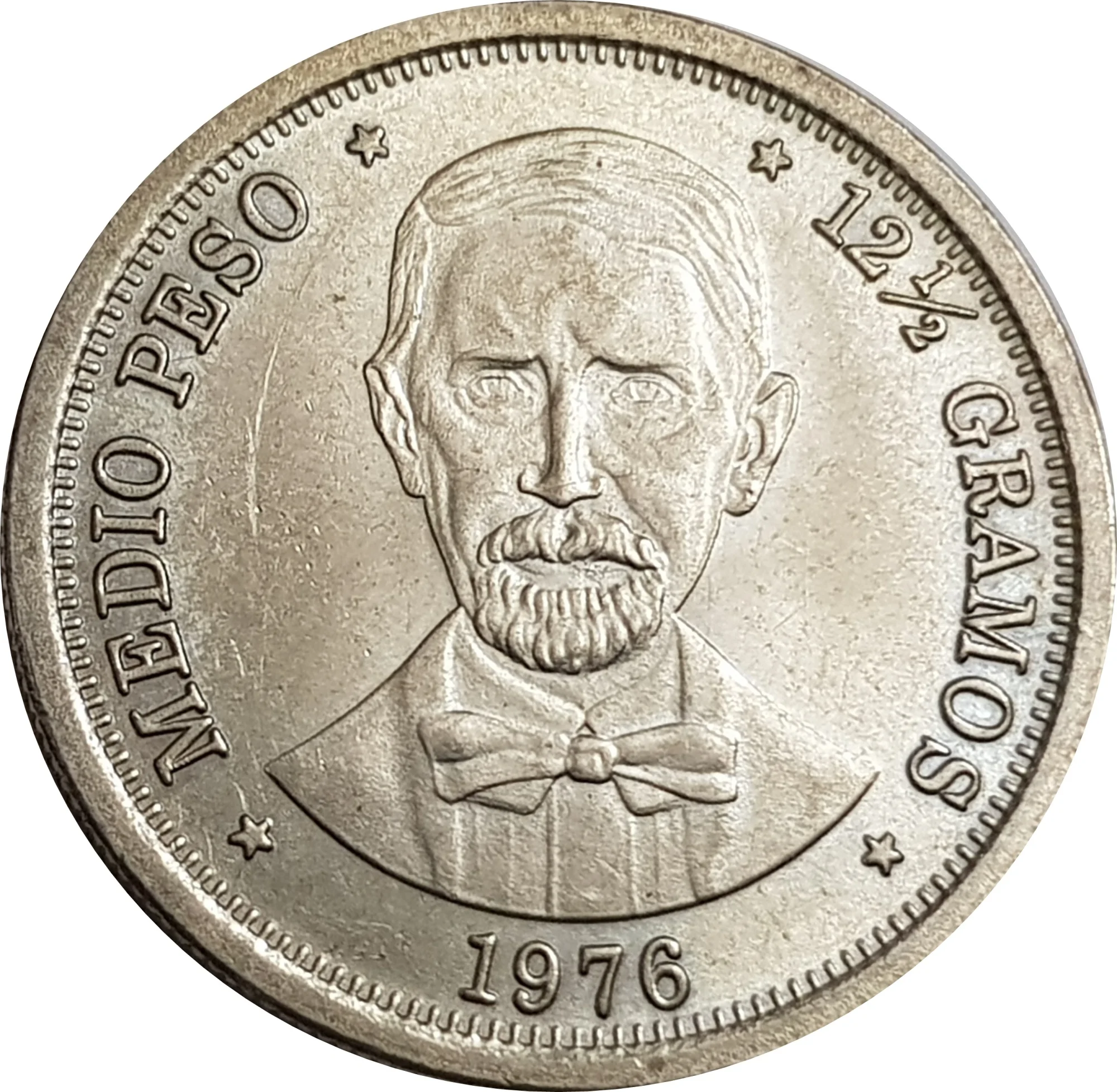
Commemoration: Centennial - Death of Juan Pablo Duarte
Dominican Republic
Context
Year: 1976
Issuer: Dominican Republic 
Period:
(since 1966)
Currency:
(since 1937)
Total mintage: 200,000
Material
References
KM: #Click to copy to clipboard44
Numista: #30969
Value
Exchange value: ½ DOP
Obverse
Description:
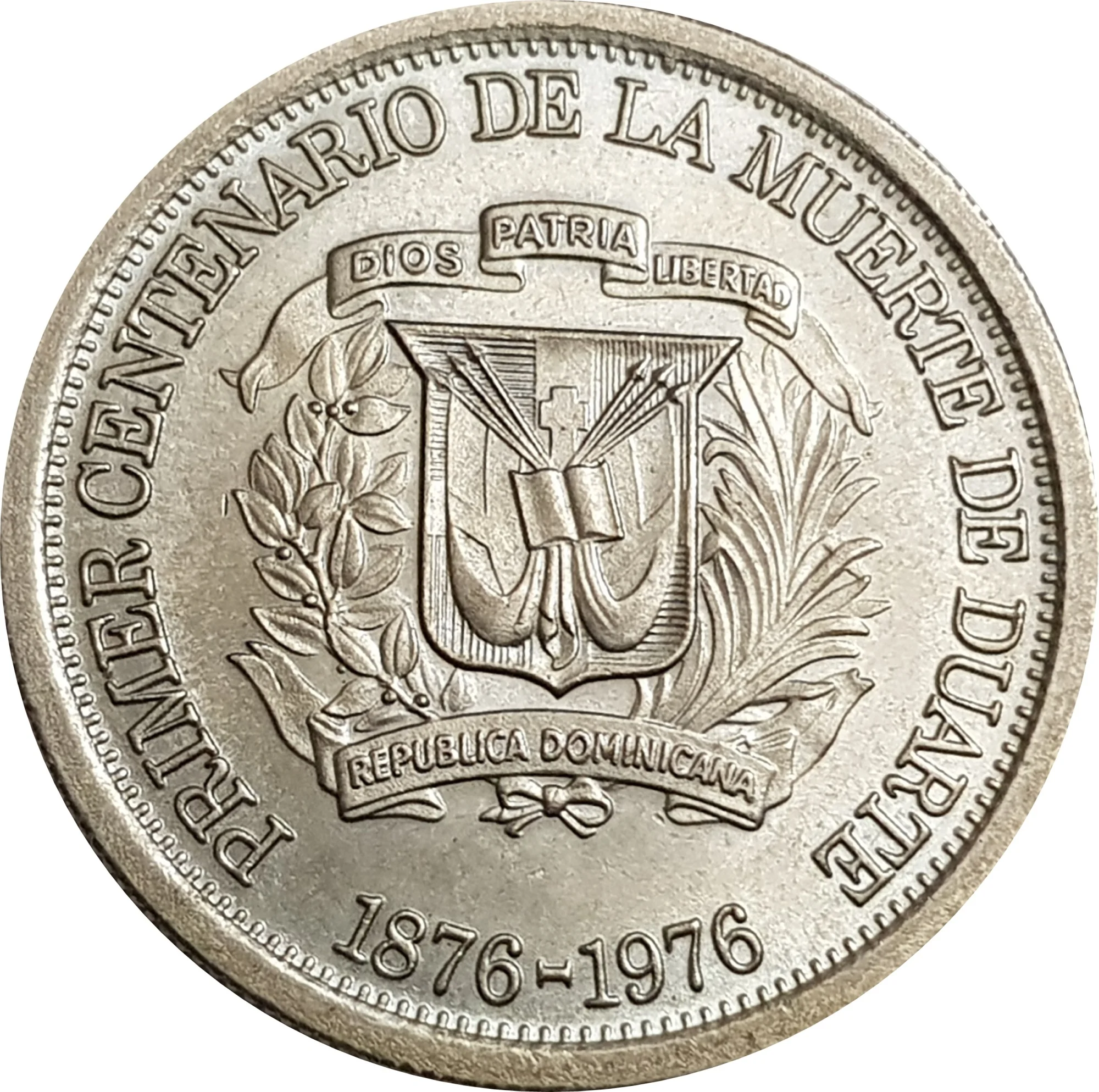
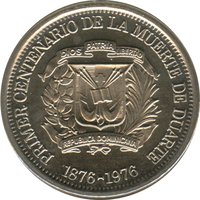
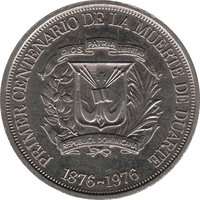
National emblem
Inscription:
PRIMER CENTENARIO DE LA MUERTE DE DUARTE
DIOS PATRIA LIBERTAD
REPUBLICA DOMINICANA
1876-1976
DIOS PATRIA LIBERTAD
REPUBLICA DOMINICANA
1876-1976
Translation:
FIRST CENTENARY OF THE DEATH OF DUARTE
GOD HOMELAND LIBERTY
DOMINICAN REPUBLIC
1876-1976
GOD HOMELAND LIBERTY
DOMINICAN REPUBLIC
1876-1976
Script: Latin
Language: Spanish
Engraver: Casimiro Nemesio de Moya
Reverse
Edge
Reeded
Mints
| Name | Mark |
|---|---|
| VDM Metals / Vereinigte Deutsche Metallwerke | — |
Mintings
| Year | Mint Mark | Mintage | Quality | Collection |
|---|---|---|---|---|
| 1976 | — | 195,000 | ||
| 1976 | — | 5,000 | Proof |
Historical background
In 1976, the Dominican Republic operated under a managed exchange rate system, with the peso (DOP) pegged to the U.S. dollar. This peg, maintained by the Central Bank, provided a degree of stability for international trade and investment, which was a priority for the government of President Joaquín Balaguer. The economy was heavily dependent on sugar exports, and the fixed rate aimed to shield the country from the volatile commodity price swings of the era. However, this stability was largely artificial and required significant foreign exchange reserves to defend, masking underlying economic pressures.
Beneath the surface, the Dominican economy faced mounting challenges that strained the currency regime. A global recession following the 1973 oil crisis had increased the cost of imports, particularly fuel, while sugar prices experienced a sharp decline. This combination led to a widening trade deficit and growing external debt. Furthermore, fiscal policy was expansionary, with high government spending contributing to inflationary pressures. The fixed exchange rate, therefore, became increasingly overvalued, hurting the competitiveness of non-sugar exports and encouraging capital flight as confidence waned.
Consequently, 1976 represented a precarious calm before a significant monetary storm. The Central Bank was forced to intermittently intervene in the market, depleting reserves to maintain the peg. While a major devaluation would not occur until 1978, the economic imbalances of the mid-1970s—the overvalued peso, persistent inflation, and external imbalances—created unsustainable pressures. The currency situation in 1976 was thus characterized by an officially maintained stability that was becoming progressively more difficult and costly to uphold, setting the stage for the financial adjustments of the following years.
Beneath the surface, the Dominican economy faced mounting challenges that strained the currency regime. A global recession following the 1973 oil crisis had increased the cost of imports, particularly fuel, while sugar prices experienced a sharp decline. This combination led to a widening trade deficit and growing external debt. Furthermore, fiscal policy was expansionary, with high government spending contributing to inflationary pressures. The fixed exchange rate, therefore, became increasingly overvalued, hurting the competitiveness of non-sugar exports and encouraging capital flight as confidence waned.
Consequently, 1976 represented a precarious calm before a significant monetary storm. The Central Bank was forced to intermittently intervene in the market, depleting reserves to maintain the peg. While a major devaluation would not occur until 1978, the economic imbalances of the mid-1970s—the overvalued peso, persistent inflation, and external imbalances—created unsustainable pressures. The currency situation in 1976 was thus characterized by an officially maintained stability that was becoming progressively more difficult and costly to uphold, setting the stage for the financial adjustments of the following years.
🌟 Limited