

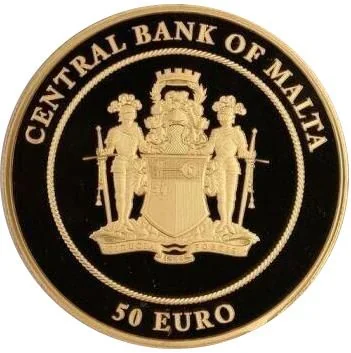
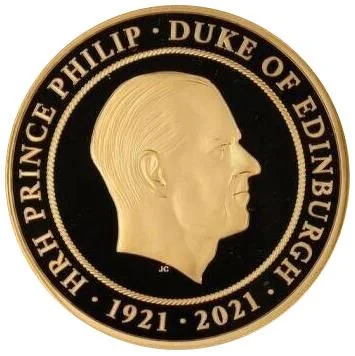
50 Euro – Malta
Non-circulating coins
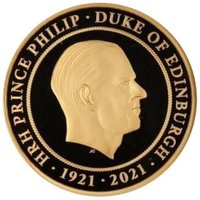
Commemoration: Death of Prince Philip, Duke of Edinburgh.
Malta
Context
Year: 2021
Issuer: Malta 
Issuing organization: Central Bank of Malta
Period:
(since 1974)
Currency:
(since 2008)
Total mintage: 49
Material
Diameter: 38.6 mm
Weight: 31.1 g
Gold weight: 31.10 g
Shape: Round
Composition: 99.99% Gold
Standard: Silver ounce
Magnetic: No
Technique: Milled
Alignment: Medal alignment
flip
References
KM: #Click to copy to clipboard225
Numista: #309605
Value
Exchange value: 50 EUR = $59.07
Bullion value: $5195.30
Obverse
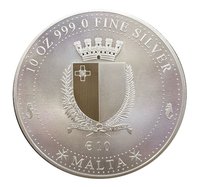
Reverse
Description:
Portrait of Prince Philip facing right.
Inscription:
HRH PRINCE PHILIP · DUKE OF EDINBURGH
· 1921 · 2021 ·
JC
· 1921 · 2021 ·
JC
Script: Latin
Designer: Jody Clark
Edge
Categories
| Symbols> Coat of Arms |
| Event> Death anniversary |
Mints
| Name | Mark |
|---|---|
| Commonwealth Mint | — |
Mintings
| Year | Mint Mark | Mintage | Quality | Collection |
|---|---|---|---|---|
| 2021 | — | 49 | Proof |
Historical background
In 2021, Malta remained a committed member of the Eurozone, using the euro (€) as its sole legal tender. This adoption, which began in 2008, provided the small island nation with significant economic stability, particularly during the global turbulence of the COVID-19 pandemic. The common currency insulated Malta from exchange rate volatility, facilitated seamless trade with its main European partners, and provided access to the European Central Bank's supportive monetary policies. Domestically, price stability was largely maintained, though the country, like the rest of the Eurozone, experienced a period of low, but rising, inflation driven by global supply chain disruptions and recovering energy prices.
The year was nonetheless marked by a specific financial controversy related to currency controls. In response to being placed on the FATF (Financial Action Task Force) "grey list" for money laundering concerns in June 2021, Maltese authorities and financial institutions enacted de facto stricter controls on large cash transactions. While not official capital controls, banks became increasingly cautious, often requiring extensive documentation for significant euro deposits or transfers, particularly from non-resident clients. This created operational challenges for some businesses and individuals, highlighting how regulatory pressures could impact the practical flow of currency within a Eurozone member state.
Overall, the euro's framework provided a bedrock of macroeconomic stability in 2021, allowing Malta's economy to rebound strongly with one of the fastest growth rates in the EU. The primary currency-related issues were not about the euro itself but were ancillary, stemming from the country's efforts to strengthen its anti-financial crime framework to regain international standing. Consequently, the year underscored the dual reality of being in a monetary union: benefiting from shared stability while also being subject to collective regulatory scrutiny and the need to maintain robust national financial governance.
The year was nonetheless marked by a specific financial controversy related to currency controls. In response to being placed on the FATF (Financial Action Task Force) "grey list" for money laundering concerns in June 2021, Maltese authorities and financial institutions enacted de facto stricter controls on large cash transactions. While not official capital controls, banks became increasingly cautious, often requiring extensive documentation for significant euro deposits or transfers, particularly from non-resident clients. This created operational challenges for some businesses and individuals, highlighting how regulatory pressures could impact the practical flow of currency within a Eurozone member state.
Overall, the euro's framework provided a bedrock of macroeconomic stability in 2021, allowing Malta's economy to rebound strongly with one of the fastest growth rates in the EU. The primary currency-related issues were not about the euro itself but were ancillary, stemming from the country's efforts to strengthen its anti-financial crime framework to regain international standing. Consequently, the year underscored the dual reality of being in a monetary union: benefiting from shared stability while also being subject to collective regulatory scrutiny and the need to maintain robust national financial governance.
✨ Legendary