

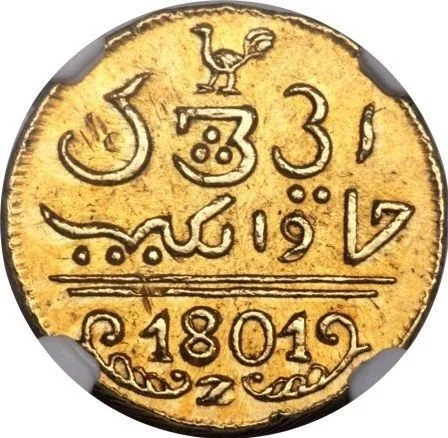
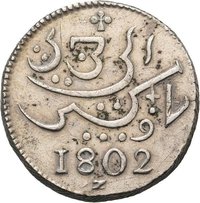
Obverse
Description:
Arabic script, dated AD
Inscription:
1801
Z
Z
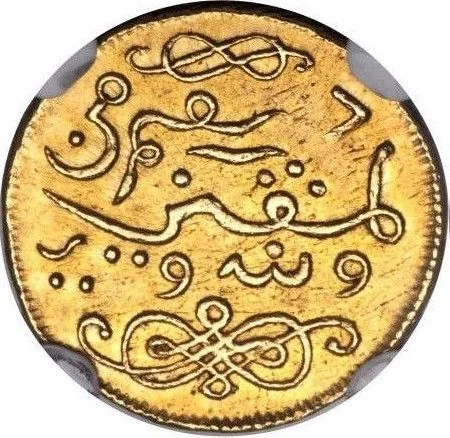
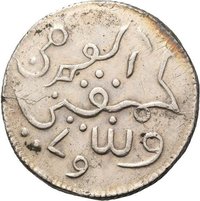
Reverse
Description:
Arabic writing system
Edge
Mints
| Name | Mark |
|---|---|
| Batavia | — |
Mintings
| Year | Mint Mark | Mintage | Quality | Collection |
|---|---|---|---|---|
| 1801 | Z | — | ||
| 1802 | Z | — | ||
| 1803 | Z | — | ||
| 1807 | Z | — |
Historical background
In 1801, Java was under the administration of the Dutch East India Company (VOC), which was in a state of bankruptcy and dissolution. The financial system was chaotic, characterized by a severe shortage of specie (gold and silver coinage) and a proliferation of different currencies. The primary circulating medium was the paper duit, but its value had collapsed due to massive over-issuance by the VOC to cover its debts and administrative costs. This hyperinflation rendered the paper money virtually worthless, undermining all economic transactions and creating deep public mistrust in the monetary authority.
Alongside this devalued paper, a complex mosaic of physical currencies circulated, including Spanish silver dollars (reals), Japanese copper kobans, and various local Chinese copper coins (picis). These coins traded not at their face value but at fluctuating market rates based on metal content and availability, leading to confusion and exploitation. The Dutch authorities attempted to impose a fixed exchange rate between the silver real and the paper duit, but this official rate was wildly disconnected from the market reality, creating a crippling dual economy and fostering widespread corruption and black-market trading.
This monetary crisis was a direct symptom of the collapsing colonial regime. The impending takeover by the Dutch state (the Batavian Republic) in 1800 had not yet stabilized the situation, leaving Java in a period of financial limbo. The fundamental problem was a complete lack of a uniform, trusted currency, which stifled trade, complicated tax collection, and placed a heavy burden on both the population and the administration. This unstable environment set the stage for the comprehensive monetary reforms that would be undertaken by the new Dutch government in the following years.
Alongside this devalued paper, a complex mosaic of physical currencies circulated, including Spanish silver dollars (reals), Japanese copper kobans, and various local Chinese copper coins (picis). These coins traded not at their face value but at fluctuating market rates based on metal content and availability, leading to confusion and exploitation. The Dutch authorities attempted to impose a fixed exchange rate between the silver real and the paper duit, but this official rate was wildly disconnected from the market reality, creating a crippling dual economy and fostering widespread corruption and black-market trading.
This monetary crisis was a direct symptom of the collapsing colonial regime. The impending takeover by the Dutch state (the Batavian Republic) in 1800 had not yet stabilized the situation, leaving Java in a period of financial limbo. The fundamental problem was a complete lack of a uniform, trusted currency, which stifled trade, complicated tax collection, and placed a heavy burden on both the population and the administration. This unstable environment set the stage for the comprehensive monetary reforms that would be undertaken by the new Dutch government in the following years.
✨ Legendary