

1 real – El Salvador
Add to wishlist
Circulating commemorative coins
Commemoration: Proclamation of Fernando VII in Santa Ana
El Salvador
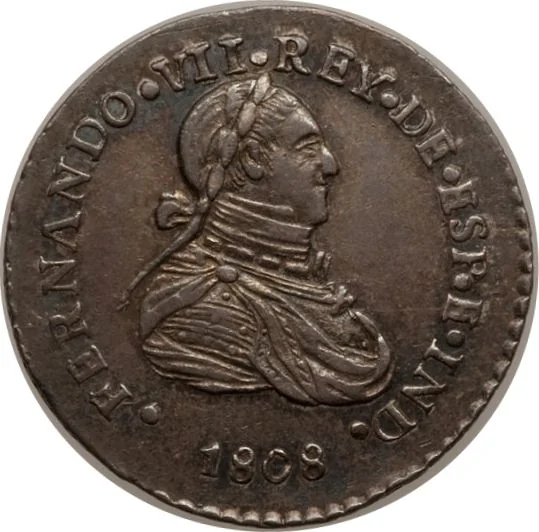
Obverse
Description:
Fernando VII bust facing right
Inscription:
· FERNANDO · VII · REY · DE · HSP · IND ·
1808
1808
Translation:
FERDINAND VII KING OF SPAIN AND THE INDIES
1808
1808
Script: Latin
Languages: Latin abbreviations, Spanish
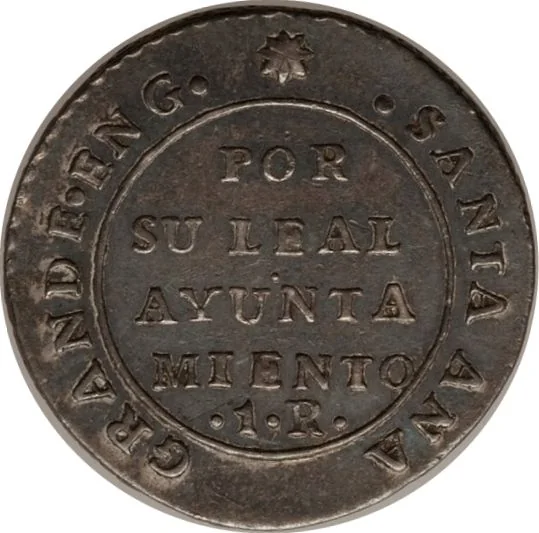
Reverse
Description:
Legend in circle
Inscription:
· SANTA · ANA GRANDE ·ENG ·
POR
SU LEAL
AYUNTA
MIENTO
· 1 · R ·
POR
SU LEAL
AYUNTA
MIENTO
· 1 · R ·
Script: Latin
Edge
Mintings
| Year | Mint Mark | Mintage | Quality | Collection |
|---|---|---|---|---|
| 1808 | — | — |
Historical background
In 1808, El Salvador did not possess its own independent currency. As an intendencia (administrative district) within the Captaincy General of Guatemala, which itself was part of the Spanish Viceroyalty of New Spain, its monetary system was fully integrated into the Spanish colonial framework. The official circulating medium was the Spanish colonial real, with 8 reales equal to 1 peso, and 16 reales to a gold escudo. This system was physically represented by a mix of silver and gold coins minted in the Americas, primarily from the great mints of Mexico City and Potosí, which bore the portrait and insignia of the Spanish monarch, Charles IV.
The period was one of significant monetary strain and scarcity. While official coinage was the standard, the economy in El Salvador, heavily based on indigo production for export, suffered from a chronic shortage of physical specie. This led to the widespread use of informal and substitute currencies in daily transactions. Cacao beans, a historic Mesoamerican medium of exchange, continued to circulate locally, especially among the indigenous and poorer populations. More critically, due to a lack of small change, merchants and hacienda owners often issued their own tlacos or vales—private tokens or promissory notes—creating a fragmented and unreliable local monetary environment.
This unstable situation existed against a backdrop of growing political and economic discontent with Spanish rule. The disruptions of the Napoleonic Wars in Europe, including the 1808 abdication of Charles IV, severely hampered transatlantic trade and the regular supply of official currency. The colonial administration in Guatemala struggled to manage the currency shortage, a problem that exacerbated social tensions. Thus, in 1808, El Salvador's currency situation was defined by its dependence on a distant imperial system, a severe scarcity of official coin, and a reliance on improvised and archaic substitutes, all of which reflected the broader weaknesses of Spanish colonial control on the eve of the independence movements.
The period was one of significant monetary strain and scarcity. While official coinage was the standard, the economy in El Salvador, heavily based on indigo production for export, suffered from a chronic shortage of physical specie. This led to the widespread use of informal and substitute currencies in daily transactions. Cacao beans, a historic Mesoamerican medium of exchange, continued to circulate locally, especially among the indigenous and poorer populations. More critically, due to a lack of small change, merchants and hacienda owners often issued their own tlacos or vales—private tokens or promissory notes—creating a fragmented and unreliable local monetary environment.
This unstable situation existed against a backdrop of growing political and economic discontent with Spanish rule. The disruptions of the Napoleonic Wars in Europe, including the 1808 abdication of Charles IV, severely hampered transatlantic trade and the regular supply of official currency. The colonial administration in Guatemala struggled to manage the currency shortage, a problem that exacerbated social tensions. Thus, in 1808, El Salvador's currency situation was defined by its dependence on a distant imperial system, a severe scarcity of official coin, and a reliance on improvised and archaic substitutes, all of which reflected the broader weaknesses of Spanish colonial control on the eve of the independence movements.
✨ Legendary