

5 rand (South African Reserve Bank) – South Africa
Add to wishlist
Non-circulating coins
Commemoration: 100th anniversary of the South African Reserve Bank
South Africa
Context
Year: 2021
Issuer: South Africa
Issuing organization: South African Reserve Bank
Period:
(since 1961)
Currency:
(since 1961)
Total mintage: 3,500
Material
References
KM: #
Numista: #308382
Value
Exchange value: 5 ZAR
Bullion value: $74.21
Inflation-adjusted value: 6.28 ZAR
Obverse
Description:
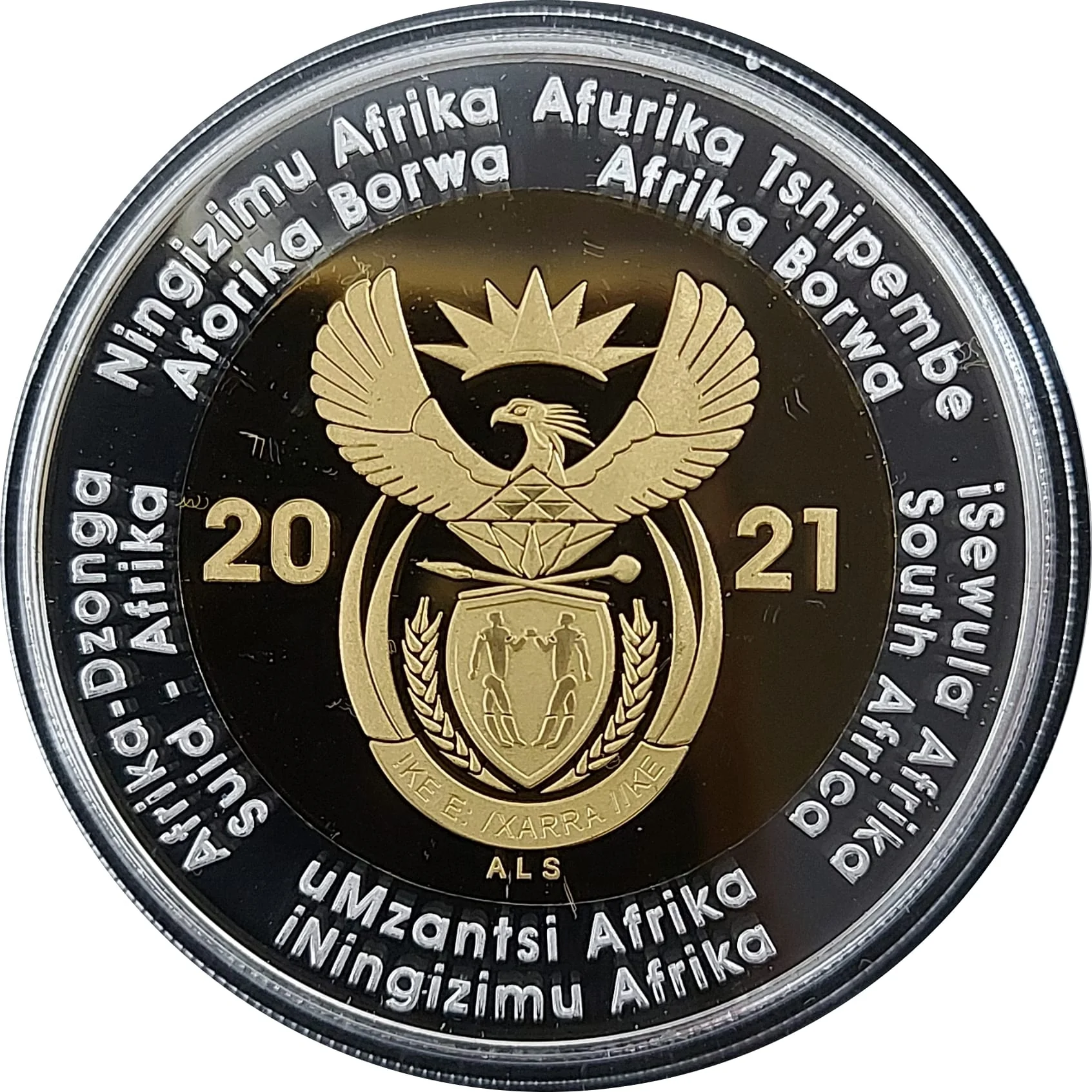
Silver ring with gold-plated centre. Features the South African Coat of Arms, date, and engraver initials. "South Africa" is inscribed in 10 official languages around the ring.
Inscription:
2021
IKE E:/ XARRA // KE
ALS
Ningizimu Afrika
Aforika Borwa
Afurika Tshipembe
Afrika Borwa
iSewula Afrika
South Africa
uMzantsi Afrika
iNingizimu Afrika
Afrika-Dzonga
Suid-Afrika
IKE E:/ XARRA // KE
ALS
Ningizimu Afrika
Aforika Borwa
Afurika Tshipembe
Afrika Borwa
iSewula Afrika
South Africa
uMzantsi Afrika
iNingizimu Afrika
Afrika-Dzonga
Suid-Afrika
Translation:
2021
IKE E:/ XARRA // KE
ALS
South Africa
South Africa
South Africa
South Africa
South Africa
South Africa
South Africa
South Africa
South Africa
South Africa
IKE E:/ XARRA // KE
ALS
South Africa
South Africa
South Africa
South Africa
South Africa
South Africa
South Africa
South Africa
South Africa
South Africa
Script: Latin
Languages: Swazi, English, Southern Ndebele, Tsonga, Tswana, Xhosa, Venda, Zulu, Afrikaans, South Sotho
Engraver: Arthur Sutherland
Reverse
Description:
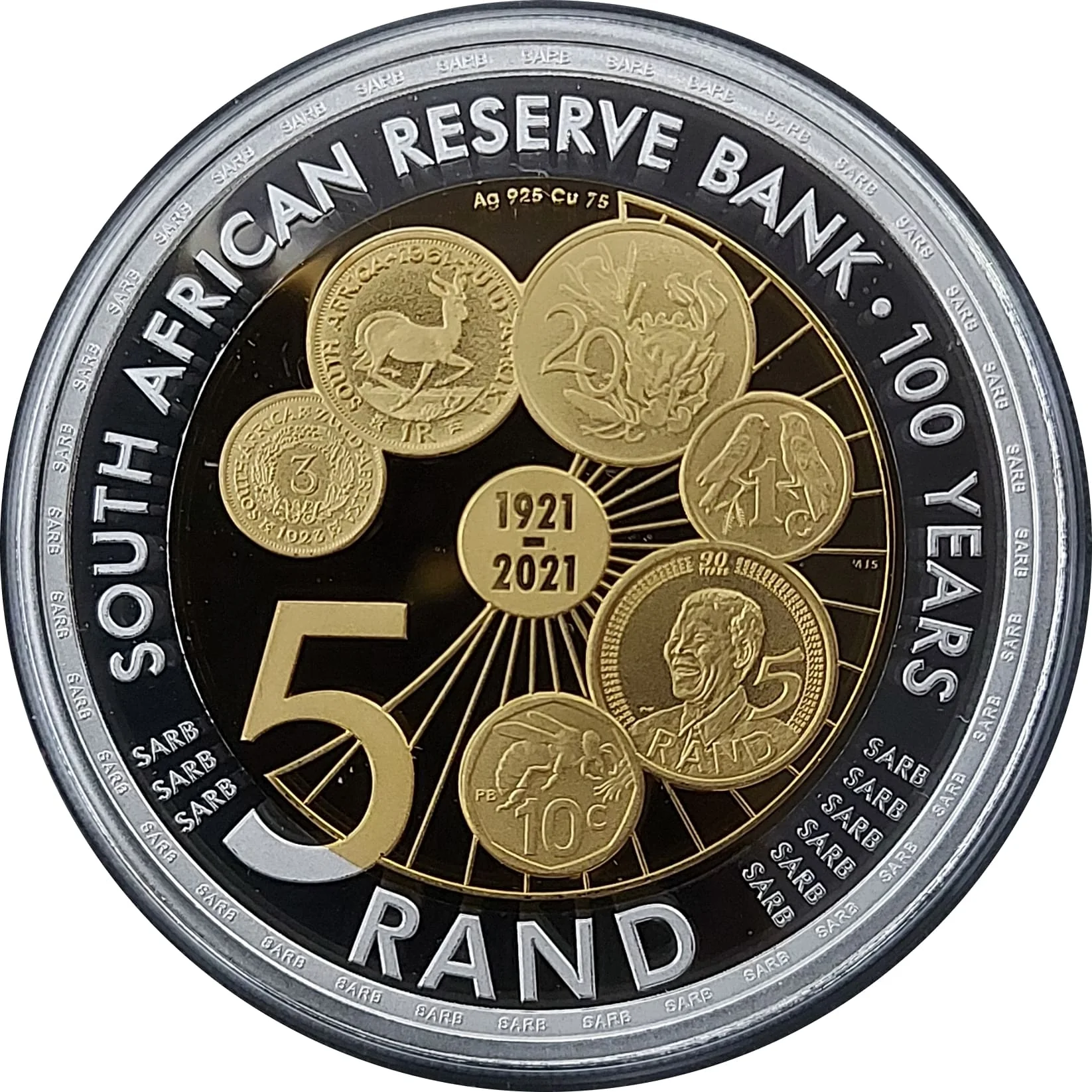
Silver ring with gold-plated centre, featuring six coins marking the SARB's centenary (1921-2021): the 1923 tickey, 1961 R1 Springbok, 1965 20c Protea, 1990 1c Sparrows, 2008 R5 Mandela, and a 10c Honey Bee. Includes engraver initials, lettering, and "SARB" repeated in the outer border.
Inscription:
SOUTH AFRICAN RESERVE BANK 100 YEARS
1921 - 2021
5 Rand
SARB
SARB
MJS
1921 - 2021
5 Rand
SARB
SARB
MJS
Script: Latin
Engraver: Thinus Scheepers
Designer: Lilian Guerra
Edge
Reeded
Categories
| Animal> Bird |
| Animal> Cow |
| Animal> Insect |
| Currency> Coin depiction |
| Person> Politician |
| Plants> Flower |
| Symbols> Coat of Arms |
Mintings
| Year | Mint Mark | Mintage | Quality | Collection |
|---|---|---|---|---|
| 2021 | — | 3,500 | Proof |
Historical background
In 2021, South Africa's currency, the rand, navigated a year of significant volatility, largely driven by a complex interplay of domestic challenges and global factors. The currency began the year on a relatively strong note, buoyed by high global commodity prices which benefited the export-driven economy. However, this resilience was consistently tested by persistent domestic issues, including severe electricity load-shedding from Eskom, sluggish economic growth, and a stubbornly high unemployment rate, which eroded investor confidence and periodically triggered sell-offs.
The rand's trajectory was heavily influenced by the country's fiscal and political landscape. Concerns over the government's ability to rein in its soaring public debt and contain widespread corruption weighed heavily on the currency. Furthermore, the slow pace of economic reforms and the government's handling of the COVID-19 pandemic, including vaccine rollout delays and recurring lockdowns, created uncertainty. These domestic headwinds made the rand particularly sensitive to shifts in global risk sentiment, often amplifying its movements against major currencies.
By the close of 2021, the rand had depreciated considerably against the US dollar, reflecting the cumulative impact of these pressures. While commodity revenues provided a crucial buffer, they were insufficient to fully offset the negative sentiment stemming from structural economic problems and political uncertainty. The year ultimately highlighted the currency's vulnerability to both internal policy failures and external shocks, setting a cautious tone for the nation's economic outlook moving forward.
The rand's trajectory was heavily influenced by the country's fiscal and political landscape. Concerns over the government's ability to rein in its soaring public debt and contain widespread corruption weighed heavily on the currency. Furthermore, the slow pace of economic reforms and the government's handling of the COVID-19 pandemic, including vaccine rollout delays and recurring lockdowns, created uncertainty. These domestic headwinds made the rand particularly sensitive to shifts in global risk sentiment, often amplifying its movements against major currencies.
By the close of 2021, the rand had depreciated considerably against the US dollar, reflecting the cumulative impact of these pressures. While commodity revenues provided a crucial buffer, they were insufficient to fully offset the negative sentiment stemming from structural economic problems and political uncertainty. The year ultimately highlighted the currency's vulnerability to both internal policy failures and external shocks, setting a cautious tone for the nation's economic outlook moving forward.
✨ Legendary