

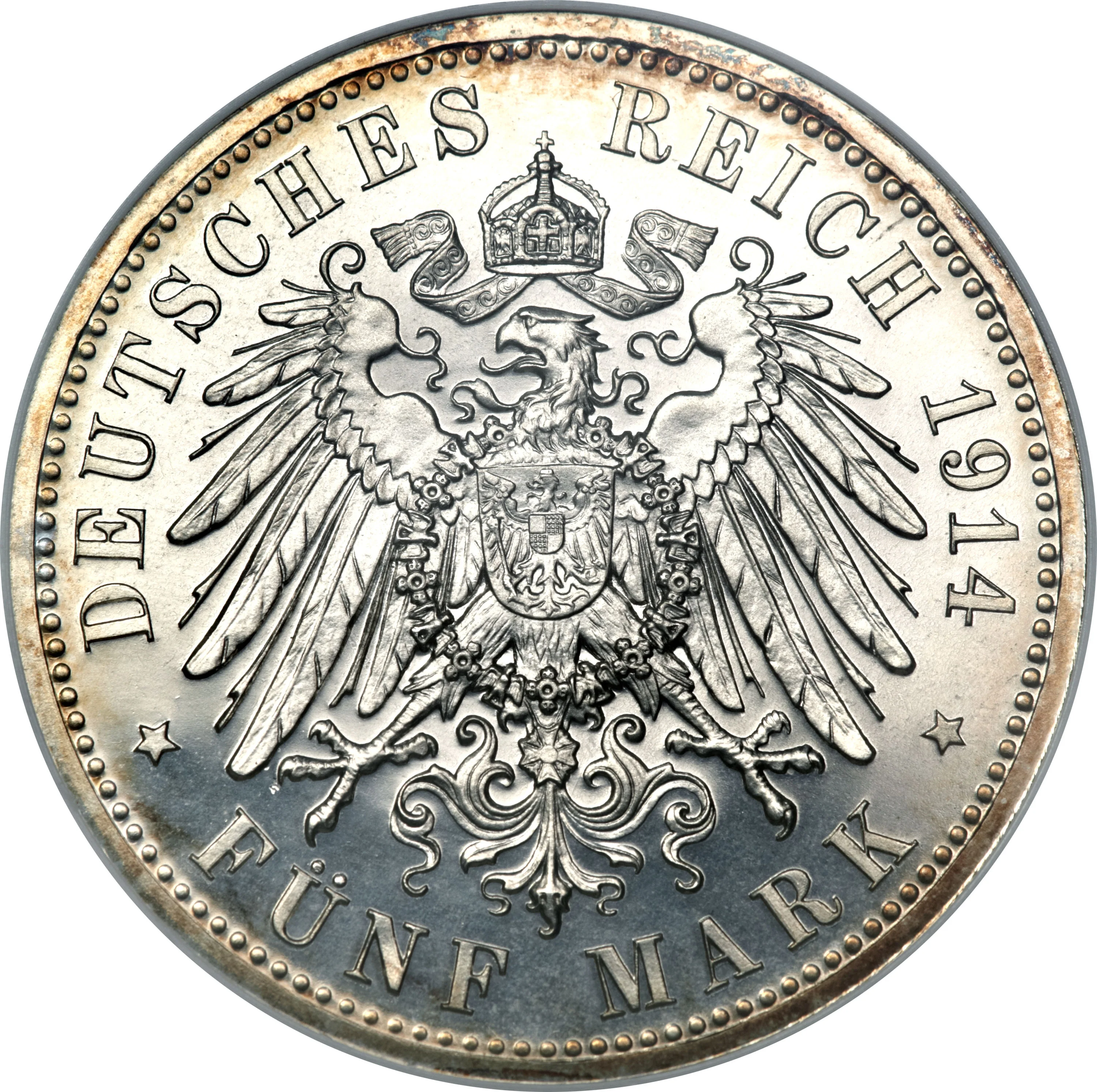
5 Mark (Wedding of Frederick II and Marie) – Anhalt-Dessau
Circulating commemorative coins
Commemoration: 25th Anniversary of the Wedding of Frederick II and Marie
Germany
Context
Year: 1914
Country: Germany 
Issuer: Anhalt-Dessau
Ruler: Frederick II
Currency:
Demonetized: Yes
Total mintage: 31,000
Material
References
KM: #Click to copy to clipboard31
Numista: #30796
Value
Bullion value: $69.30
Obverse
Description:
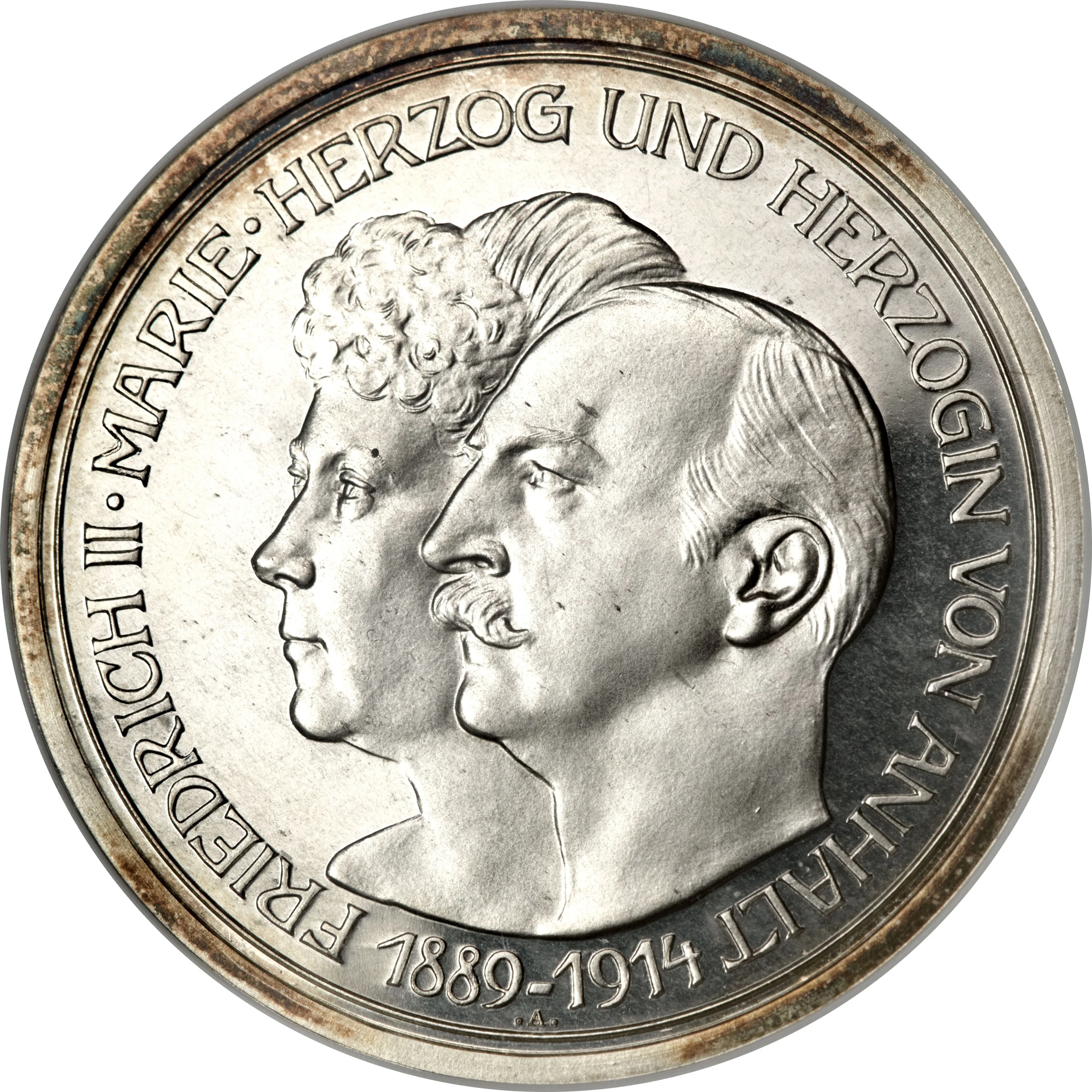
Inscription around rim. Left-facing profiles of Duke Friedrich II of Anhalt and Duchess Marie of Baden. Mint mark below.
Inscription:
FRIEDRICH II· MARIE· HERZOG UND HERZOGIN VON ANHALT
1889-1914
.A .
1889-1914
.A .
Translation:
FREDERICK II · MARIE · DUKE AND DUCHESS OF ANHALT
1889-1914
.A .
1889-1914
.A .
Script: Latin
Language: German
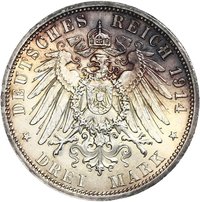
Reverse
Edge
Categories
| Marriage |
Mints
| Name | Mark |
|---|---|
| Berlin | A |
Historical background
In 1914, the currency situation in the Duchy of Anhalt-Dessau, like in all German states, was governed by the unified monetary system established by the German Empire in 1871. The official and exclusive legal tender was the German Goldmark, a stable currency backed by the Reichsbank in Berlin. This meant that the era of individual states issuing their own distinct coinage had ended; Anhalt-Dessau no longer possessed an independent monetary policy and its economy was fully integrated into the national financial framework.
However, a legacy of the pre-unification period remained in the form of Scheidemünzen (small change coins). While the Reichsmark was paramount, individual states were permitted to mint low-value, token coins in limited quantities for local use. In Anhalt-Dessau, this included coins in denominations of pfennigs and marks, which bore the insignia of the duchy and the portrait of Duke Friedrich II. These were not sovereign currencies but subsidiary to the Goldmark, accepted everywhere within the Empire and their value guaranteed by the central Reich government.
Consequently, on the eve of World War I, the currency "situation" in Anhalt-Dessau was one of stability and uniformity. Citizens and businesses transacted in a single, trusted national currency, with locally minted small change serving a practical function. This financial normality would be profoundly disrupted just weeks later, with the outbreak of war in August 1914 leading to the suspension of gold convertibility, the eventual issuance of Notgeld (emergency money), and the period of inflation that would mark the subsequent years.
However, a legacy of the pre-unification period remained in the form of Scheidemünzen (small change coins). While the Reichsmark was paramount, individual states were permitted to mint low-value, token coins in limited quantities for local use. In Anhalt-Dessau, this included coins in denominations of pfennigs and marks, which bore the insignia of the duchy and the portrait of Duke Friedrich II. These were not sovereign currencies but subsidiary to the Goldmark, accepted everywhere within the Empire and their value guaranteed by the central Reich government.
Consequently, on the eve of World War I, the currency "situation" in Anhalt-Dessau was one of stability and uniformity. Citizens and businesses transacted in a single, trusted national currency, with locally minted small change serving a practical function. This financial normality would be profoundly disrupted just weeks later, with the outbreak of war in August 1914 leading to the suspension of gold convertibility, the eventual issuance of Notgeld (emergency money), and the period of inflation that would mark the subsequent years.
💎 Very Rare