

1 Vereinsthaler – Anhalt-Dessau
Circulating commemorative coins
Commemoration: Reunification of the Anhalt Duchies on the 19th of August 1863
Germany
Context
Year: 1863
Country: Germany 
Issuer: Anhalt-Dessau
Ruler: Leopold IV Frederick
Currency:
Subdivision: 1 Vereinsthaler = 1⁄30 Metric Pound
Demonetized: Yes
Total mintage: 20,300
Material
References
KM: #Click to copy to clipboard15
Numista: #30793
Value
Bullion value: $46.20
Obverse
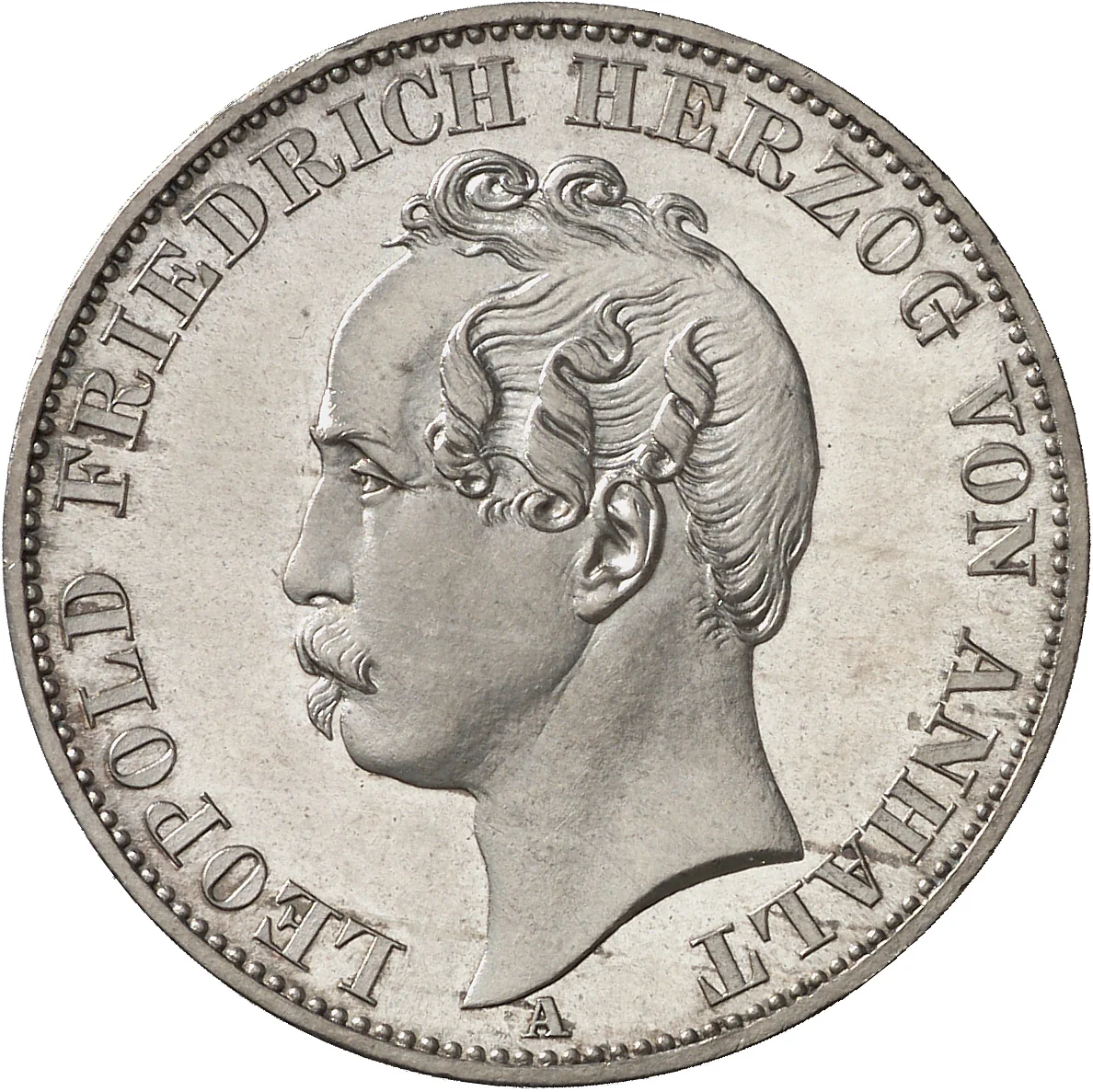
Description:
Inscription encircling left-facing portrait of Duke Leopold Friedrich of Anhalt-Dessau; mint mark below.
Inscription:
LEOPOLD FRIEDRICH HERZOG VON ANHALT
A
A
Translation:
LEOPOLD FRIEDRICH DUKE OF ANHALT
Script: Latin
Language: German
Designer: Friedrich Wilhelm Kullrich
Reverse
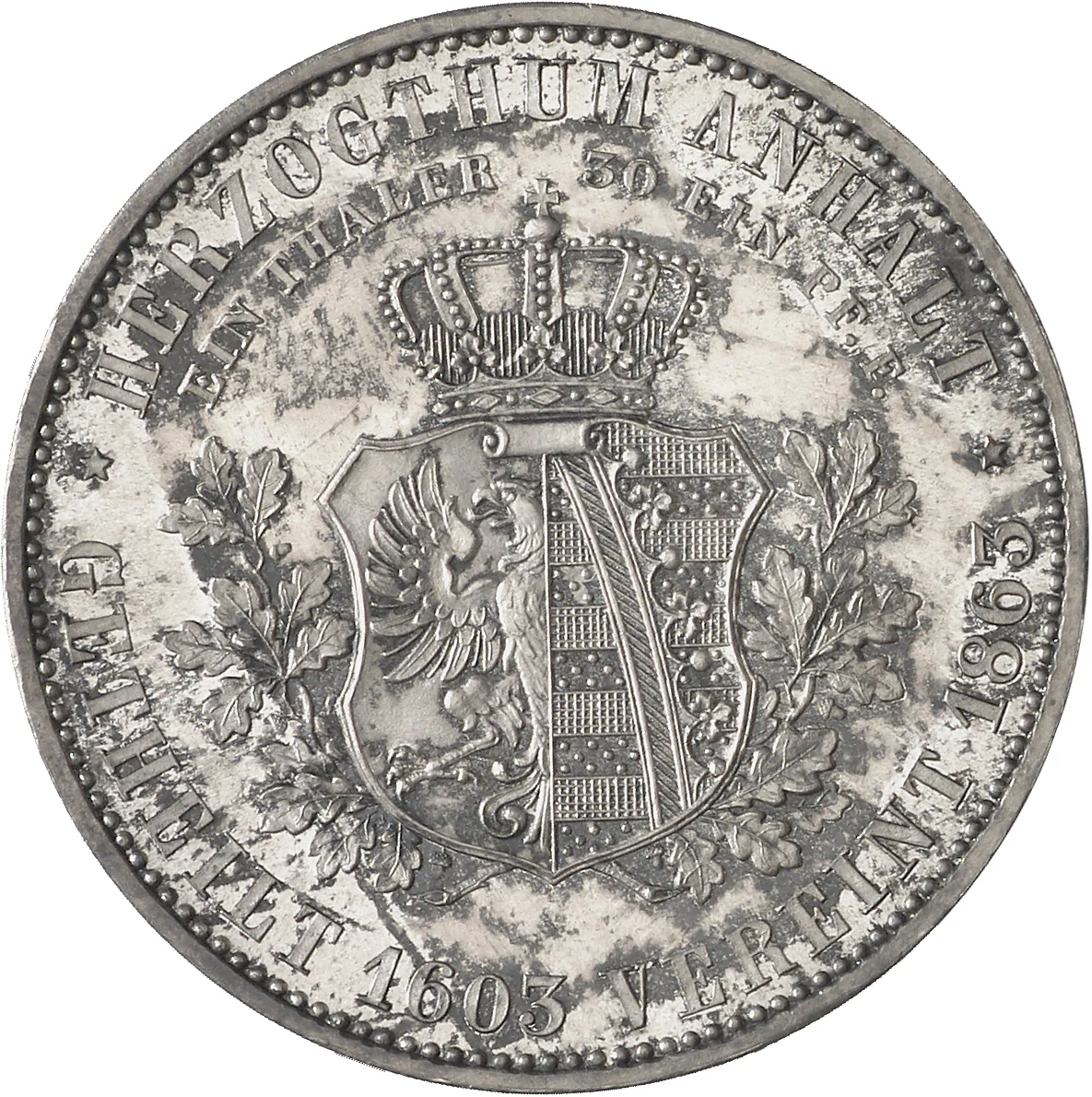
Description:
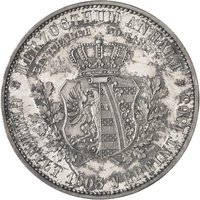
Top: denomination. Center: crowned family and state arms flanked by oak branches. Bottom: date.
Inscription:
* HERZOGTHUM ANHALT *
EIN THALER 30 EIN PF. F.
GETHEILT 1603 VEREINT 1863
EIN THALER 30 EIN PF. F.
GETHEILT 1603 VEREINT 1863
Script: Latin
Designer: Friedrich Wilhelm Kullrich
Edge
Plain with inscription.
Legend:
GOTT SEGNE ANHALT
Mints
| Name | Mark |
|---|---|
| Berlin | A |
Mintings
| Year | Mint Mark | Mintage | Quality | Collection |
|---|---|---|---|---|
| 1863 | A | 20,300 |
Historical background
In 1863, the currency situation in the Duchy of Anhalt-Dessau was characterized by its integration within the broader framework of the German Customs Union (Zollverein) and the ongoing struggle for a standardized German monetary system. The duchy, like most German states, had abandoned its own distinct coinage in favor of adhering to the "Vereinsthaler" (Union Thaler) convention established by the Dresden Coinage Treaty of 1838. This treaty created a common silver standard across the Zollverein, defining the Vereinsthaler as a specific weight and fineness of silver. Consequently, Anhalt-Dessau's circulating currency was not uniquely "Anhaltish" but part of this wider, treaty-governed pool of coins minted by various member states, all legally equivalent.
However, this theoretical uniformity coexisted with practical complexity. While large transactions and state accounts were conducted in Vereinsthalers, daily commerce was dominated by a plethora of smaller divisional coins, often older issues from various German regions, and crucially, the competing "South German Gulden" standard. The Dresden Treaty had established a fixed exchange rate of 1 Vereinsthaler to 1.75 Gulden, creating a dual-system where prices were often quoted in both units. This required constant mental calculation from the populace and created friction in trade, a problem felt acutely in a small state like Anhalt-Dessau whose economy was deeply intertwined with its neighbors.
Therefore, the year 1863 represented a late point in a transitional period. The political drive for German unification was intensifying, and with it, the push for a truly uniform currency. The Austro-Prussian War of 1866 would soon resolve the Thaler-Gulden divide in Prussia's favor, leading directly to the creation of the Goldmark under the North German Confederation in 1871. Thus, Anhalt-Dessau in 1863 was operating under a stable but cumbersome silver-based, dual-standard system, on the cusp of being swept into the modern, centralized, and gold-backed currency that would symbolize the new German Empire.
However, this theoretical uniformity coexisted with practical complexity. While large transactions and state accounts were conducted in Vereinsthalers, daily commerce was dominated by a plethora of smaller divisional coins, often older issues from various German regions, and crucially, the competing "South German Gulden" standard. The Dresden Treaty had established a fixed exchange rate of 1 Vereinsthaler to 1.75 Gulden, creating a dual-system where prices were often quoted in both units. This required constant mental calculation from the populace and created friction in trade, a problem felt acutely in a small state like Anhalt-Dessau whose economy was deeply intertwined with its neighbors.
Therefore, the year 1863 represented a late point in a transitional period. The political drive for German unification was intensifying, and with it, the push for a truly uniform currency. The Austro-Prussian War of 1866 would soon resolve the Thaler-Gulden divide in Prussia's favor, leading directly to the creation of the Goldmark under the North German Confederation in 1871. Thus, Anhalt-Dessau in 1863 was operating under a stable but cumbersome silver-based, dual-standard system, on the cusp of being swept into the modern, centralized, and gold-backed currency that would symbolize the new German Empire.
💎 Very Rare