

¼ dollar – United States
Add to wishlist
United States
Context
Years: 1831–1838
Issuer: United States
Period:
(since 1776)
Currency:
(since 1785)
Subdivision: ¼ dollar = 25 Cents
Total mintage: 3,362,400
Material
References
KM: #
Numista: #30781
Value
Exchange value: ¼ USD = $0.25
Bullion value: $15.37
Obverse
Description:
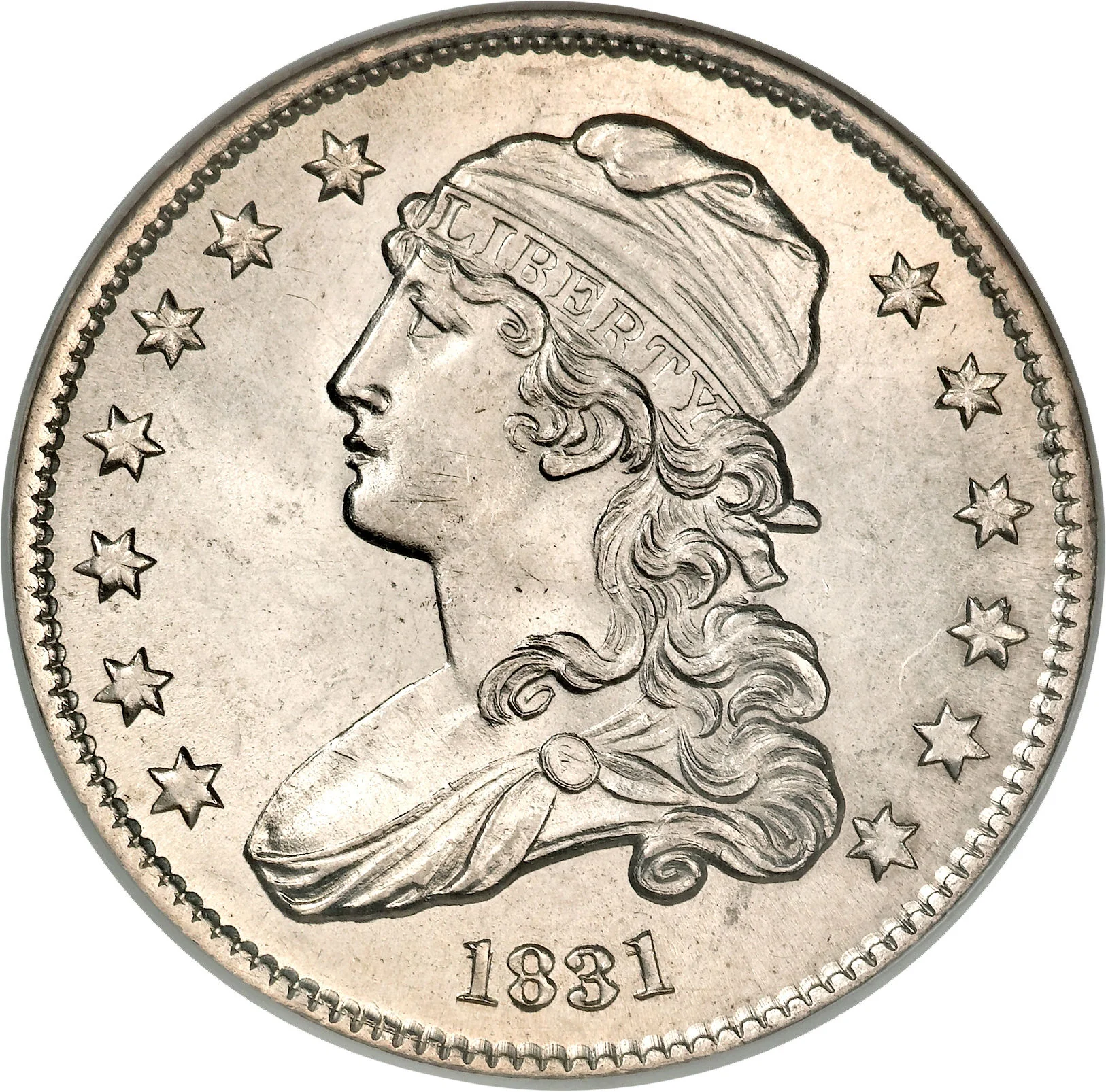
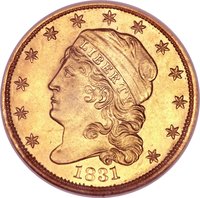
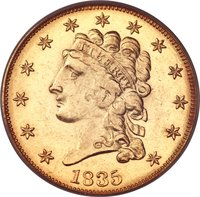
Liberty cap, left. Thirteen stars.
Inscription:
1831
Script: Latin
Engraver: William Kneass
Reverse
Description:
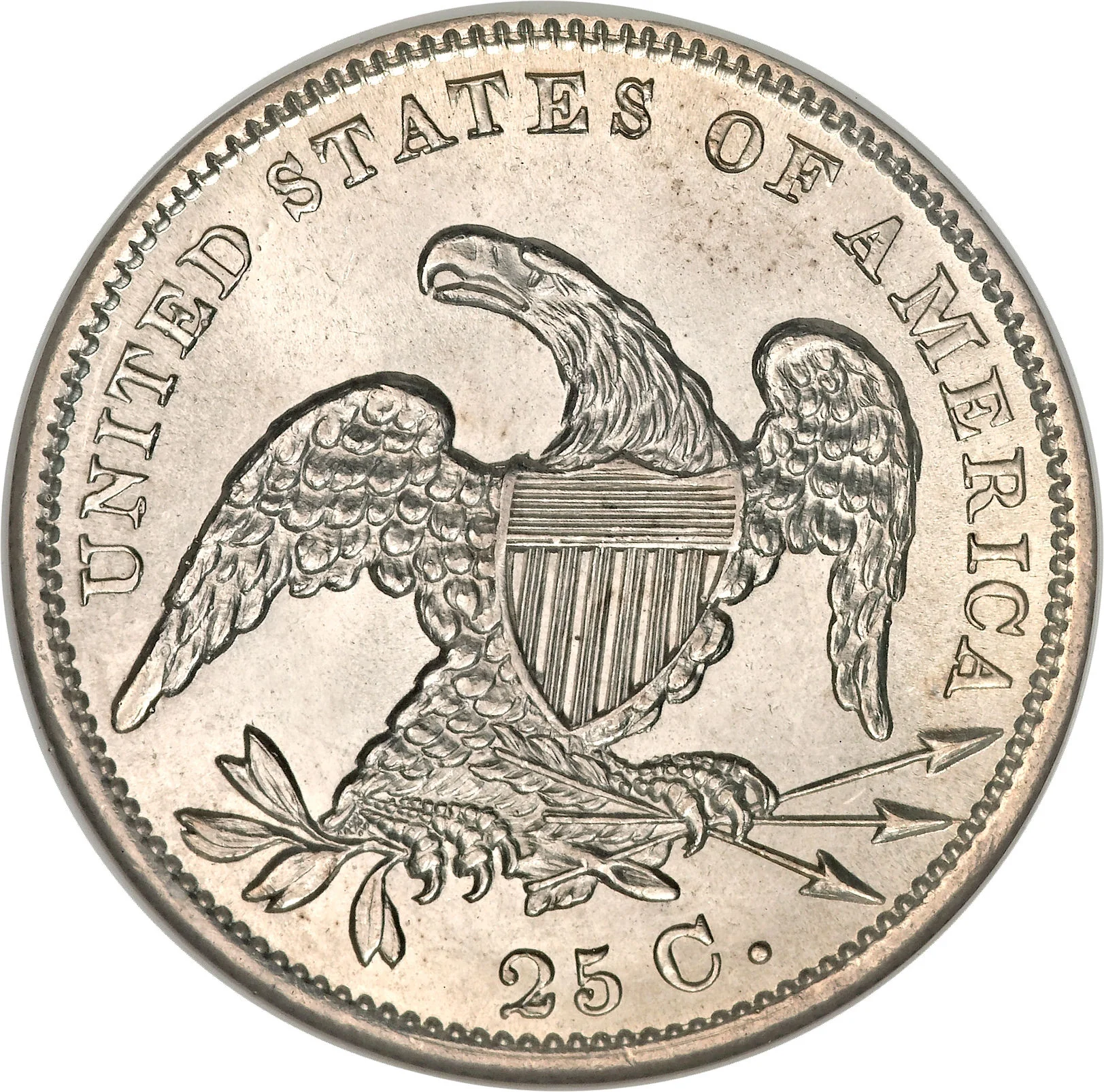
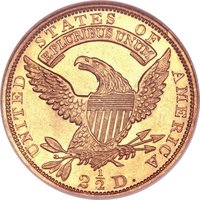
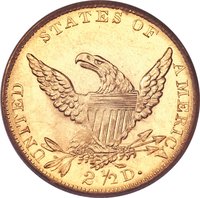
Eagle clutching arrows and an olive branch.
Inscription:
UNITED STATES OF AMERICA
25 C.
25 C.
Script: Latin
Engraver: William Kneass
Edge
Reeded
Categories
| Animal> Bird> Eagle |
| Symbol> Allegory |
| Symbol> Phrygian cap |
| Object> Cold weapons |
Mints
| Name | Mark |
|---|---|
| United States Mint of Philadelphia | — |
Mintings
| Year | Mint Mark | Mintage | Quality | Collection |
|---|---|---|---|---|
| 1831 | — | — | ||
| 1832 | — | 320,000 | ||
| 1833 | — | — | ||
| 1834 | — | — | ||
| 1835 | — | 1,952,000 | ||
| 1836 | — | 472,000 | ||
| 1837 | — | 252,400 | ||
| 1838 | — | 366,000 |
Historical background
In 1831, the United States operated under a bimetallic standard, where both gold and silver were legal tender, with their values fixed by law at a ratio of 15-to-1. However, this official ratio did not align with the global market, where silver was slightly undervalued. Consequently, gold coins were exported for profit, leaving silver as the dominant circulating coinage. The nation lacked a uniform federal paper currency; instead, a patchwork of hundreds of state-chartered private banks issued their own banknotes, redeemable in specie (gold or silver) upon demand. This system created a complex and often unreliable monetary landscape, as the value and acceptability of these notes depended entirely on the solvency and reputation of the issuing bank, leading to frequent counterfeiting and depreciation.
The era was defined by the bitter political struggle over the Second Bank of the United States (BUS), which held a federal charter and acted as the government's fiscal agent. Under President Nicholas Biddle, the BUS exercised significant control over the money supply by regulating the notes of state banks, demanding they redeem their notes in specie, which helped curb inflation and maintain stability. To President Andrew Jackson and his agrarian allies, however, the BUS represented a dangerous concentration of financial power, an unconstitutional monopoly that favored Eastern commercial interests over common farmers and debtors. This conflict was reaching its peak in 1831, as Jackson made the Bank's recharter a central issue in his bid for re-election.
Thus, the currency situation in 1831 was one of tension and transition. While the bimetallic standard and the disciplining role of the BUS provided a framework for stability, the system was politically polarized and geographically uneven. The widespread circulation of heterogeneous state banknotes created practical daily uncertainty for citizens, while the looming battle over the national bank threatened a fundamental reshaping of the nation's financial architecture. The stage was set for Jackson's eventual veto of the BUS recharter in 1832, which would lead to the Bank's demise and a subsequent era of wildcat banking and monetary instability.
The era was defined by the bitter political struggle over the Second Bank of the United States (BUS), which held a federal charter and acted as the government's fiscal agent. Under President Nicholas Biddle, the BUS exercised significant control over the money supply by regulating the notes of state banks, demanding they redeem their notes in specie, which helped curb inflation and maintain stability. To President Andrew Jackson and his agrarian allies, however, the BUS represented a dangerous concentration of financial power, an unconstitutional monopoly that favored Eastern commercial interests over common farmers and debtors. This conflict was reaching its peak in 1831, as Jackson made the Bank's recharter a central issue in his bid for re-election.
Thus, the currency situation in 1831 was one of tension and transition. While the bimetallic standard and the disciplining role of the BUS provided a framework for stability, the system was politically polarized and geographically uneven. The widespread circulation of heterogeneous state banknotes created practical daily uncertainty for citizens, while the looming battle over the national bank threatened a fundamental reshaping of the nation's financial architecture. The stage was set for Jackson's eventual veto of the BUS recharter in 1832, which would lead to the Bank's demise and a subsequent era of wildcat banking and monetary instability.
🌱 Fairly Common