

½ cent – United States
Add to wishlist
United States
Context
Years: 1809–1836
Issuer: United States
Period:
(since 1776)
Currency:
(since 1785)
Total mintage: 3,031,912
Material
References
KM: #
Numista: #30704
Value
Exchange value: 1⁄200 USD = $0.00
Obverse
Description:
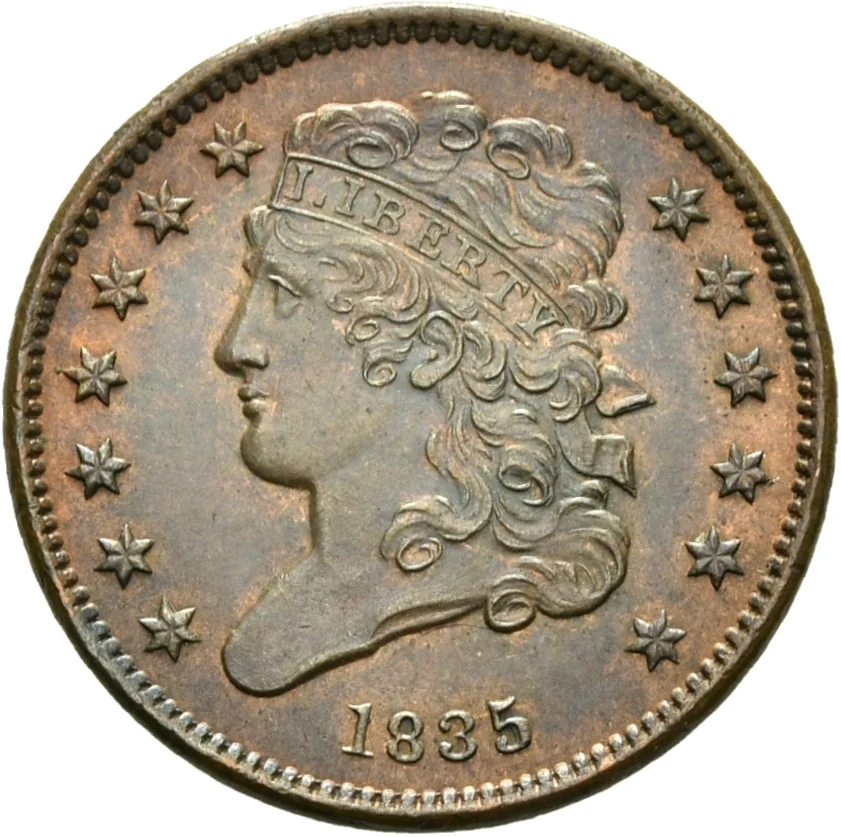
Classic left-facing bust, date below.
Inscription:
1833
Script: Latin
Engraver: Robert Scot
Designer: John Reich
Reverse
Description:
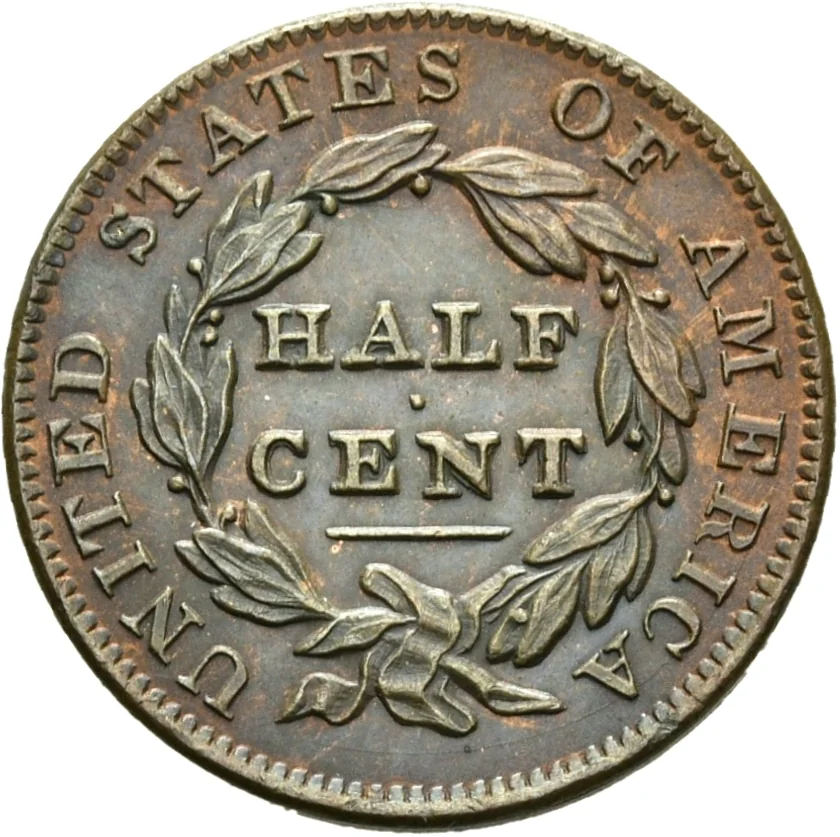
Value within wreath, country name around rim.
Inscription:
UNITED STATES OF AMERICA
HALF CENT
HALF CENT
Script: Latin
Engraver: Robert Scot
Designer: John Reich
Edge
Plain
Mints
| Name | Mark |
|---|---|
| United States Mint of Philadelphia | — |
Mintings
| Year | Mint Mark | Mintage | Quality | Collection |
|---|---|---|---|---|
| 1809 | — | 1,154,572 | ||
| 1810 | — | 215,000 | ||
| 1811 | — | 63,140 | ||
| 1825 | — | 63,000 | ||
| 1826 | — | 234,000 | ||
| 1828 | — | — | ||
| 1829 | — | 487,000 | ||
| 1831 | — | 2,200 | ||
| 1832 | — | 154,000 | ||
| 1833 | — | 120,000 | ||
| 1834 | — | 141,000 | ||
| 1835 | — | 398,000 | ||
| 1836 | — | — | Proof |
Historical background
In 1809, the United States operated without a central bank or a uniform national currency, creating a complex and often chaotic monetary landscape. The First Bank of the United States, which had provided some stability, saw its charter expire in 1811, leaving a void in federal oversight. Consequently, the primary circulating "money" consisted of foreign coins—especially Spanish silver dollars and their fractional parts (reales, or "bits")—and a vast array of paper banknotes issued by hundreds of state-chartered private banks. This system was inherently unstable, as the value and acceptability of a banknote depended entirely on the reputation and distance from the issuing bank, leading to widespread counterfeiting and frequent bank failures.
The federal government's role in currency was minimal. It minted gold and silver coins at the Philadelphia Mint, but these were in short supply and often exported or hoarded. To finance its operations, the Treasury issued its own debt instruments, but these did not function as everyday currency. The real economic lifeblood was the heterogeneous mix of private banknotes, which traded at varying discounts depending on the perceived solvency of the issuer. Merchants and citizens needed published "banknote detectors" to navigate this system, verifying the authenticity and current value of notes from distant banks.
This fragmented system posed significant challenges to interstate commerce and economic development. The lack of a uniform, trusted currency hindered trade and credit, while the impending War of 1812 (declared in 1812) would soon expose the system's profound weaknesses. The war's financial demands would lead to a suspension of specie (gold and silver) payments by banks outside of New England, causing severe inflation and currency depreciation, and ultimately forcing a national reckoning that would lead to the chartering of the Second Bank of the United States in 1816.
The federal government's role in currency was minimal. It minted gold and silver coins at the Philadelphia Mint, but these were in short supply and often exported or hoarded. To finance its operations, the Treasury issued its own debt instruments, but these did not function as everyday currency. The real economic lifeblood was the heterogeneous mix of private banknotes, which traded at varying discounts depending on the perceived solvency of the issuer. Merchants and citizens needed published "banknote detectors" to navigate this system, verifying the authenticity and current value of notes from distant banks.
This fragmented system posed significant challenges to interstate commerce and economic development. The lack of a uniform, trusted currency hindered trade and credit, while the impending War of 1812 (declared in 1812) would soon expose the system's profound weaknesses. The war's financial demands would lead to a suspension of specie (gold and silver) payments by banks outside of New England, causing severe inflation and currency depreciation, and ultimately forcing a national reckoning that would lead to the chartering of the Second Bank of the United States in 1816.

🌱 Common