

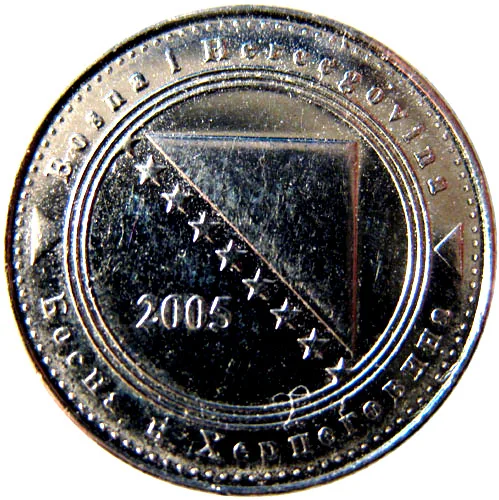
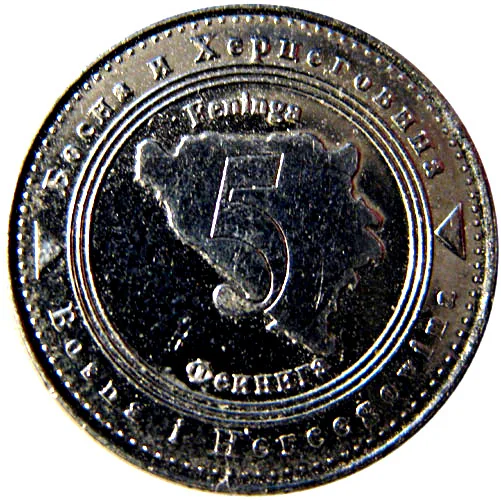
5 feninga – Bosnia and Herzegovina
Add to wishlist
Bosnia and Herzegovina
Context
Years: 2005–2025
Issuer: Bosnia and Herzegovina
Period:
(since 1992)
Currency:
(since 1998)
Total mintage: 86,564,000
Material
References
KM: #
Numista: #3069
Value
Exchange value: 0.05 BAM
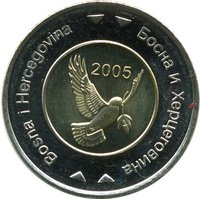
Obverse
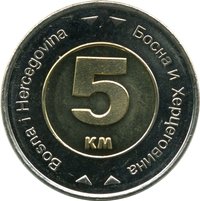
Reverse
Edge
Reeded
Mints
| Name | Mark |
|---|---|
| Royal Mint | — |
Mintings
| Year | Mint Mark | Mintage | Quality | Collection |
|---|---|---|---|---|
| 2005 | — | 20,000,000 | ||
| 2008 | — | 10,000,000 | ||
| 2011 | — | 10,000,000 | ||
| 2013 | — | 21,564,000 | ||
| 2017 | — | 25,000,000 | ||
| 2021 | — | — | ||
| 2025 | — | — |
Historical background
In 2005, Bosnia and Herzegovina (BiH) operated under a unique and stable currency regime established by the Dayton Peace Agreement. The official currency was the Convertible Mark (BAM), introduced in 1998 to replace the Bosnian dinar, Croatian kuna, and other notes circulating in the country's entities. Its design was a powerful symbol of national unity, featuring neutral motifs like landscapes and historical figures instead of politically charged symbols, and it was pegged to the Euro (and previously the German Mark) at a fixed rate of 1 EUR = 1.95583 BAM. This currency board arrangement, managed by the Central Bank of Bosnia and Herzegovina, was crucial for providing monetary stability, controlling inflation, and fostering post-war economic recovery by instilling confidence in the financial system.
The currency situation was intrinsically linked to the country's complex political structure. The BAM was the sole legal tender across the entire state, a key factor in maintaining economic cohesion between the two highly autonomous entities: the Federation of Bosnia and Herzegovina (FBiH) and the Republika Srpska (RS). Despite this unified currency, fiscal policy remained decentralized, with each entity having its own budget, tax administration, and significant economic autonomy. This created challenges, as coordinated economic reform was often difficult to achieve, but the shared and stable currency provided a critical common foundation for trade and investment.
By 2005, the Convertible Mark was considered a significant success story in BiH's post-war reconstruction. It had effectively eliminated hyperinflation and provided a predictable environment for business. However, the rigid currency board also meant Bosnia had relinquished control over its independent monetary policy, relying entirely on the stability of the Eurozone. The economy faced persistent issues like high unemployment, a large informal sector, and a cumbersome administrative structure, but the currency itself was not a source of instability. The focus for policymakers in 2005 was less on the currency regime and more on using this stability to implement structural reforms and stimulate growth within the constraints of the fixed exchange rate.
The currency situation was intrinsically linked to the country's complex political structure. The BAM was the sole legal tender across the entire state, a key factor in maintaining economic cohesion between the two highly autonomous entities: the Federation of Bosnia and Herzegovina (FBiH) and the Republika Srpska (RS). Despite this unified currency, fiscal policy remained decentralized, with each entity having its own budget, tax administration, and significant economic autonomy. This created challenges, as coordinated economic reform was often difficult to achieve, but the shared and stable currency provided a critical common foundation for trade and investment.
By 2005, the Convertible Mark was considered a significant success story in BiH's post-war reconstruction. It had effectively eliminated hyperinflation and provided a predictable environment for business. However, the rigid currency board also meant Bosnia had relinquished control over its independent monetary policy, relying entirely on the stability of the Eurozone. The economy faced persistent issues like high unemployment, a large informal sector, and a cumbersome administrative structure, but the currency itself was not a source of instability. The focus for policymakers in 2005 was less on the currency regime and more on using this stability to implement structural reforms and stimulate growth within the constraints of the fixed exchange rate.
🌱 Very Common