

5 Mark – German Democratic Republic
Circulating commemorative coins
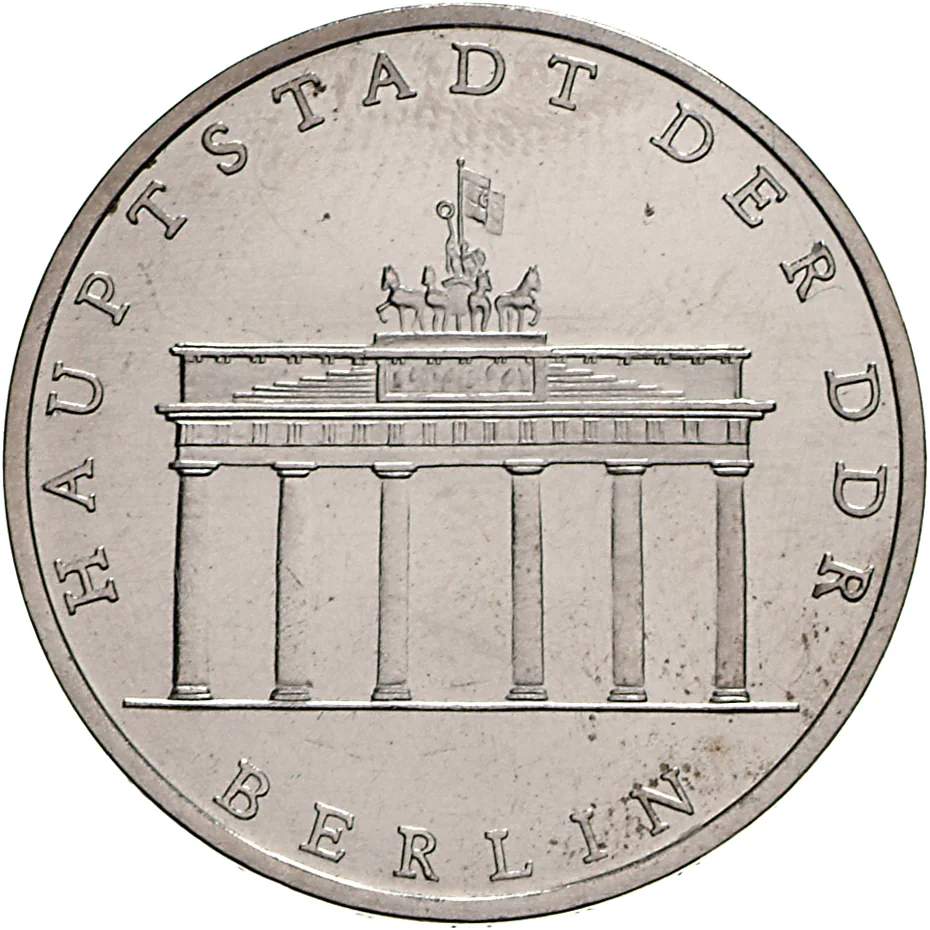
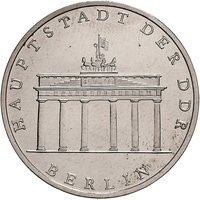
Commemoration: The Brandenburg gate of Berlin
Germany
Context
Years: 1971–1990
Country: Germany 
Issuer: German Democratic Republic 
Period:
(1949—1990)
Currency:
(1948—1990)
Demonetization: 30 June 1990
Total mintage: 18,777,266
Material
Diameter: 29 mm
Weight: 9.7 g
Thickness: 2.07 mm
Shape: Round
Composition: Copper-nickel
Technique: Milled
Alignment: Medal alignment
flip
References
KM: #Click to copy to clipboard29
Numista: #3058
Value
Exchange value: 5 DDM
Inflation-adjusted value: 21.63 DDM
Obverse
Description:
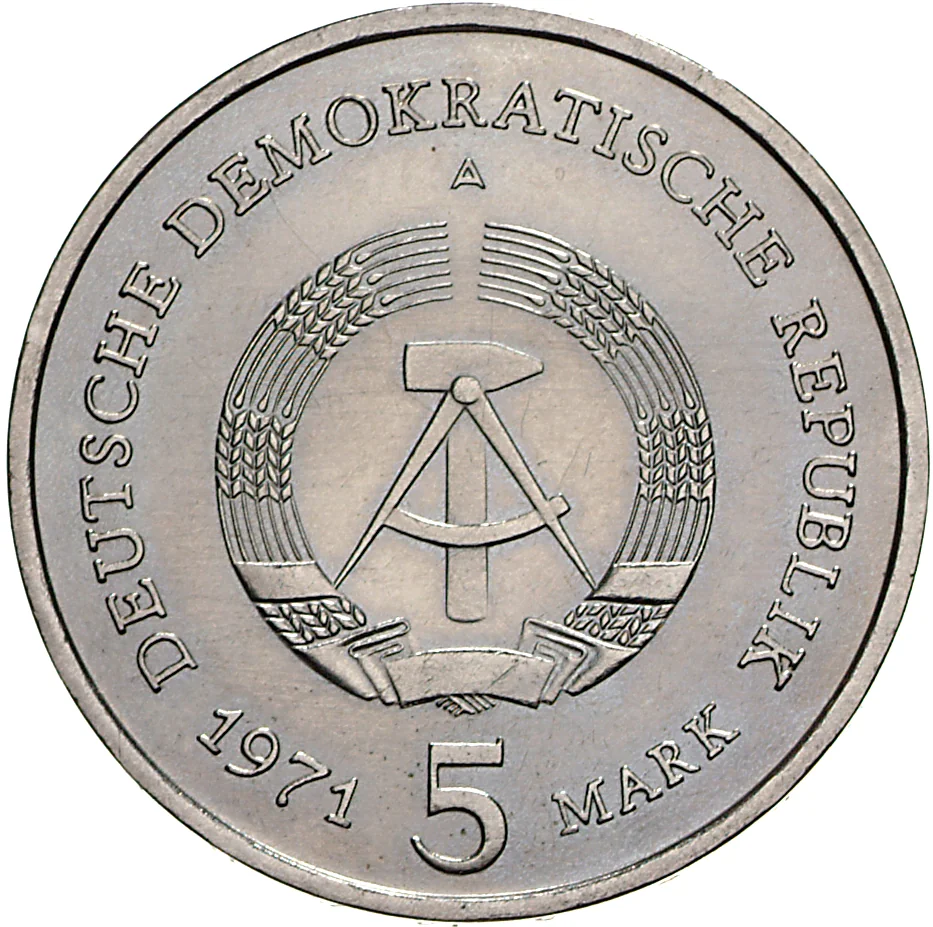
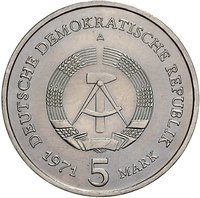
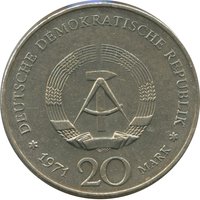
East German emblem in center, country name above rim, date left of value below.
Inscription:
DEUTSCHE DEMOKRATISCHE REPUBLIK
A
1971 5 MARK
A
1971 5 MARK
Translation:
German Democratic Republic
A
1971 5 Mark
A
1971 5 Mark
Script: Latin
Language: German
Engraver: Wilfried Fitzenreiter
Reverse
Edge
Plain with incuse lettering.
Legend:
* 5 MARK * 5 MARK * 5 MARK * 5 MARK
Categories
| Building |
Mints
| Name | Mark |
|---|---|
| Berlin | A |
Mintings
| Year | Mint Mark | Mintage | Quality | Collection |
|---|---|---|---|---|
| 1971 | A | 18,137,882 | ||
| 1979 | A | 32,500 | ||
| 1979 | A | 2,500 | Proof | |
| 1980 | A | 29,800 | ||
| 1980 | A | 2,500 | Proof | |
| 1981 | A | 30,900 | ||
| 1981 | A | 2,500 | Proof | |
| 1982 | A | 30,000 | ||
| 1982 | A | 2,500 | Proof | |
| 1983 | A | 3,000 | ||
| 1984 | A | 18,500 | ||
| 1984 | A | 3,015 | Proof | |
| 1985 | A | 3,000 | ||
| 1986 | A | 2,800 | Proof | |
| 1986 | A | 15,780 | ||
| 1987 | A | 347,310 | ||
| 1987 | A | 6,424 | Proof | |
| 1988 | A | 25,650 | ||
| 1988 | A | 2,300 | Proof | |
| 1989 | A | 25,500 | ||
| 1989 | A | 2,405 | Proof | |
| 1990 | A | 50,500 |
Historical background
In 1971, the currency situation in the German Democratic Republic (GDR) was defined by the rigid separation of its monetary system from the West through the Alleinvertretungsanspruch (sole representation claim) and the use of a non-convertible currency. The official currency, the GDR Mark (Mark der DDR), was artificially maintained by the state and could not be freely exchanged for Western currencies, particularly the Deutsche Mark (DM) used in the Federal Republic of Germany (FRG). This created a fundamental economic duality: while the official exchange rate for administrative purposes was set at 1:1, a vastly different and highly sought-after black market rate existed, where one West German DM could fetch between 4 and 10 East German Marks, starkly revealing the weakness of the GDR's planned economy.
This dual-currency reality was a source of major economic and political vulnerability for the SED regime. The superior purchasing power of the Deutsche Mark made it a highly desirable parallel currency within the GDR, used in the Intershops—special retail stores established in 1962 that sold coveted Western goods. These shops, accessible only with hard currency, created a two-tiered consumer society that undermined socialist ideology and highlighted the system's inability to provide a comparable standard of living. Furthermore, the GDR was financially propped up by a complex system of mandatory currency exchange for Western visitors, which forced them to change a minimum amount of DM into GDR Marks at the artificial 1:1 rate, generating vital hard currency revenue for the state.
The year 1971 was particularly significant as it fell during the transition of power from Walter Ulbricht to Erich Honecker, who would soon launch a new "Unity of Economic and Social Policy." While major currency reforms were not enacted that specific year, the persistent pressures of the currency situation—capital flight, consumer dissatisfaction, and the drain of hard currency reserves—fundamentally shaped Honecker’s subsequent policies. His administration would later increase dependence on Western credits and expand the Intershop system, further entrenching the monetary divide as a permanent, if embarrassing, feature of East German life until its collapse in 1989-90.
This dual-currency reality was a source of major economic and political vulnerability for the SED regime. The superior purchasing power of the Deutsche Mark made it a highly desirable parallel currency within the GDR, used in the Intershops—special retail stores established in 1962 that sold coveted Western goods. These shops, accessible only with hard currency, created a two-tiered consumer society that undermined socialist ideology and highlighted the system's inability to provide a comparable standard of living. Furthermore, the GDR was financially propped up by a complex system of mandatory currency exchange for Western visitors, which forced them to change a minimum amount of DM into GDR Marks at the artificial 1:1 rate, generating vital hard currency revenue for the state.
The year 1971 was particularly significant as it fell during the transition of power from Walter Ulbricht to Erich Honecker, who would soon launch a new "Unity of Economic and Social Policy." While major currency reforms were not enacted that specific year, the persistent pressures of the currency situation—capital flight, consumer dissatisfaction, and the drain of hard currency reserves—fundamentally shaped Honecker’s subsequent policies. His administration would later increase dependence on Western credits and expand the Intershop system, further entrenching the monetary divide as a permanent, if embarrassing, feature of East German life until its collapse in 1989-90.
🌱 Very Common