

20 pesos (Foundation of Mexico-Tenochtitlan) – Mexico
Add to wishlist
Circulating commemorative coins
Commemoration: 700th Anniversary of the Foundation of Mexico-Tenochtitlan
Mexico
Context
Material
Diameter: 30 mm
Weight: 12.67 g
Thickness: 2.4 mm
Shape: Dodecagonal
Techniques: Latent image, Milled
Alignment: Coin alignment
flip
References
KM: #
Numista: #305469
Value
Exchange value: 20 MXN
Inflation-adjusted value: 25.06 MXN
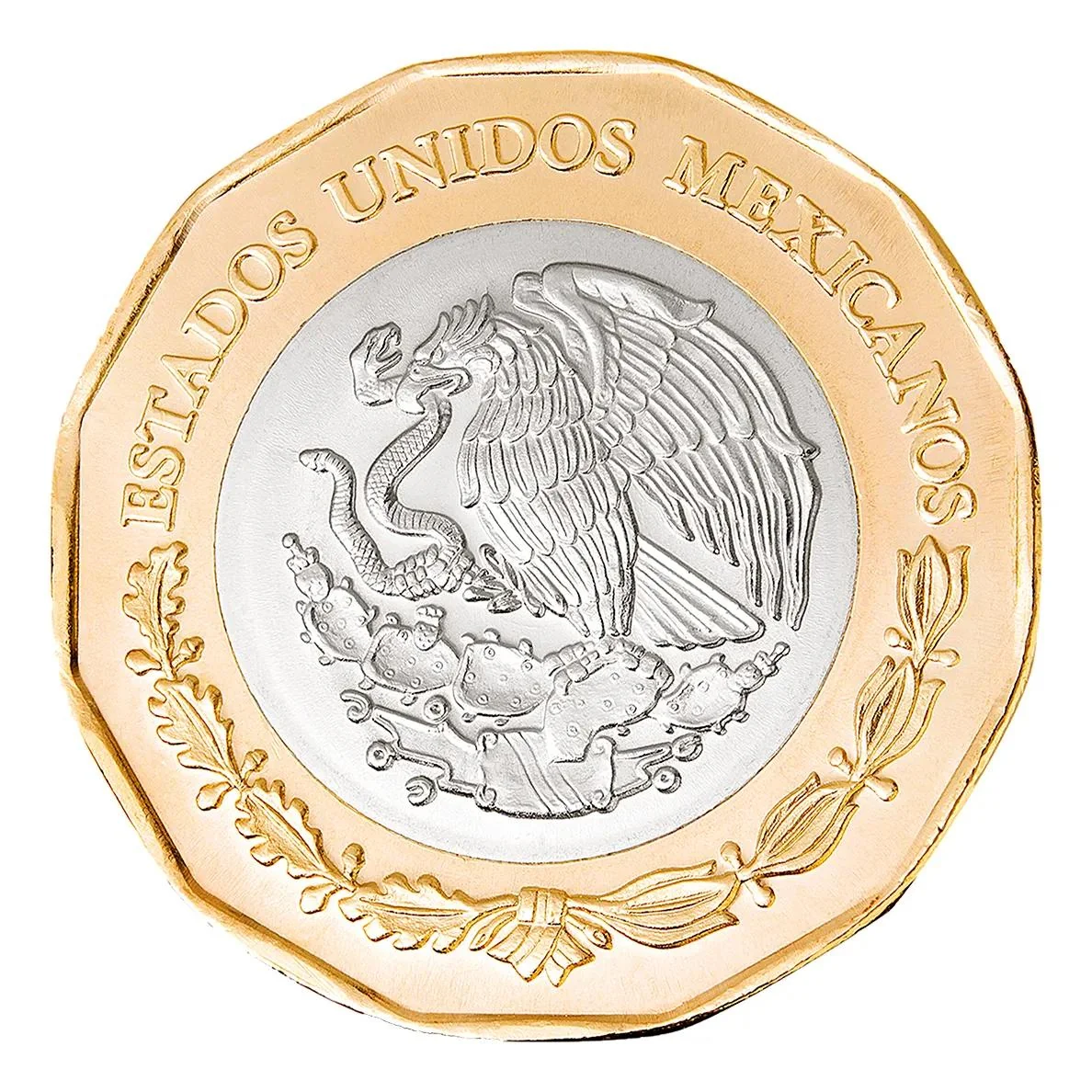
Obverse
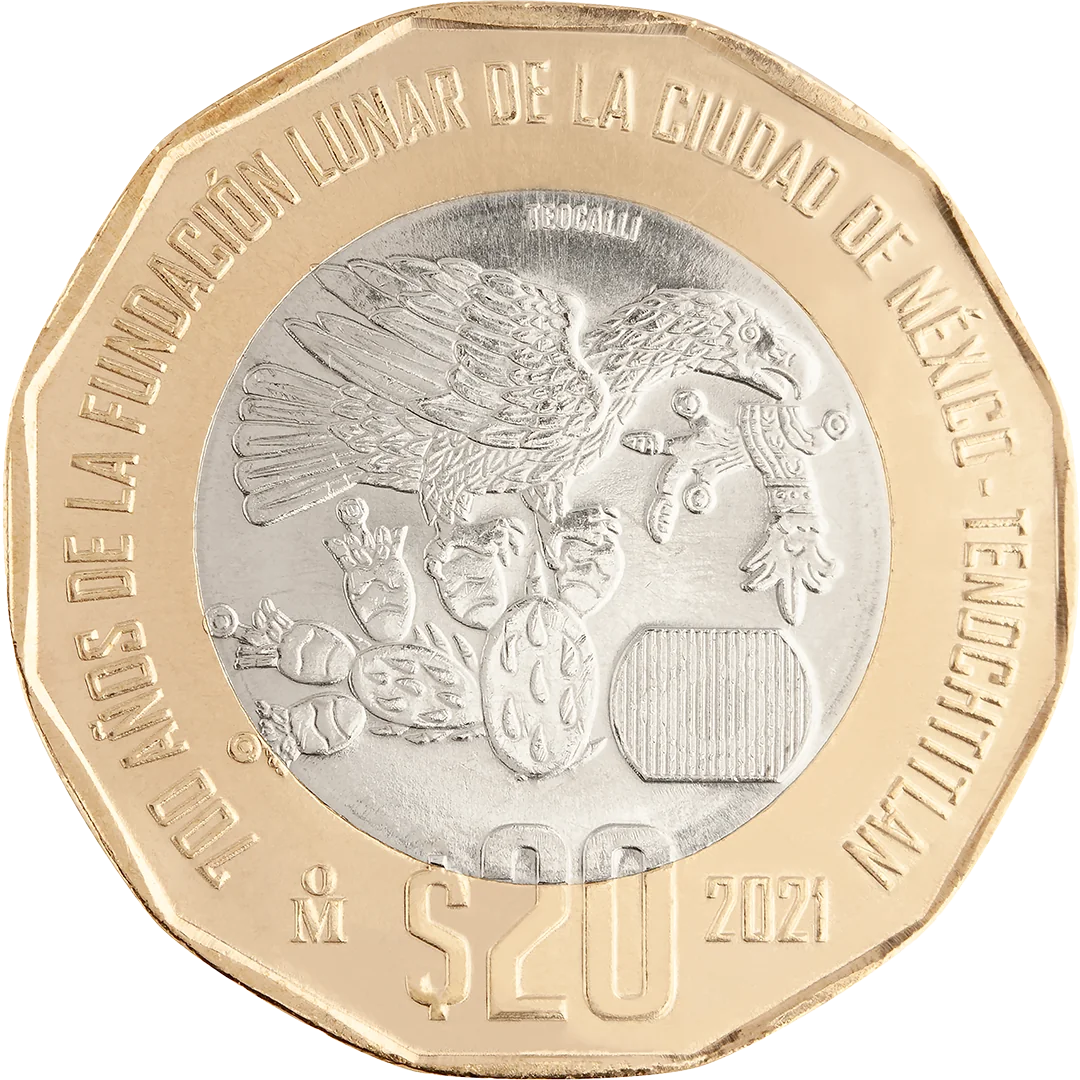
Reverse
Description:
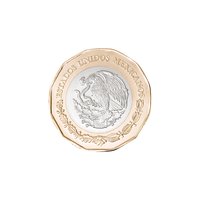
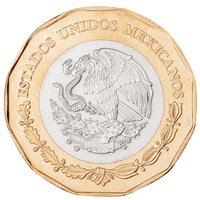
The coin's centerfield features the eagle from the "Teocalli de la Guerra Sagrada," with the moon glyph as a latent image on the right.
Inscription:
700 Años De La Fundación Lunar De La Ciudad De México-Tenochtitlan
Mo $20 2021
Mo $20 2021
Translation:
700 Years Since the Lunar Foundation of Mexico City-Tenochtitlan
Mo $20 2021
Mo $20 2021
Script: Latin
Language: Spanish
Edge
Segmented reeding
Categories
| Animal> Bird> Eagle |
| Symbols> Coat of Arms |
Mints
| Name | Mark |
|---|---|
| Mexican Mint | (Mo) |
Mintings
| Year | Mint Mark | Mintage | Quality | Collection |
|---|---|---|---|---|
| 2021 | Mo | 30,500,000 |
Historical background
In 2021, Mexico's currency, the peso (MXN), demonstrated notable resilience despite significant global and domestic headwinds. The year began with the peso trading at approximately 20.0 per US dollar, strengthening to around 19.8 by year-end—a modest but meaningful appreciation. This performance was underpinned by high remittances from abroad, which reached record levels, and a relatively high interest rate differential compared to major economies, attracting portfolio investment. Furthermore, the global economic recovery and rising oil prices provided tailwinds for an export-oriented economy like Mexico's.
However, this stability was achieved against a backdrop of persistent challenges. Domestically, President Andrés Manuel López Obrador's (AMLO) policy direction, including initiatives that favored state-owned energy companies and heightened regulatory uncertainty, periodically weighed on investor sentiment. The Banco de México (Banxico) played a crucial role, proactively raising its benchmark interest rate from 4.25% to 5.50% over the year to combat inflation, which surged well above its 3% target due to global supply chain disruptions and rising commodity prices. This hawkish monetary policy helped support the peso by maintaining yield attractiveness.
Globally, the peso remained sensitive to shifts in U.S. monetary policy expectations and broader risk appetite. The prospect of tightening by the U.S. Federal Reserve and the persistence of the COVID-19 pandemic, particularly the Delta variant, created volatility. Ultimately, 2021 was characterized by the peso's ability to weather these storms, ending the year as one of the best-performing currencies among major emerging markets, a testament to the balancing act between Banxico's credible policy and the market's cautious view of the domestic economic landscape.
However, this stability was achieved against a backdrop of persistent challenges. Domestically, President Andrés Manuel López Obrador's (AMLO) policy direction, including initiatives that favored state-owned energy companies and heightened regulatory uncertainty, periodically weighed on investor sentiment. The Banco de México (Banxico) played a crucial role, proactively raising its benchmark interest rate from 4.25% to 5.50% over the year to combat inflation, which surged well above its 3% target due to global supply chain disruptions and rising commodity prices. This hawkish monetary policy helped support the peso by maintaining yield attractiveness.
Globally, the peso remained sensitive to shifts in U.S. monetary policy expectations and broader risk appetite. The prospect of tightening by the U.S. Federal Reserve and the persistence of the COVID-19 pandemic, particularly the Delta variant, created volatility. Ultimately, 2021 was characterized by the peso's ability to weather these storms, ending the year as one of the best-performing currencies among major emerging markets, a testament to the balancing act between Banxico's credible policy and the market's cautious view of the domestic economic landscape.

🌱 Common