

50 Pence – Falkland Islands
Non-circulating coins
Commemoration: Liberation of the Falkland Islands & the end of the Falkland Islands War.
United Kingdom
Context
Year: 1982
Country: United Kingdom 
Issuer: Falkland Islands 
Ruler: Elizabeth II
Currency:
(since 1971)
Material
Diameter: 38.61 mm
Weight: 28.28 g
Thickness: 3.2 mm
Shape: Round
Composition: Copper-nickel
Technique: Milled
Alignment: Medal alignment
flip
References
KM: #Click to copy to clipboard18
Numista: #13561
Value
Exchange value: 0.50 FKP
Inflation-adjusted value: 2.45 FKP
Obverse
Description:
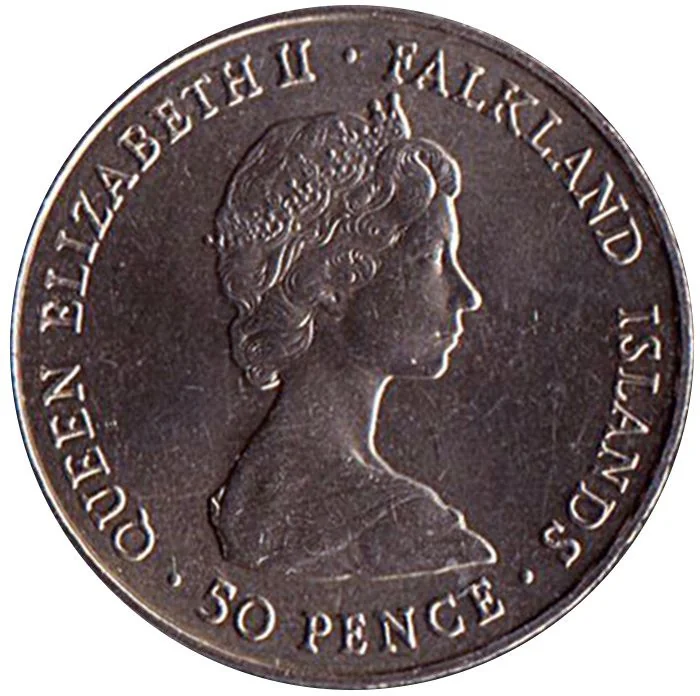
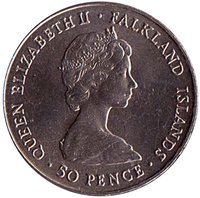
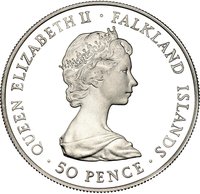
Portrait of Queen Elizabeth II encircled by legend.
Inscription:
QUEEN ELIZABETH II · FALKLAND ISLANDS
· 50 PENCE ·
· 50 PENCE ·
Script: Latin
Engraver: Arnold Machin
Reverse
Description:
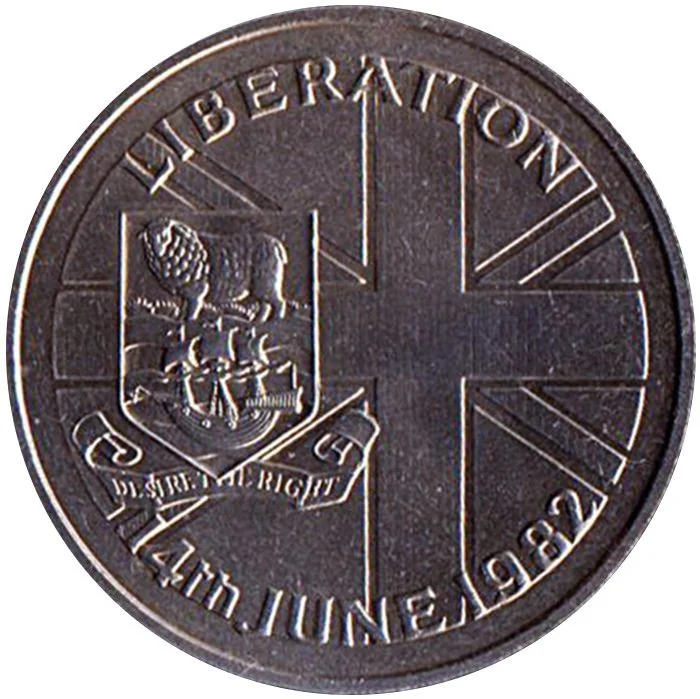
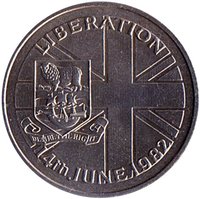
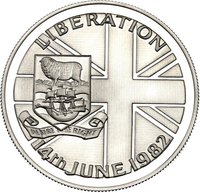
Falkland Islands shield on Union Jack with legends above and below.
Inscription:
LIBERATION
DESIRE THE RIGHT
14th JUNE 1982
DESIRE THE RIGHT
14th JUNE 1982
Script: Latin
Engraver: Philip Nathan
Edge
Reeded
Categories
| Symbols> Coat of Arms |
| History> War |
Mints
| Name | Mark |
|---|---|
| Royal Mint | — |
Mintings
| Year | Mint Mark | Mintage | Quality | Collection |
|---|---|---|---|---|
| 1982 | — | — |
Historical background
In 1982, the Falkland Islands operated under a unique currency system that reflected its status as a British Dependent Territory. The official currency was the Falkland Islands pound (FKP), which was pegged at par with the British pound sterling (GBP). This meant the two currencies were interchangeable on the islands, with Bank of England notes and coins circulating freely alongside locally issued notes from the Falkland Islands Government. The economy was small and pastoral, heavily reliant on wool exports, and the currency's stability was entirely underpinned by its sterling link and British administration.
The Argentine invasion on April 2, 1982, created an immediate and profound monetary crisis. The occupying Argentine military administration declared the Argentine peso as legal tender and attempted to impose it on the islanders. They set an artificial exchange rate, fixing the Falkland pound at a value significantly below its sterling parity. This move was widely rejected by the local population, who largely refused to use the peso, viewing it as illegitimate. Instead, they hoarded their sterling and Falkland pounds, reverting to informal barter for essential goods where possible, as a form of passive resistance.
Following the British liberation of the islands in June 1982, the currency situation was swiftly normalized. The Argentine peso was abolished as legal tender, and the pre-war parity with sterling was fully restored. The conflict, however, had lasting financial consequences; the British government had to provide substantial economic aid for reconstruction, and the episode solidified the islanders' determination to maintain British sovereignty and their sterling-linked currency, a position later reinforced by the 1985 issuance of distinct Falkland Islands pound banknotes and coins to further assert their political identity.
The Argentine invasion on April 2, 1982, created an immediate and profound monetary crisis. The occupying Argentine military administration declared the Argentine peso as legal tender and attempted to impose it on the islanders. They set an artificial exchange rate, fixing the Falkland pound at a value significantly below its sterling parity. This move was widely rejected by the local population, who largely refused to use the peso, viewing it as illegitimate. Instead, they hoarded their sterling and Falkland pounds, reverting to informal barter for essential goods where possible, as a form of passive resistance.
Following the British liberation of the islands in June 1982, the currency situation was swiftly normalized. The Argentine peso was abolished as legal tender, and the pre-war parity with sterling was fully restored. The conflict, however, had lasting financial consequences; the British government had to provide substantial economic aid for reconstruction, and the episode solidified the islanders' determination to maintain British sovereignty and their sterling-linked currency, a position later reinforced by the 1985 issuance of distinct Falkland Islands pound banknotes and coins to further assert their political identity.
🌱 Common