


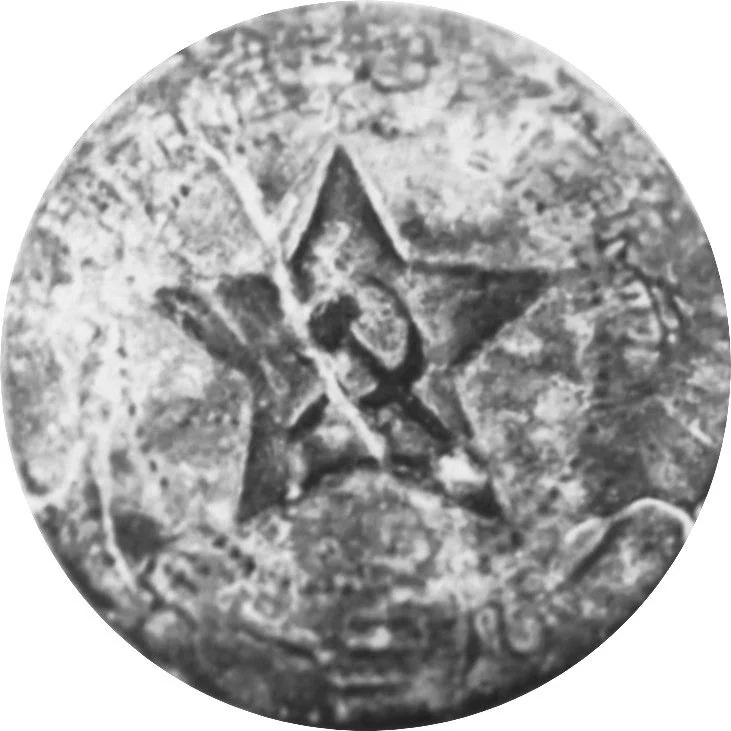
1 fen – Hunan-Hupeh-Kiangsi Soviet
Add to wishlist
China
Context
Year: 1931
Country: China
Issuer: Hunan-Hupeh-Kiangsi Soviet
Issuing organization: Hunan-Hupeh-Kiangsi Worker's and Farmer's Bank
Currency:
(1930—1936)
Demonetized: Yes
Material
References
KM: #
Numista: #303383
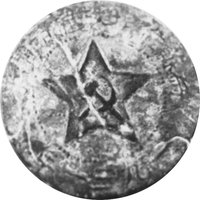
Obverse
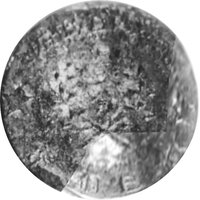
Reverse
Description:
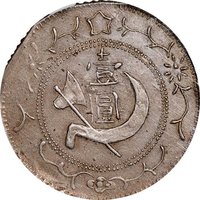
Star with hammer and sickle, angled island, flanked by two lines of legend.
Inscription:
爭閗而權【正攴】埃維蘇為
年一三九一
年一三九一
Translation:
Strive and fight to rectify power, Ai Weisuwe.
Year 1391.
Year 1391.
Script: Chinese
Language: Classical Chinese
Edge
Plain
Mintings
| Year | Mint Mark | Mintage | Quality | Collection |
|---|---|---|---|---|
| — | — | — | ||
| 1931 | — | — |
Historical background
The currency situation in the Hunan-Hupeh-Kiangsi Soviet (the Central Soviet Area) in 1931 was defined by a critical struggle for financial sovereignty and stability amidst intense military encirclement and economic blockade by the Kuomintang (KMT). The nascent Communist government, having established the Chinese Soviet Republic in November 1931, faced severe shortages of basic goods and rampant inflation caused by the circulation of a chaotic mix of old warlord notes, KMT currency, and even foreign coins. This monetary disorder undermined the soviet's economy and the Red Army's supply lines, making the creation of an independent and credible financial system a military and political imperative.
In response, the Soviet government, through its newly founded Central Bank, introduced its own paper currency, the Chinese Soviet Republic Dollar. Issued in 1932 but planned from 1931, this currency was backed primarily by the state's authority and a reserve of confiscated silver and goods, rather than a hard specie standard. Its primary purposes were to displace the hostile KMT currency, unify the monetary system within the soviet zones, and finance revolutionary expenditures through controlled issuance. The initial design and planning in 1911 laid the groundwork for this system, aiming to build public trust and facilitate the collection of taxes and the purchase of grain from peasants.
However, the currency's stability was perpetually precarious. The KMT's strict blockade severely limited the soviet's access to key resources like salt and cloth, which in turn put immense pressure on the value of the soviet dollar. Maintaining public confidence was a constant challenge, as the government had to carefully manage issuance to avoid devaluation while funding the war effort. Thus, the currency of 1931-32 was less a tool of economic development and more an instrument of revolutionary survival, reflecting the profound difficulties of building a stable financial system in the midst of a protracted and blockaded civil war.
In response, the Soviet government, through its newly founded Central Bank, introduced its own paper currency, the Chinese Soviet Republic Dollar. Issued in 1932 but planned from 1931, this currency was backed primarily by the state's authority and a reserve of confiscated silver and goods, rather than a hard specie standard. Its primary purposes were to displace the hostile KMT currency, unify the monetary system within the soviet zones, and finance revolutionary expenditures through controlled issuance. The initial design and planning in 1911 laid the groundwork for this system, aiming to build public trust and facilitate the collection of taxes and the purchase of grain from peasants.
However, the currency's stability was perpetually precarious. The KMT's strict blockade severely limited the soviet's access to key resources like salt and cloth, which in turn put immense pressure on the value of the soviet dollar. Maintaining public confidence was a constant challenge, as the government had to carefully manage issuance to avoid devaluation while funding the war effort. Thus, the currency of 1931-32 was less a tool of economic development and more an instrument of revolutionary survival, reflecting the profound difficulties of building a stable financial system in the midst of a protracted and blockaded civil war.
✨ Legendary